Vizag scientist offers breakthrough solution to nuclear reactor cracks

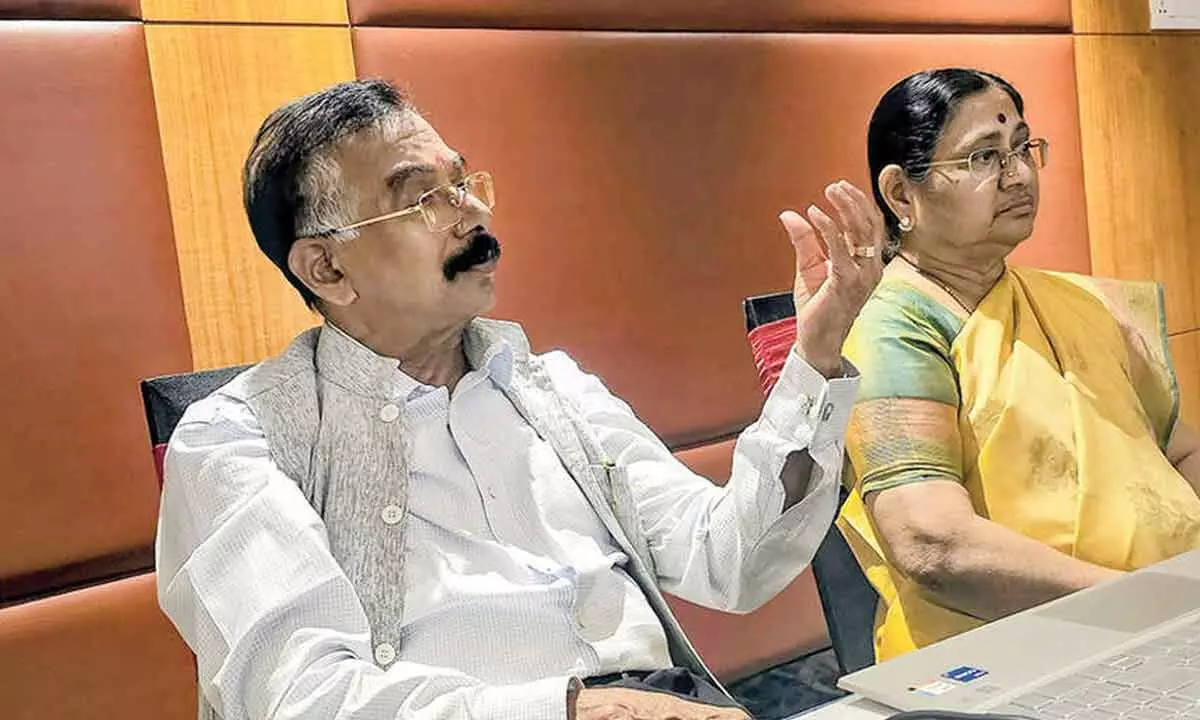
Visakhapatnam: In a significant scientific development with far-reaching implications for nuclear safety, N Kalidas, founder-director of Visakhapatnam-based research techno-scientific NGO INSWAREB, has claimed that his decades of research provides a durable solution to the persistent problem of cracks in nuclear reactor structures.
Addressing the media here on Monday, Kalidas and director general of the institution N Bhanumathi mentioned that despite extensive research carried out across several countries over the past two decades, efforts to prevent cracking in nuclear reactor concrete structures have yielded only limited success. However, recent findings have opened new possibilities.
They referred to a 2024 study by the University of Tokyo, which revealed that radiation emitted from nuclear reactors alters the crystalline structure of minerals present in concrete.
According to the study, prolonged radiation exposure transforms crystalline materials into an amorphous form, increasing mineral particle size and eventually leading to cracks in reactor concrete.
Kalidas noted that the University of Tokyo has published several research papers establishing this phenomenon.
Building on these findings, INSWAREB conducted an in-depth review of the Japanese research and confirmed that the amorphous transformation process could be adapted in concrete design, he added.
Kalidas explained that this insight aligned closely with his organisation’s 35-year-long research on fly ash.
“Our studies have consistently shown that when fly ash containing amorphous material is mixed with cement, the strength and durability of concrete increase substantially,” he said.
After analysing, Kalidas informed senior officials in the department officials at the Centre that incorporating this technology into nuclear reactor concrete would significantly improve radiation resistance and structural longevity. The response, he said, was swift.
Central officials reportedly placed the research details before the Chairman of the Department of Atomic Energy, who, after reviewing the findings, decided to move the research towards practical implementation.
The responsibility for further development has now been entrusted to the Bhabha Atomic Research Centre (BARC).
At present, shield walls in nuclear reactors are constructed using conventional concrete, which gradually loses durability due to continuous radiation exposure. Recognising this limitation, the research team proposed the use of nano-concrete technology to effectively block radiation and extend the lifespan of reactor structures.
Taking the concept further, the researchers have proposed a protective radiation shield using high-density aggregates blended with radiation-resistant chemicals within the nano-concrete matrix.
A preliminary structural design for such a shield has also been prepared.
If implemented, Kalidas said, the technology could mark a major leap in nuclear reactor safety, combining indigenous research, sustainable materials and advanced concrete science, placing Visakhapatnam on the map of global nuclear innovation.