Sorting Robots vs Manual Sorting: Which Is Right for Your Operations?

Sorting is a very crucial operation in the fulfillment center. The process has a great influence on processing speed, shipping accuracy, and customer satisfaction. The good thing with every package that moves through a fulfillment center is that there is a very efficient process where each package will arrive at the right destination for shipping. However, the thing is that most warehouses have traditionally relied on manual sorting systems.
A sorting robot delivers a completely fresh approach to sorting. By means of vision technology and routing intelligence, there is a higher accuracy level in an automated sorting system. A critical examination of manual sorting processes against those in an automated sorting system is presented in this article in a manner that will help operations managers arrive at an educated estimate of which approach will best meet their volumetric requirements and future prospects. A comparison between manual sorting and an automated sorting machine is presented, which is in no way clouded by familiarity and preferences.
Importance of Sorting Automation
The sorting robot increases the process capability greatly and eliminates the inefficiency of the current manual sortation. The automated sortation system has high efficiency regardless of the fluctuations in volumes. The sortation efficiency has a direct relation to customer satisfaction and final shipping cost efficiency.
Manual Sorting Issues
The sorting process using human resources is also relevant when the volume is not large or is irregular. However, the technique also has limitations, which are applicable once the volume is increased. Sorting cannot be improved beyond the capacity of human resources. The rate of sorting differs depending on the shift being considered. Performance is normally low during peak hours.
There are also problems of turnover in the labor department. The sorting jobs are menial and involve a lot of physical labor. Consequently, this results in labor turnover and fatigue of employees. As soon as employees feel fatigued, they are bound to commit errors. The routing errors result in misrouted shipments, improper routing, and ultimately rework.
Capabilities of Robotic Sorting
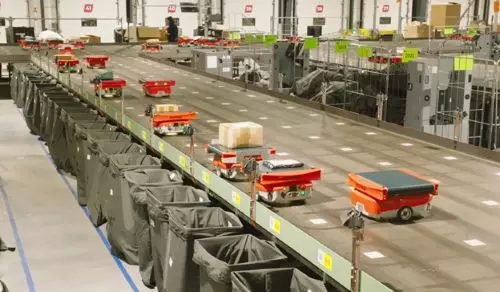
The shortcomings associated with a sorting robot are addressed by automation and intelligence. The identification systems that entail vision can read labels, bar codes, and/or dimensions on packages, thus eliminating any human judgment in sorting and routing packages. The robotic arm or automated sorter is able to route packages addressed to various sites at very high speeds. Additionally, a sorting robot, unlike a human-controlled sorting station, does not fatigue at all in multiple shifts. This implies that the ability of a warehouse to manage dispatches and service levels, especially during a surge, is improved.
Comparing Cost and Return on Investment
While manual sorting seems economical in the short run, since its cost of investment is less, it tends to increase in the long run due to dependence on labor and errors that need correction. A linear increase in labor cost is also associated with an increase in volume, with a heightening risk of labor shortage.
Automation involves capital investment upfront, but the rate of return tends to improve. There will also be fewer errors, less rework, consistency of production rates, and minimum dependence on labor. This would ensure that it would perform better than financial points of view.
Scalability Factors
Manual sorting can scale linearly. If the need for more volume is addressed, the solution would involve either more people, more shift schedules, or more floor space. This can progressively become difficult to maintain.
Robotic sorting solutions are modularly scalable. It is possible to integrate more lanes, more robots, or even a sorting module without disrupting any ongoing process. This is where a sorting robot is most beneficial, especially in a business which anticipates a peak period.
Integration Considerations
Manual sorting has small system interface, but as such, there is little visibility either. On the other hand, automated sorting would have interface activities with the warehouse management system, conveyors, AMR, and control software.
Then, there is the factor of maintenance. While automation calls for maintenance, it will reduce the unplanned breakdowns that result due to human variation. Effective design will provide reliability and maintainability.
Adverb in Intelligent Sorting System Automation
Addverb plays an important role in sorting innovation and automation, as they focus on the integration of sorting systems based on robotics technology and use conveyors, robotic sorter and vertical sortation robots. They are able to offer a well-organized flow of materials through induction and outgoing lanes. They can develop both hardware and intelligent software in-house; therefore, there is seamless collaboration and efficiency because they facilitate intelligent sorting and automation of materials sorted manually in a warehouse.
Conclusion
Manual sorting is effective, but its applications are limited to a lot of small and not-so-complex environments where flexibility is more important than speed. But in volumes that are high and errors are not tolerated, automation is the only way forward. A sorting robot and automated sorting solution enable high, consistent, and error-free throughput, thus taking a far-sighted approach in designing automated sorting using smart modular automation-integrated ecosystems offered by Addverb.