






- Govt Employees Can Get Rs 1.8 Lakh Laptops, Keep Them After 4 Years
- Anirudh Ravichander And Kavya Maran’s Dreamy Greece Wedding Pics Are Here
- Bullet-Riddled Bodies Of Two Missing SPOs Recovered In J&K’s Kishtwar, Search For Terrorists Underway
- Gold and Silver rates today, 12 Nov in Hyderabad, Visakhapatnam, check gold prices of 18K, 22K, 24K
- Bullet-riddled bodies of two missing SPOs recovered in J&K’s Kishtwar
- RBI issues consolidated domestic money transfer rules; retains Rs 50,000 cash NEFT cap
- Democrats accuse US envoys of weakening Ukraine
- One killed as three-storey building collapses in New York
Kia India Announces Major Investment of USD 2 billion in AP: Japan sought a steady supply of rare earth minerals
In Short
Lee, however, did not specify any timeline for the investment or by when the additional capacity would become operational.

Share :
Kia India Announces Major Investment of USD 2 billion in AP: Japan sought a steady supply of rare earth minerals
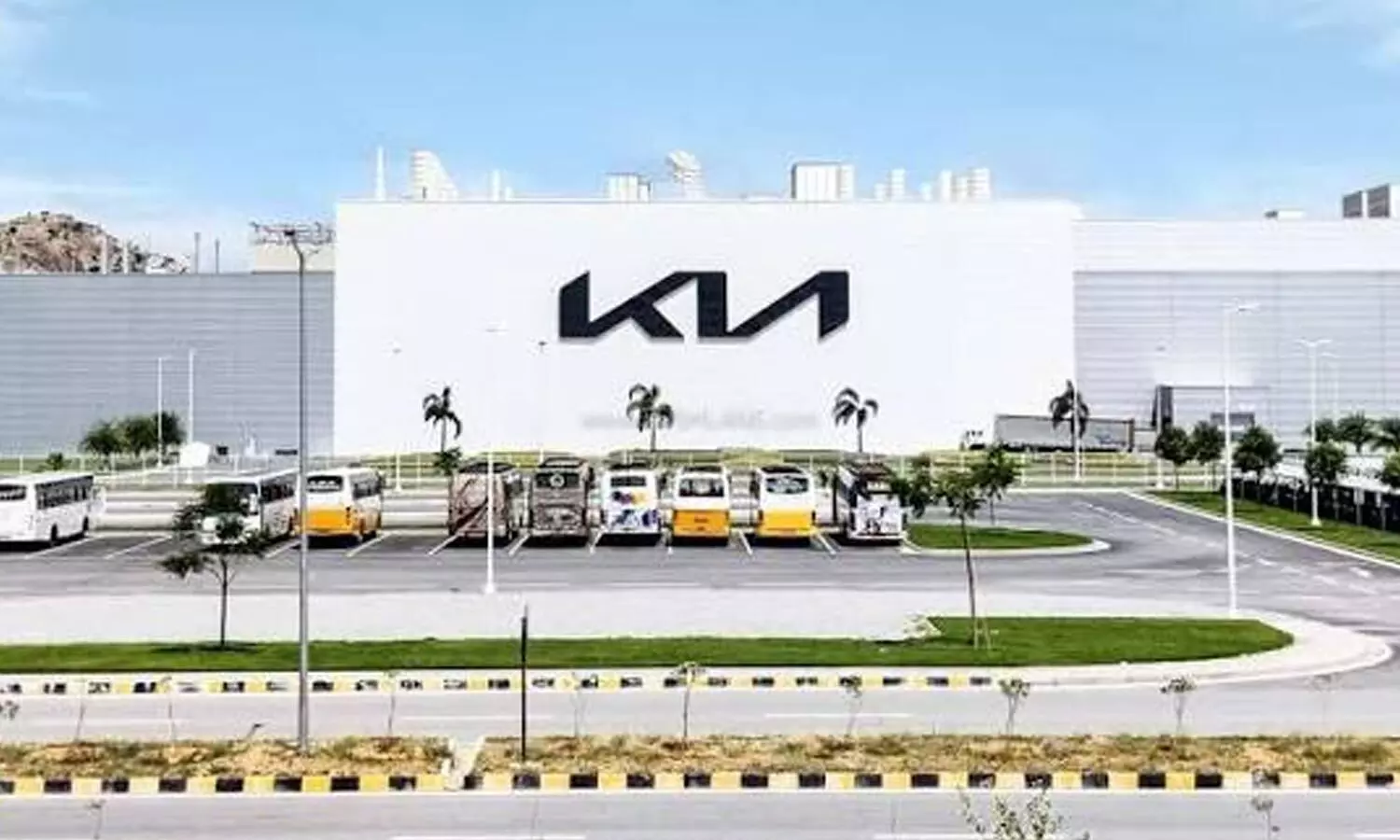
Kia Motors announced a major investment of USD 2 billion to set up a new manufacturing facility in Andhra Pradesh that will increase the South Korean automaker's annual production capacity to more than 6 lakh units.
This project is expected to create around 12,000 jobs and increase Kia India's annual production capacity to 630,000 vehicles. This was announced at the CII Partnership Summit being held at Visakhapatnam on Thursday by Gwanggu Lee, Managing Director and Chief Executive Officer, Kia India.
Lee, however, did not specify any timeline for the investment or by when the additional capacity would become operational.
Kia India already has a manufacturing facility in Anantapur, Andhra Pradesh, that it set up in 2017. It has an annual manufacturing capacity of 4.30 lakh units.
In the financial year 2026, the automaker produced 3.17 lakh units. It dispatched 2.89 lakh units in the domestic market and exported 27,953 units.
Meanwhile, a Japanese delegation led by Ambassador Keiichi Ono has urged the Andhra Pradesh government to ensure a steady supply of rare earth minerals to Japan.
The request was made during a meeting between Ono and Chief Minister N Chandrababu Naidu in Vizag on Wednesday, ahead of the CII Partnership Summit in Vizag on November 12 and 13.
“The Japanese representatives raised the issue of ensuring a steady supply of rare earth minerals to Japan. They said such cooperation would help further strengthen the India-Japan partnership in the supply of critical minerals,” said an official press release.
The diplomatic outreach aligns with the TDP-led government's push to develop the state's coastline into a 'Rare Earth Element Corridor'.
According to an official press note, State Mines Minister K Ravindra had recently highlighted that 16 kinds of mineral reserves have been identified in over 16,000 hectares in the state.
According to the Andhra Pradesh Mineral Development Corporation (APMDC), the state hosts the second-highest beach sand mineral reserves in India, accounting for nearly 25 per cent of these national resources.
These resources are particularly high in concentrations of ilmenite, rutile, zircon and monazite, which is a key source of rare earth elements (REEs),
Beach sand minerals are critical inputs across a range of high-value industries, from paints and aerospace components to nuclear fuel and permanent magnets used in electric vehicles and wind turbines.
Ilmenite and rutile are processed into titanium dioxide pigment and titanium metal, while monazite yields rare earth oxides essential for electronics and clean energy technologies.
Currently, India imports over 75 per cent of its titanium dioxide pigment requirements, with nearly two-thirds sourced from China, despite having some of the world’s largest titanium mineral reserves, said an official release.
Incidentally, rare earth magnets are a fast-growing opportunity as they are crucial for motors, renewable energy systems, defence equipment and consumer electronics.
In July, 2026, the Andhra Pradesh government had reserved an area of 12 sq km around three villages in Palnadu district for the Atomic Minerals Directorate for Exploration and Research, Department of Atomic Energy, to prospect for Rare Earth Elements (REE) and other associated critical minerals.
Further, the visiting Japanese delegation informed the Chief Minister that Proterial India was planning to manufacture ‘amorphous metal’ in India for the first time.
This material is used in the production of high-capacity transformers, said the release, adding that “with the industrial incentives offered by the state government, the company has drawn up plans to commence production at Sri City in December 2026.”
The Japanese delegates also said that a new Global Capability Centre (GCC) will be established in Visakhapatnam this year through India-Japan cooperation, leveraging the talent of Indian professionals.
The representatives also noted that Japan-based JERA had entered into a preliminary agreement with AM Green to procure around 70,000 tonnes of green ammonia annually from Kakinada for a period of five years.
They described the agreement as a significant step towards establishing a green ammonia supply chain between India and Japan, the release added.


