Alarming Rise in Online Gambling and Betting in Telangana Since 2017: PRAHAR Announces State-Wide Citizen Survey to Understand Public Expectations

Illicit betting and online gambling networks are not just economic risks—they are fast becoming silent enablers of national security threats.
Despite being the first Indian state to enforce a complete ban on online gaming back in 2017, Telangana continues to witness a dramatic rise in illegal online gambling and betting activities. Fueled by foreign platforms, anonymous digital transactions, and unregulated mobile apps, this underground ecosystem has grown more sophisticated, elusive—and dangerous.
PRAHAR (Public Response Against Helplessness and Action for Redressal), a Delhi based NGO working at the intersection of digital governance and national security, has announced the launch of a large-scale citizen survey across 2,500 respondents in Telangana. The objective is to understand how people perceive online betting and gambling vs online gaming, what they want from regulation, and how compliance can be ensured by building alignment between public expectations and government actions.
“Our research shows that while the rapid penetration of the digital ecosystem across India—even at the grassroots level—is tremendously empowering, it has also introduced new vulnerabilities. Hidden players are actively exploiting this space to advance their agendas. In the absence of a strong national regulatory framework, illegal betting and online gambling platforms are being weaponized as financial engines and recruitment gateways. There is growing evidence to suggest that these syndicates are linked to actors and invisible hands with far more sinister intentions—aimed at undermining India’s sovereignty and political stability,” said Abhay Raj Mishra, President and National Convenor of PRAHAR.
“It is essential that we understand what the people of Telangana want—not just for better compliance, but also for social consensus. Compliance becomes natural when there is no conflict between public expectations and government actions. That is why we are launching this survey.”
This new initiative builds upon two recent PRAHAR research studies. The first, titled “The Invisible Hand”, uncovered how foreign-owned digital platforms are being used to entrap Indian users and funnel them into a cycle of financial exploitation, data theft, radicalisation, and identity compromise. According to projections in the report, India could face up to 17 trillion cyberattacks annually by 2047. In Telangana specifically, cybercrime cases linked to online gambling rose by over 800% between 2020 and 2025, with money laundering, youth suicides, and celebrity-endorsed betting apps all forming part of the challenge.
The second research effort was a comprehensive survey conducted among 5,000 youth across Tamil Nadu—Chennai, Coimbatore, Madurai and Tiruchirappalli—focused on their attitudes and behaviours towards online gaming. Strikingly, 75% of participants could not distinguish between legal and illegal gaming platforms, while 86% were against any form of state-imposed limits on gameplay time or money. This reflected a broader insight: young Indians are not opposed to regulation, but they reject blanket bans that offer no clear legal or safe alternative.
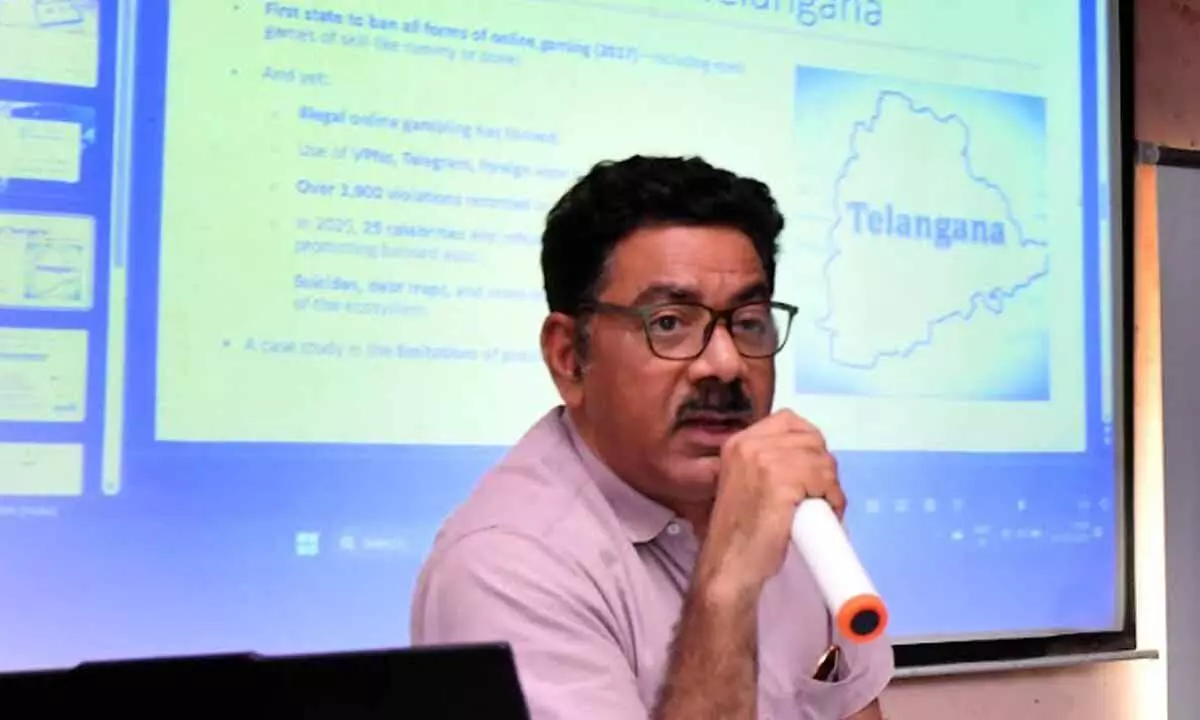
These insights are particularly relevant for Telangana, which banned all forms of online gaming, including games of skill, in 2017. Yet over the years, illegal networks have not only survived but scaled. In 2025 alone, over 3,900 betting-related violations were recorded in the state, and 25 celebrities and influencers were booked for promoting banned betting platforms. The use of VPNs, Telegram groups, foreign-hosted servers, and proxy agents has rendered enforcement incredibly complex. Additionally, tragic incidents of suicide among young bettors burdened by debt have made headlines in recent months.
What emerges from this is a worrying paradox: prohibition in law has not translated to prevention in practice. And citizens are often left with little understanding of what is legal, what is not, and how to make informed choices in the absence of credible, accessible platforms.
To address this gap, PRAHAR’s Telangana survey will explore three key dimensions—awareness, usage, and aspirations. What do citizens know about betting laws? How do they engage with online platforms? And what kind of framework do they believe can work for them, their families, and society at large?
“Our role is not to prescribe a policy solution for Telangana,” added Mr. Mishra. “Our role is to help surface the voice of the people—because when regulation reflects public will, it doesn’t need enforcement. It earns voluntary compliance.”
The survey results, expected in a months’ time, will be shared with policymakers, civil society, and the public to foster a data-driven conversation on what regulation should look like in a digitally empowered, yet secure, India.