




How Tenure Selection Can Affect NCD Investment Decisions
In Short
Learn how NCD tenure selection can affect investment decisions by influencing returns, liquidity, interest-rate risk, cash-flow needs, and overall investment goals.

Share :
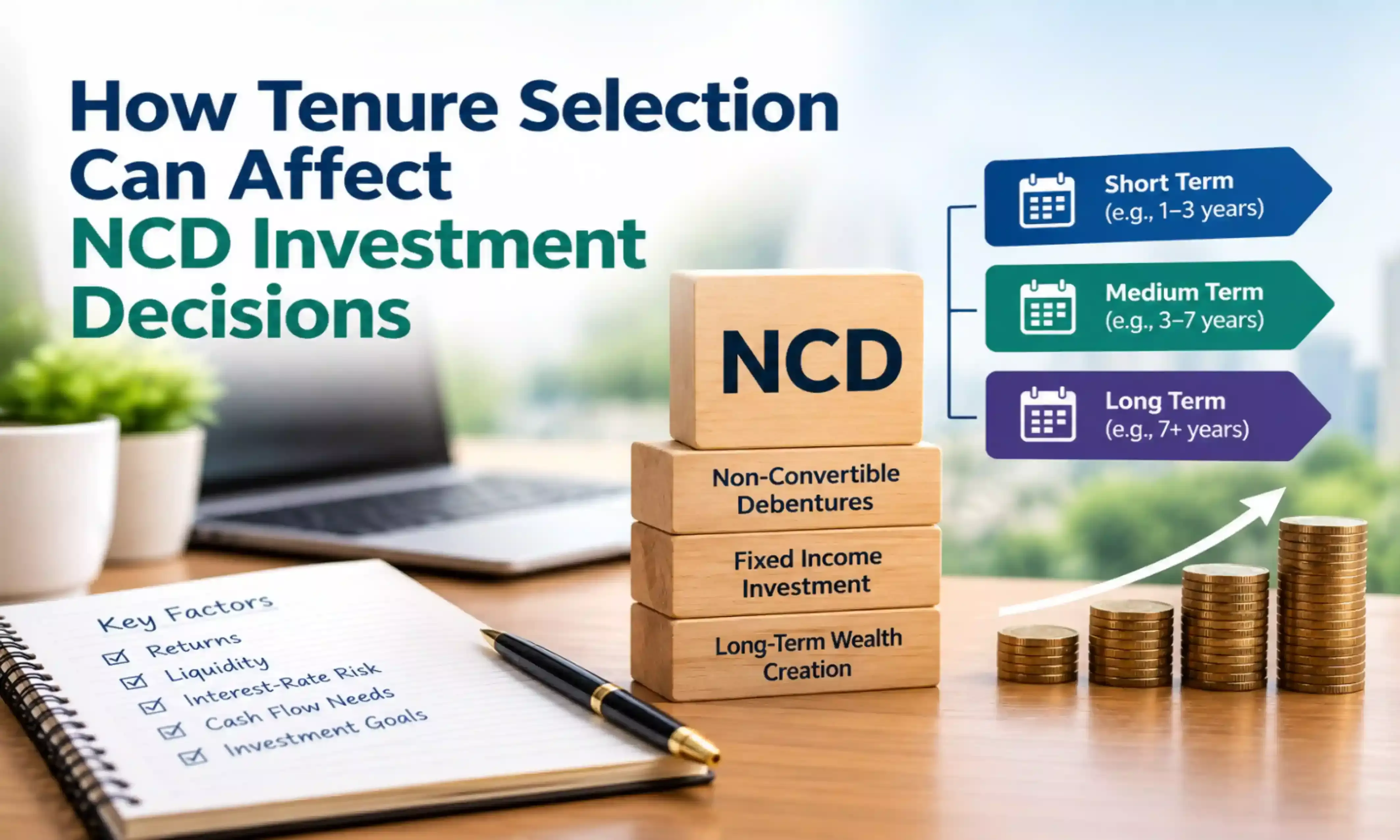
How Tenure Selection Can Affect NCD Investment Decisions
Imagine having to choose between two NCDs: one that returns your principal in two years and another that keeps your money invested for five. Even if both offer an attractive coupon rate, the choice isn't quite the same.The tenure of an NCD determines how long an investor's money stays invested and when the principal is due to be repaid. This matters when planning future expenses or deciding how much money can be committed for a longer period. So, while comparing NCDs, it is worth looking at the maturity period along with the coupon rate, credit rating and other issue terms. fixed-income products
What Is Tenure in an NCD?
When a company raises money through an NCD, it agrees to repay the borrowed amount after a specified period. This period, from the allotment date to the maturity date, is called the tenure. It tells investors how long their money will remain with the issuer and when the principal is scheduled to be returned.
There isn't one standard tenure for all NCDs. Some issues come with a maturity period of 1 year, while others can extend to 10 years. The available options are mentioned in the issue's offer document.
If you're planning to buy NCD investments, checking the maturity period is a useful starting point. It gives you an idea of how long you will be committing your money before you can expect the principal repayment.
NCDs are broadly classified into two categories based on their tenure:
Short-Term NCDs
These generally mature within 1 to 3 years. The shorter investment period means the principal is scheduled to be repaid sooner than it would be under a longer-tenure NCD.
Long-Term NCDs
These generally have a tenure of more than 3 years. The principal remains invested for a longer period and is due for repayment on the maturity date specified in the issue terms.
How Tenure Selection Influences NCD Investment Decisions
The difference between a 2-year and a 5-year NCD isn't just three additional years of investment. It also changes when the principal is expected back and how the investment fits around other financial commitments. This becomes clearer when looking at the following aspects.
Keeping Financial Goals in View
The time at which you expect to need your money can help narrow down the available NCD options. Suppose you're setting aside funds for a child's education expense due in three years. An NCD maturing around that time may be worth comparing with other available options. A five-year NCD, on the other hand, would keep the money invested beyond your expected requirement. The maturity date, therefore, deserves attention before making a choice.
Understanding When Interest Will Be Received
The maturity period and interest payment frequency are two separate features, but they work together to shape the investment's cash flow. For example, an NCD with annual interest payments may provide receipts throughout its tenure. A cumulative NCD, however, pays the accumulated interest along with the principal at maturity. Looking at both details helps clarify whether the payment arrangement suits your requirements.
Comparing NCDs Under the Same Issue
An NCD issue may offer multiple series, each with its own tenure, coupon rate and interest payment schedule. This gives investors a few options to compare, but the highest coupon rate alone may not make one series a better fit.
Factors to Consider When Selecting an NCD Tenure
Here are the factors to take into consideration.
Financial Goals
Think about when you are likely to need the invested money. If you have a planned expense coming up in two years, an NCD with a similar maturity period may be more relevant than one that runs for five years. The aim is to avoid a mismatch between the investment's maturity and your expected financial requirements.
Liquidity Requirements
Think about whether you might need the invested money before the NCD matures. While fixed-income products like listed NCDs can be sold on stock exchanges, finding a buyer isn't always easy. Even if you manage to sell, the price may be lower than what you paid, depending on market conditions. If you think you might need the money during the investment period, this is something to weigh before choosing a longer tenure.
Interest Payment Preference
How and when you receive interest can also influence your choice of NCD. NCDs come with different interest payment options. Some pay interest at regular intervals, such as monthly, quarterly or annually, while others pay the accumulated interest along with the principal when the NCD matures. The choice depends on whether you would prefer to receive interest during the investment period or at the end. On the other hand, if you don't need these payments during the investment period, you can compare cumulative options as well.
Conclusion
Choosing an NCD tenure comes down to understanding how long you can leave your money invested and when you expect to need it back. A shorter maturity may be more relevant for an upcoming financial requirement, while a longer one involves a greater time commitment. Neither option should be judged by tenure alone. The coupon rate, credit rating, interest payment structure and issuer's financial position also deserve attention. On Altifi, investors can explore NCD offerings and compare these details to understand the terms of different issues before investing.


