




- A trinity called peace
- “Something pulls me towards Hyderabad”
- Hitesh Dolwani-Hyd’s TT torchbearer
- The spiritual and cultural meaning of Ganesha’s departure
- The AI Career Mirage
- What Chhtrapati Shivaji, Kautilya and the Thirukkural can teach modern management?
- The Great Indian civilisation: Eclectic, syncretic and cosmopolitanist
- From first period to menopause: Why women need a lifelong approach to wellness
India’s debt burden in perspective: How it compares with US, China
In Short
India’s debt position appears relatively manageable, although India is not a low-debt economy.

Share :
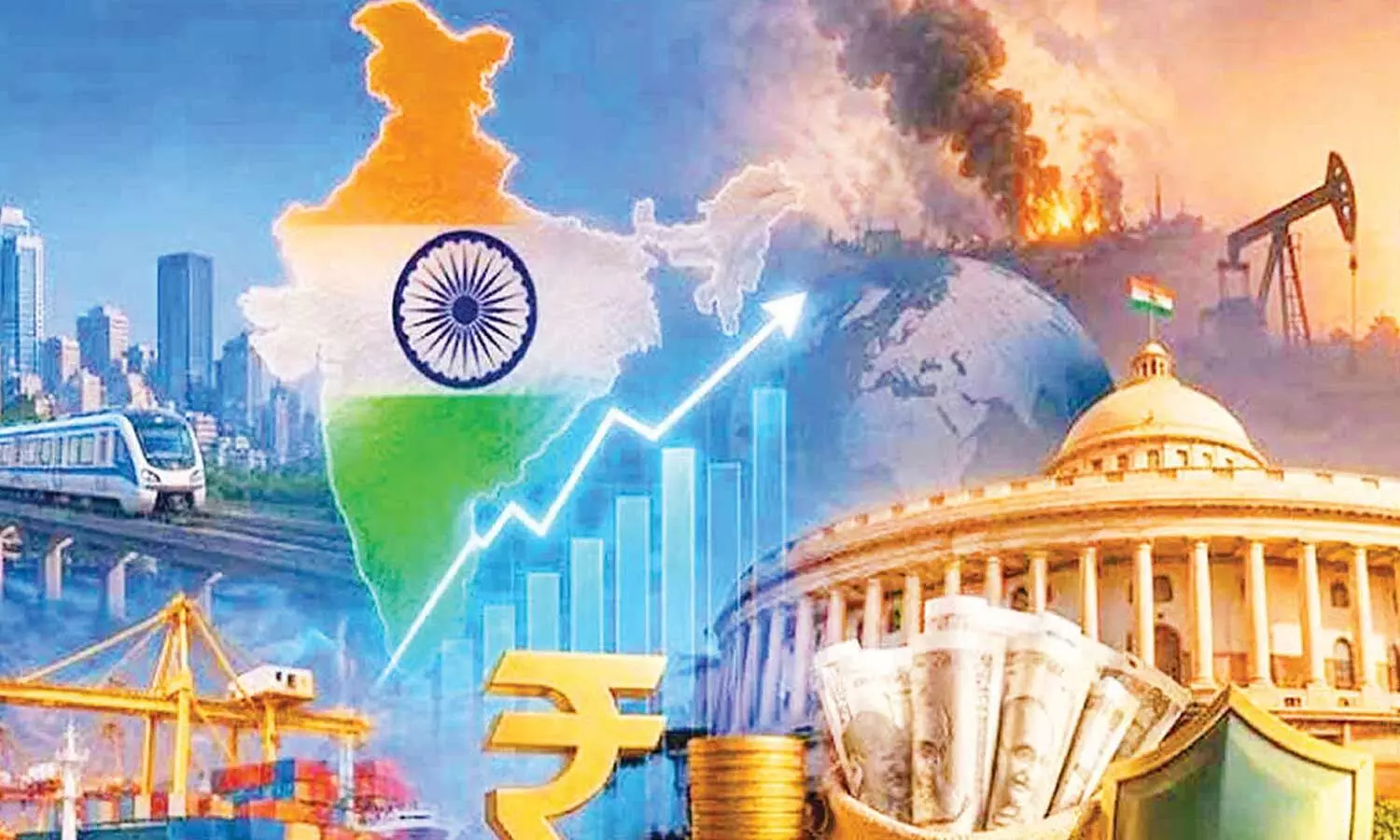
India’s debt burden in perspective: How it compares with US, China
Strong economic growth, domestic financing and productive public investment provide buffers, but rising interest costs and fiscal pressures remain key risks
India’s debt position appears relatively manageable, although India is not a low-debt economy. The IMF estimates India’s general-government gross debt at 83.4 per cent of GDP in 2026, below Japan, the US and China. The Union Budget 2026–27 places central government debt at 55.6 per cent of GDP, compared with 56.1 per cent in 2025–26
Government debt varies across countries, and its economic implications cannot be judged by the debt-to-GDP ratio alone. Debt structure, interest burden, growth, revenues, domestic savings and the use of borrowed funds all matter. International comparisons must use consistent definitions. On a comparable general-government basis, India’s debt position is lower than that of Japan, the US and China, though India is not a low-debt economy.
As per the IMF estimates for 2026, general-government gross debt is about 204.4 per cent of GDP in Japan, 122.3 per cent in the United States, 106.9 per cent in China and 83.4 per cent in India. Thus, India has the lowest debt ratio among these four major economies. However, at more than 80 per cent of GDP, India’s general-government debt remains substantial. India’s debt burden is relatively manageable rather than low. India’s central government debt is lower than its general-government debt, which includes state liabilities; similarly, China’s central-government debt understates its broader public-sector debt. Therefore, debt comparisons must use consistent definitions.
The US: Rising debt and interest burden
The United States faces one of the world’s largest debt burdens. IMF estimates put US general-government debt at around 122.3 per cent of GDP in 2026, while the Congressional Budget Office (CBO) estimates federal debt held by the public at about 101 per cent of GDP, rising to 120 per cent by 2036. These measures differ and should not be conflated. The bigger concern is the rising cost of servicing debt. CBO estimates net interest outlays at about $1 trillion in 2026, or 3.3 per cent of GDP, increasing to around $2.1 trillion, or 4.6 per cent of GDP, by 2036. Rising interest payments could reduce resources for infrastructure, social programmes and public investment. The US, however, has important advantages: most debt is denominated in dollars, the world’s dominant international currency, while its financial markets are deep and liquid. This gives it substantial borrowing and refinancing capacity. The US experience therefore shows that high debt does not automatically cause a crisis, but persistent deficits and rising interest costs can steadily reduce fiscal space.
Japan: Extremely high debt, but manageable
Japan has the highest debt burden among the four countries, with government gross debt estimated at 204.4 per cent of GDP in 2026. Japan has avoided a conventional sovereign debt crisis largely because its debt is predominantly in yen, domestic institutions and the Bank of Japan hold substantial government securities, and interest rates have remained exceptionally low for many years. Nevertheless, Japan faces structural challenges from an ageing population, weak long-term growth and prolonged deflationary pressures. A significant rise in interest rates could sharply increase servicing costs because of the enormous debt stock. Japan therefore demonstrates that very high debt can remain manageable under favourable financing conditions, but weak growth combined with rising borrowing costs increases fiscal risks.
China: Low central debt, but much higher broader debt
China’s debt position looks very different depending on how government debt is measured. While central-government debt is relatively low, the IMF’s broader general-government estimate, including local-government obligations, reaches about 106.9 per cent of GDP in 2026. Focusing only on central debt can therefore understate fiscal pressures. Local governments have relied heavily on borrowing for infrastructure and development, including through financing vehicles and other off-budget arrangements. China also faces slower growth of roughly 4–5 per cent, reducing the economy’s capacity to absorb a large and rising debt stock. China’s experience highlights that the composition and location of debt matter as much as the headline debt ratio. Local-government liabilities and slower economic growth remain important challenges for fiscal sustainability.
India: A substantial but relatively manageable debt position
Against this international background, India’s debt position appears relatively manageable, although India is not a low-debt economy. The IMF estimates India’s general-government gross debt at 83.4 per cent of GDP in 2026, below Japan, the US and China. The Union Budget 2026–27 places Central Government debt at 55.6 per cent of GDP, compared with 56.1 per cent in 2025–26. These figures are not directly comparable because they cover different parts of the public sector. As of March 31, 2026, Central Government liabilities were about Rs 201.17 lakh crore. Fiscal consolidation has also progressed: the fiscal deficit fell from 9.2 per cent of GDP in 2020–21 to 4.4 per cent in 2025–26, with 4.3 per cent targeted for 2026–27. The interest-payment-to-revenue ratio declined from 41.6 per cent to 37.6 per cent over the same period, indicating some improvement in debt-servicing capacity.
Borrowing for asset creation
India has increasingly emphasised capital expenditure and infrastructure. The 2026-27 Budget provides about Rs 17.15 lakh crore in effective capital expenditure, against fresh borrowings of around Rs 16.96 lakh crore. Borrowing for infrastructure and productive assets can raise future output, employment, incomes and tax revenues, strengthening debt-servicing capacity. Borrowing mainly for recurrent expenditure has a different implication because it may not create assets that generate future income. Thus, the purpose and returns from borrowing matter as much as its size.
Growth, interest rates and debt sustainability
The experiences of the US, Japan, China and India show that debt sustainability cannot be judged by the debt-to-GDP ratio alone. Growth, interest rates, domestic financial markets, currency stability and fiscal institutions all matter. When economic growth exceeds the effective interest rate on debt, and primary deficits remain controlled, the debt ratio can stabilise or decline. India’s relatively strong growth of 6-7 per cent provides an advantage, provided fiscal deficits are gradually reduced, and revenues increase. But growth alone is insufficient. Sustainable debt management also requires stronger revenue mobilisation, expenditure efficiency, fiscal discipline and productive public investment.
What the four countries teach us
The four countries offer four different lessons. Japan demonstrates that an extremely high debt ratio can remain manageable for a prolonged period when domestic financing is strong and borrowing costs are low, but demographic and growth pressures can create long-term risks. The United States shows that even an economy with the world’s deepest financial markets and a globally dominant currency can face increasing fiscal pressure when persistent deficits combine with rapidly rising interest costs. China demonstrates the importance of looking beyond central-government debt. Local-government obligations and off-budget liabilities can significantly change the assessment of public-sector debt sustainability. India occupies a relatively more favourable position among the four on the latest internationally comparable debt measure. Its debt is substantial, but stronger economic growth, predominantly domestic and rupee-denominated financing, fiscal consolidation and greater emphasis on capital expenditure provide important buffers. The challenge for India is to ensure that these advantages are maintained. If economic growth slows substantially while interest costs rise and fiscal deficits remain high, the debt burden could become more difficult to manage.
Conclusion
The key question is not simply how much debt India has, but whether government revenues and economic growth are rising fast enough to service it. Debt sustainability depends on its composition, cost, maturity, currency, utilisation and the productive capacity created through borrowing. If India uses borrowing efficiently for infrastructure and productive assets, maintains strong growth and gradually reduces its fiscal deficit, the debt burden can remain manageable.
(The author is Retired Professor, OU and visiting Professor, CESS, Hyderabad)
US military says it killed 4 in strike on alleged drug-smuggling boat in Caribbean
Yemen's Houthis claim attack on Riyadh, heralding escalation in tensions with Saudi Arabia
2 dead, 4 injured in electrocution incident in Lalbaug
Iran's decision on NPT withdrawal depends on US behavior, top security official says
Vizag has potential to become global city: CM Naidu
AP to declare drought-hit mandals on Oct 1
US extends $100,000 H1B fee by one more year!
Centre scraps location-based CGHS eligibility restrictions
Belt shops thriving even in Hyderabad
Rs 47.52 lakh Aarogyasri funds diversion under police probe at Srikalahasti hospital


