




- Governor Yadav urges youth to help build self-reliant Nagaland
- Apple May Bring 3 Long-Awaited MacBook Pro Upgrades in October 2026
- NIA arrests Imam in Bengal's East Burdwan for suspected terror links
- Mysuru MP Yaduveer Inaugrated Three-Day Community Health Camp in Mysuru Reaches 950+ Beneficiaries
- Jaaved Jaaferi recalls Jackie Shroff’s kindness during '100 days', calls him ‘one of the most generous actors’
- Belagavi woman allegedly killed by husband after seeking divorce
- Andhra Pradesh Election Commission denies reports about delay in local body polls
- One dead, other injured after car catches fire in Guntur
Seoul stocks fall for 2nd day on inflation woes
In Short
South Korea’s KOSPI declined for the second straight session as rising oil prices, Middle East tensions and higher US Treasury yields heightened inflation concerns and weighed on investor sentiment.

Share :
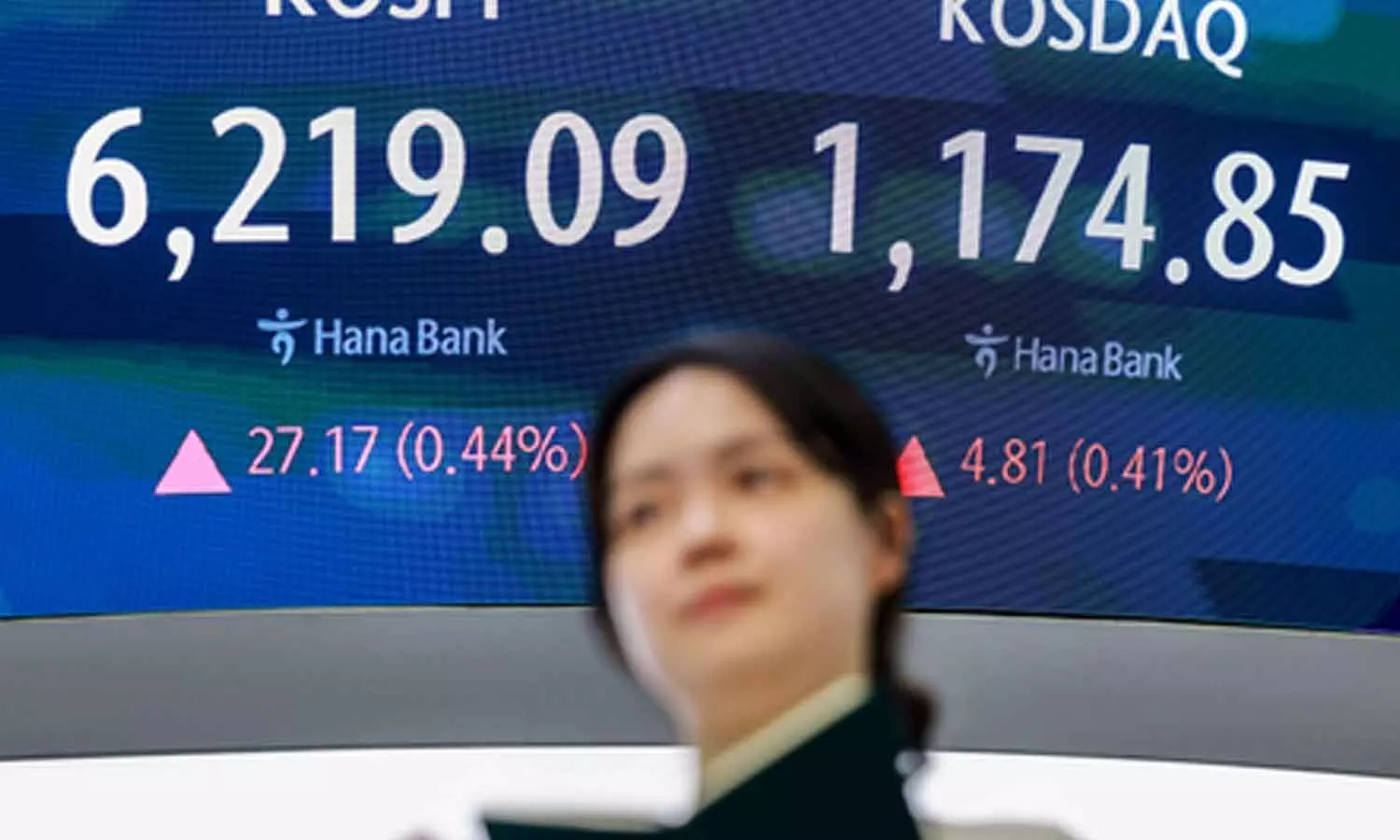
Seoul stocks fall for 2nd day on inflation woes
Seoul: South Korean shares retreated on Tuesday as rising oil prices fuelled inflation concerns and pushed U.S. Treasury yields higher amid Middle East tensions. The Korean won strengthened against the U.S. dollar.
The benchmark Korea Composite Stock Price Index (KOSPI) lost 18.93 points, or 0.27 percent, to end at 6,870.81, marking its second consecutive session of losses, reports Yonhap news agency.
The index opened 0.19 percent lower and extended its losses in afternoon trading as foreign and institutional investors sold local shares.
Overnight, U.S. stocks retreated as renewed tensions between Washington and Tehran drove crude oil prices higher, fuelling concerns that higher energy costs could keep inflation and interest rates high.
Treasury yields extended their climb, with the benchmark 10-year yield rising to 5.23 percent and the 30-year yield climbing to 5.55 percent, hovering around multiyear highs.
Oil prices rose for a second consecutive session Tuesday on lingering concerns over potential supply disruptions in the Middle East stemming from the U.S.-Iran conflict.
Trade volume was light at 210.06 million shares worth 17.99 trillion won (US$13.26 billion), with decliners far outnumbering advancers 622 to 231.
Foreigners sold a net 2.9 trillion won, while individuals and institutions bought a net 1.14 trillion won and 121.06 billion won, respectively.
"The local stock market was bearish as rising U.S. Treasury yields weighed on investor sentiment, while renewed gains in global oil prices further dampened risk appetite," Lee Kyoung-min, an analyst at Daishin Securities, said.
Market heavyweights were mixed. Market bellwether Samsung Electronics gained 0.93 percent to 272,500 won, while chip giant SK hynix inched down 0.17 percent to 1.76 million won.
Leading automaker Hyundai Motor fell 1.27 percent to 350,000 won, while battery maker LG Energy Solution sank 3.16 percent to 352,500 won.
The Korean won was quoted at 1,356.7 won against the U.S. dollar as of 3:30 p.m., up 3.2 won from the previous trading session's close.
Bond prices, which move inversely to yields, closed higher. The yield on three-year Treasurys fell 4.3 basis points to 4.076, and the return on the benchmark five-year government bonds went down 6.9 basis points to 4.276.
Neelam shares a loved-up throwback with Samir, shares glimpse of family time with daughter Ahana
Asian Games: History beckons as unbeaten India face South Korea in women’s hockey semifinal
Governor Yadav urges youth to help build self-reliant Nagaland
Broad-based growth, rising capacity utilisation driving fresh capex cycle: FICCI President
Modi Scared of Gen Z? Congress Vows to Fight to the Finish
Sitharaman holds bilateral meetings with Saudi Arabia, Switzerland, other countries
Fighting for electoral integrity: Thackeray brothers announce October 4 march against ECI
Aishwarya Rai Bachchan Stuns In A Regal Look At Paris Fashion Week
Domestic electricity tariffs hiked, says J&K govt in Assembly
Gujarat govt rejigs Porbandar forest division as Asiatic lions return to Barda


