




Vijay Shekhar Sharma Turned Paytm Into An AI-First Company Early. The Q1 FY27 Numbers Show Why
In Short
Explore how Vijay Shekhar Sharma positioned Paytm as an AI-first company and what the Q1 FY27 numbers reveal about its growth, strategy, and financial performance.

Share :
Vijay Shekhar Sharma Turned Paytm Into An AI-First Company Early. The Q1 FY27 Numbers Show Why
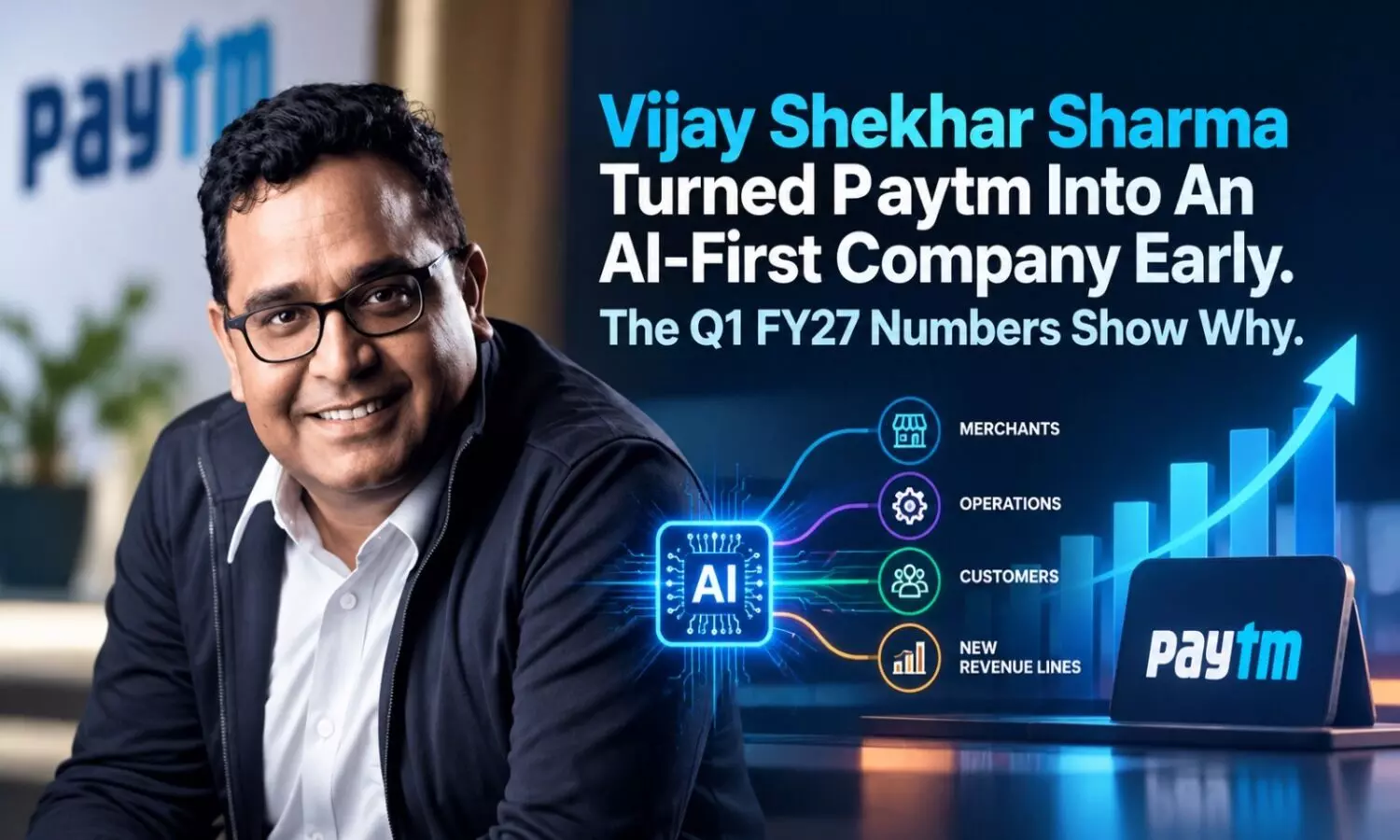
Across India's payments industry, artificial intelligence has moved from pitch decks to profit-and-loss statements. At Paytm, Founder and Chief Executive Vijay Shekhar Sharma has spent the past year pushing AI into how the company builds software, acquires customers, serves merchants, controls costs and hunts for its next revenue line. The Q1 FY27 results suggest the approach is beginning to show up in the numbers.
Paytm's operating revenue rose 28% year-on-year to ₹2,448 crore, while EBITDA increased 182% to a record ₹203 crore. Total indirect expenses grew just 6%. The cost of building the platform declined 3% year-on-year even as Paytm kept investing in AI and product development.
That gap between revenue and costs is the story. Paytm said AI-led productivity helped absorb annual appraisal increases, while software, cloud and data-centre expenses fell 5% year-on-year despite continued investment in artificial intelligence.
On the earnings call, Sharma pointed to a second use for the same technology: not saving money, but making it. Paytm builds its own AI systems for functions such as collections, retention and customer servicing, running them on its own infrastructure to cut latency, computing costs and dependence on outside vendors. The next step, Sharma said, is to sell that technology beyond Paytm.
"And we have optimized and added a skill to us. Now, this is magic. And once we've done it, we will sell it to outside people," Sharma told analysts. He added that he is personally working on businesses outside payments and financial services, and expects AI monetisation to become visible over the coming quarters. Crucially, the plan is aimed at businesses, not consumers: the AI services are being built "to be catered to merchants (both large and small) and not to consumers," Emkay noted after the results.
AI is already deployed across Paytm's operations, from merchant onboarding, servicing, fraud prevention and collections to software development and consumer personalisation. In merchant lending, the company says AI-led capabilities are improving engagement, retention, risk insights and collection efficiency.
Brokerages are now building those efficiencies into their forecasts. Jefferies said, "Operating synergies are not just coming from scale, but also leveraging internal AI platforms," and expects Paytm's EBITDA to rise from ₹500 crore in FY26 to around ₹2,100 crore by FY28. Bernstein pointed to platform-building costs declining despite continued investment in AI and product development.
Some analysts are already treating the sell-it-outside ambition as a distinct opportunity. Haitong Securities said Paytm "intends to monetise this as a new third-party-facing, non-payments/non-financial-services revenue line to merchants and businesses." JM Financial similarly noted the company "plans to commercialise internally developed AI solutions for merchants and enterprises."
Paytm is not cutting spending across the board. Marketing costs and sales-and-service employee costs each rose 27% year-on-year. That is the distinction that matters: the strategy is to squeeze the cost of building and running technology while continuing to spend on distribution and customer acquisition in mobile payments in India.
The next test for Sharma's AI strategy goes beyond efficiency. If technology first built to run Paytm can be sold to other businesses, AI stops being a cost lever and becomes a revenue engine of its own, one that did not exist on the company's books a year ago.


