




- Helicopter returning from Badrinath Dham crashes near Joshimath; search operation underway
- Uttarakhand to observe Sardar Patel’s 151st birth anniversary as National Unity Day tomorrow
- Swami Dayanand Saraswati Death Anniversary 2026: Remembering The Founder Of Arya Samaj And His Reformist Legacy
- Kajal Aggarwal Celebrates Karwa Chauth With Husband Gautam, Shares Adorable Pics
- Tiger Shroff firing case: 12th accused arrested from Sonipat, money trail under scanner
- Manoj Tiwari Takes Dip In Yamuna, Claims River Is Cleaner; AAP Challenges BJP To Drink Water At Kalindi Kunj
- Global security landscape increasingly fragmented, contested: Foreign Secretary Misri at VISV-2026
- Apple Raises iPhone, MacBook Prices as Chipmakers Gain Power
Why Glass Ampoules Are Important for Sterile Drug Packaging
In Short
Learn why glass ampoules are important for sterile drug packaging, including their barrier properties, container integrity, contamination protection, stability, and pharmaceutical safety

Share :
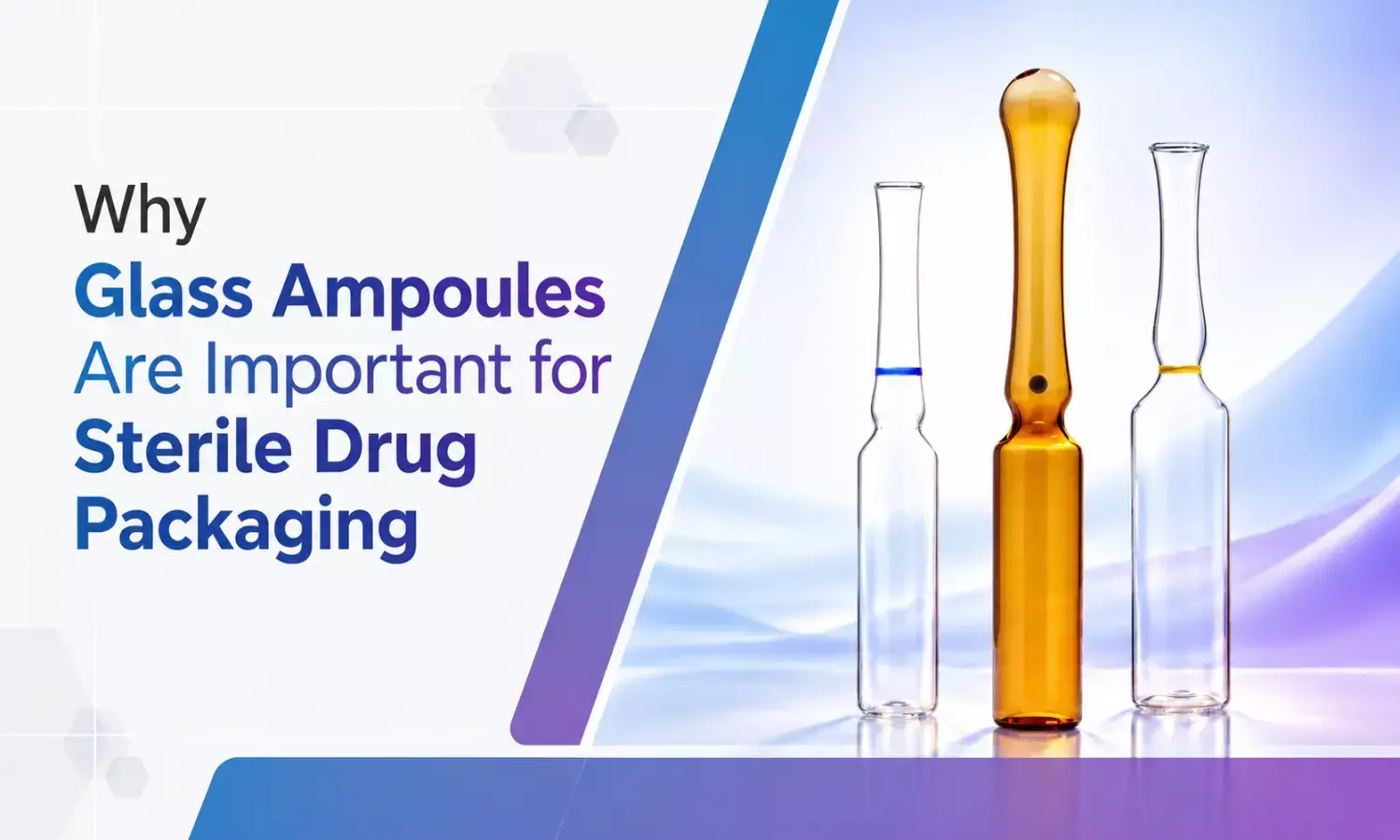
Why Glass Ampoules Are Important for Sterile Drug Packaging
Injectable drugs may be stored for up to two to three years. During this time, they must remain sterile and not be chemically altered by the primary container. An ampoule has a basic structure to enable this. It consists of a glass body with an open neck used to fill the drug solution and the neck is flame-sealed. Because they use no rubber or plastic in the seal, Glass ampoules are still preferred, as they can store a sterile single dose.
How an Ampoule Is Made and Sealed
Pharmaceutical ampoules are formed from borosilicate glass tubing. The tubing is heated, shaped into a body and a narrow stem, and cut to length, with standard dimensions set out in ISO 9187-1. Operators fill the drug through the open stem. For oxygen-sensitive products, operators usually purge the headspace with nitrogen before sealing. Most production lines use pull sealing, in which the top of the stem is drawn away as the glass melts. This method creates a stronger, more uniform seal than melting the tip alone.
To allow controlled opening, the neck is weakened at the factory by one of two methods:
- a one-point cut (OPC), identified by a coloured dot above the score line
- a ceramic break ring printed around the neck
Both methods allow the neck to break cleanly under moderate pressure, which reduces the risk of injury to the user.
Why Borosilicate Glass Is Used
Injections require glass that will not interact with the product. Pharmaceutical glass can be classified based on its water resistance (USP <660>). Type I borosilicate glass has the highest water resistance. This means very little alkali will leach into solution and therefore the pH and formulation are stable during the shelf life. Ampoules made from type I glass can be purchased in sizes between 1 ml and 50 ml from manufacturers such as Borosil Scientific.
Borosilicate glass has a low coefficient of linear expansion, meaning it is commonly used in laboratory apparatus like glass condenser. This is due to the fact that it will undergo many cycles of heating and cooling. The low coefficient of linear expansion means that the ampoule can withstand the high temperature of flame sealing and sterilising in an autoclave (121°C) without cracking.
How Ampoules Protect the Drug
A fused glass seal provides complete closure. This offers several practical benefits:
- Microbial protection, as there is no gap through which micro-organisms can enter
- Moisture and oxygen protection, since neither passes through glass
- Tamper evidence, as an opened ampoule cannot be resealed
- Visual inspection, as clear glass allows particles or discolouration to be detected before use
One limitation should be noted. Breaking the neck can release small glass fragments into the solution, and many hospitals therefore draw up ampoule doses through a filter needle or filter straw.
Ampoule or Vial?
The vial itself is made of the same type (I) glass. The main consideration comes down to the closure and number of doses needed. A rubber stopper allows multiple punctures, thus making it suitable for multi-dose products. It, however, introduces a second substance into contact with the drug. Some formulations take up extractables from rubber, while others lose active ingredient through adsorption onto the stopper. In such cases, an ampoule is generally the more suitable container.
Feature | Ampoule | Vial |
Closure | Flame-sealed glass neck | Rubber stopper with aluminium seal |
Doses | One | One or several |
Drug contact | Glass only | Glass and stopper |
Opening | Neck is snapped off | Needle pierces the stopper |
Typical use | Small-volume, single-dose injectables | Multi-dose and lyophilised products |
Where Ampoules Are Used
Ampoules are best suited to small volumes of sterile liquid administered as a single dose. Typical applications include:
- injectable medicines, including local anaesthetics and emergency drugs
- water for injection and other diluents
- certain vaccines and biological products
- diagnostic reagents
- certified reference standards for analytical testing
In each case, the product must reach the patient or laboratory exactly as it was filled.
Choosing the Right Ampoule
Decisions made at the specification stage have a direct effect on filling performance. The main factors to confirm are:
- Glass type: Type I borosilicate for all parenteral products
- Capacity: sufficient volume for the full dose plus headspace, as liquid on the neck can weaken the seal
- Colour: amber glass for light-sensitive drugs
- Dimensions: close tolerances on stem diameter and wall thickness to prevent breakage on high-speed lines
Agreeing these points with the glass supplier before filling trials avoids costly changes later.
Conclusion
The ampoule has been used in the pharmaceutical industry for over a century. It remains a strong choice for its intended purpose. The sealed glass provides a sterile, stable, and visible single dose. The glass ampoule remains a trusted and popular choice for single-dose injectable applications. With careful consideration given to glass type, fill volume, colour and size, protection can be provided from the fill line to the patient.
Bolsonaro backs off Brazil poll challenge after Trump says 'I’m not running Brazil'
'It's privilege to watch Phillips': Bracewell praises New Zealand star for third T20I century
Sunainaa: I refuse to let someone else's actions define my peace!
‘Form matters the most’: Nayar cautions UP Warriorz against judging WPL squad on paper


