




- SC refuses to entertain plea of Delhi riots accused to attend law classes in Ghaziabad
- AICC chief Kharge's remarks against PM Modi reflect Congress' declining political culture: Karnataka BJP
- PM Gati Shakti model paves way for people-centric infrastructure
- Google Messages tests AI scam detection to flag risky texts and links.
- Dhanush’s Fan Club Rebranding Fuels Tamil Nadu Political Buzz, TVK Dismisses Challenge
- Instagram Arrives on Apple TV With Reels, Videos and Live Shows
- No merger with NCP(SP) ahead: Ruling NCP reaffirms alliance autonomy
- Assam’s conviction rate jumps to 30.88 pc from 6.1 pc in five years: CM Sarma
World shares mostly advance after decline on Wall Street, oil prices fall more than 1%
In Short
Global stock markets were mostly higher as oil prices declined, while investors awaited major technology earnings, central bank interest rate decisions and US inflation data amid concerns over energy costs and AI investment returns.

Share :
World shares mostly advance after decline on Wall Street, oil prices fall more than 1%
Tokyo: World shares were mostly higher Monday and oil prices fell after rising last week to their highest level in more than four years.
Investors were bracing for earnings reports of big companies and central bank decisions this week that could shake markets, analysts said.
Several influential AI-related companies report their latest financial results this week, including Google's parent, Alphabet, along with Microsoft and Amazon.
In early European trading, Germany's DAX surged 0.7% to 25,363.59, while the CAC 40 in Paris picked up 0.9% to 7,848.62. Britain's FTSE 100 added 0.5% to 10,742.88.
The future for the S&P 500 was up 0.2% while that for the Dow Jones Industrial Average gained 0.4%.
Asian markets started the day off with losses, though some benchmarks bounced back.
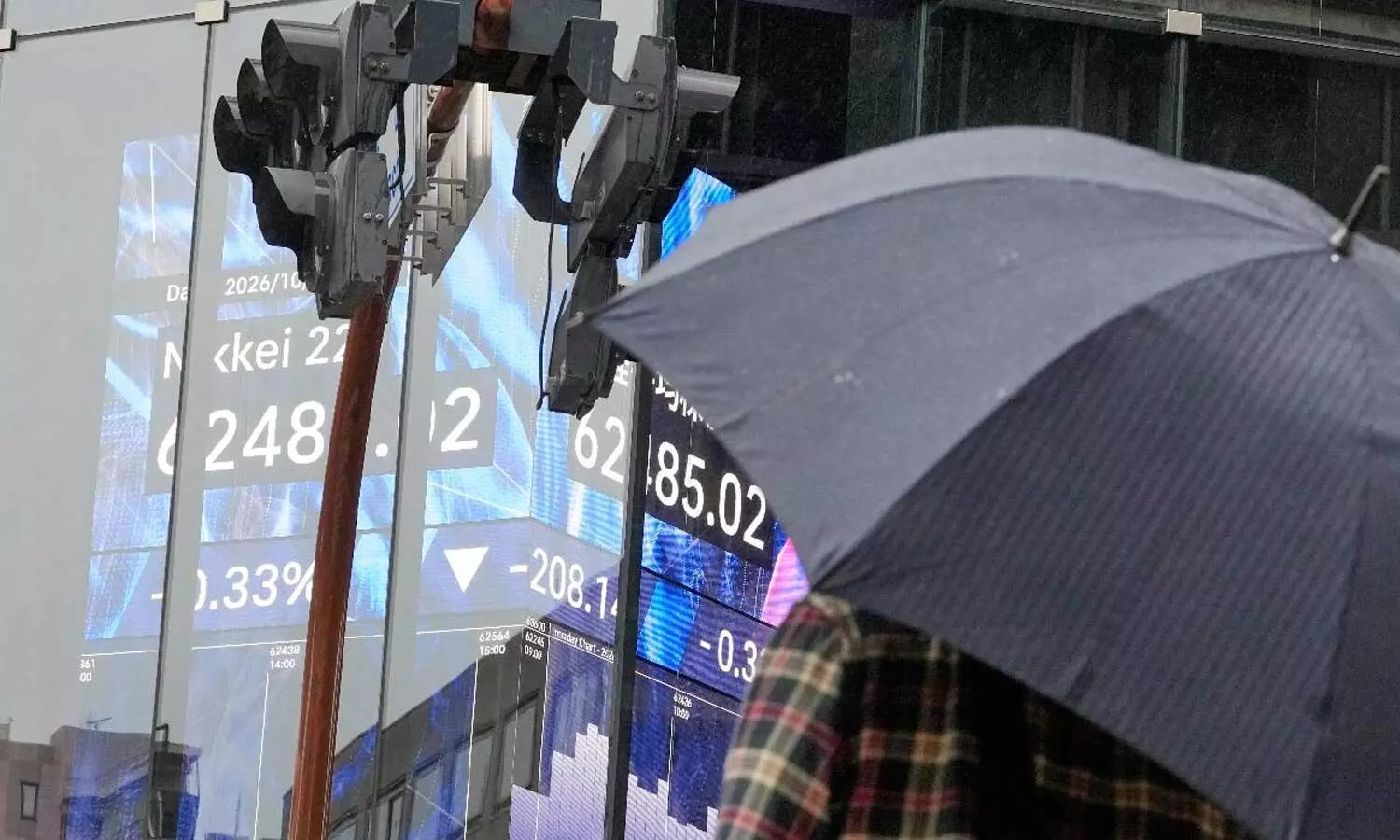
Tokyo's Nikkei 225 slipped 0.8% to 62,189.65 as shares of computer chipmakers and other tech firms came under renewed selling pressure. Advantest, which makes testing equipment for computer chips, fell 3.9%, while chip- and flat-panel production manufacturer Tokyo Electron lost 3.7%.
The Bank of Japan is due to announce a decision on its key interest rate later in the week.
The Kospi in Seoul dropped 1.5% to 5,469.47. Memory chipmaker Samsung Electronics lost 1.1%.
In Hong Kong, the Hang Seng picked up 0.5% to 23,211.81, while the Shanghai Composite index rebounded from early losses to gain 0.2%, closing at 3,697.52.
Australia's S&P/ASX 200 likewise reversed its losses to advance 0.2%, to 8,809.90.
The price of Brent crude, the international standard, fell 1.7% to $109.86 a barrel. US benchmark crude sank 2.1% to $101.08 a barrel.
On Friday, the price for a barrel of Brent crude rose 3.1% to settle at $116.72, its highest level since June 2022. It has surged from less than $97 since early October.
Also Friday, the S&P 500 fell 0.5%, adding to its decline from a day before and logging its second-straight weekly loss. The Dow fell 1.2%, and the Nasdaq composite slipped 0.2%.
Several AI-related companies rallied, helping ease some of the impact from the broader market slide.
Stocks that have benefited from the frenzy over AI have been buffeted by waves of selling as investors fret over whether their high prices are justified. Many of those companies have been borrowing to fund investments in AI technology and high interest rates are making those loans more expensive.
Market players are closely watching corporate earnings, looking for a better sense of whether those investments are likely to pay off.
“This week is less about broad conviction and more about proof. Big Tech now has to show that the spending binge still deserves the market's faith," Stephen Innes of SPI Asset Management said in a commentary.
“Investors want proof now. They want to know whether the billions going into the compute buildout are building a durable earnings machine or just a shinier version of the same old capex furnace,” he said.
American Express slumped 3.7%, one of several financial stocks that lost ground, despite reporting profits for its most recent quarter that beat analysts' forecasts. The company did announce its first major job cuts in roughly a decade.
Treasury yields in the US edged higher following sharp drops on Thursday.
Yields have been rising globally, partly over worries about governments taking on too much debt. Inflation also remains a concern and is stubbornly well above 3% in the US. That prompted the Federal Reserve to raise its benchmark interest rate at its last meeting in an effort to cool inflation.
Wall Street expects the central bank to hold rates steady at its meeting this week, but is leaning heavily toward another rate hike in December.
This week also will bring several big economic updates, including the Fed's preferred measure of inflation. The personal consumption expenditures index, or PCE, is expected to show that inflation rose at a 3.7% rate in September, sharply above the Fed's 2% target.
The US war with Iran has severely cut the world's oil supply, driving energy prices higher and fuelling a sharp jump in the cost of everything from gasoline to food and clothes.
In other dealings early Monday, the dollar rose to 157.28 Japanese yen from 156.99 yen. The euro fell to $1.1212 from $1.1223.


