






Onus on govt and people for a pollution-free Diwali
In Short
Diwali pollution in India is a predictable "grey rhino" crisis. Urgent year-round governance, public transport investment, and citizen accountability are needed to clear the air.

Share :
Onus on govt and people for a pollution-free Diwali
Diwali pollution has become an annual grey rhino event—a looming, predictable threat that we all recognise but choose to ignore. Black swan occurrences are unforeseeable, and therefore very difficult to deal with. The Covid-19 crisis was a black swan about which no one knew. Hence the untold loss of life and incalculable damage to the economy. The inability to tackle grey rhinos, however, is symptomatic of sclerosis in Indian statecraft, the callousness of the political class, and the irresponsible behaviour of people in general.
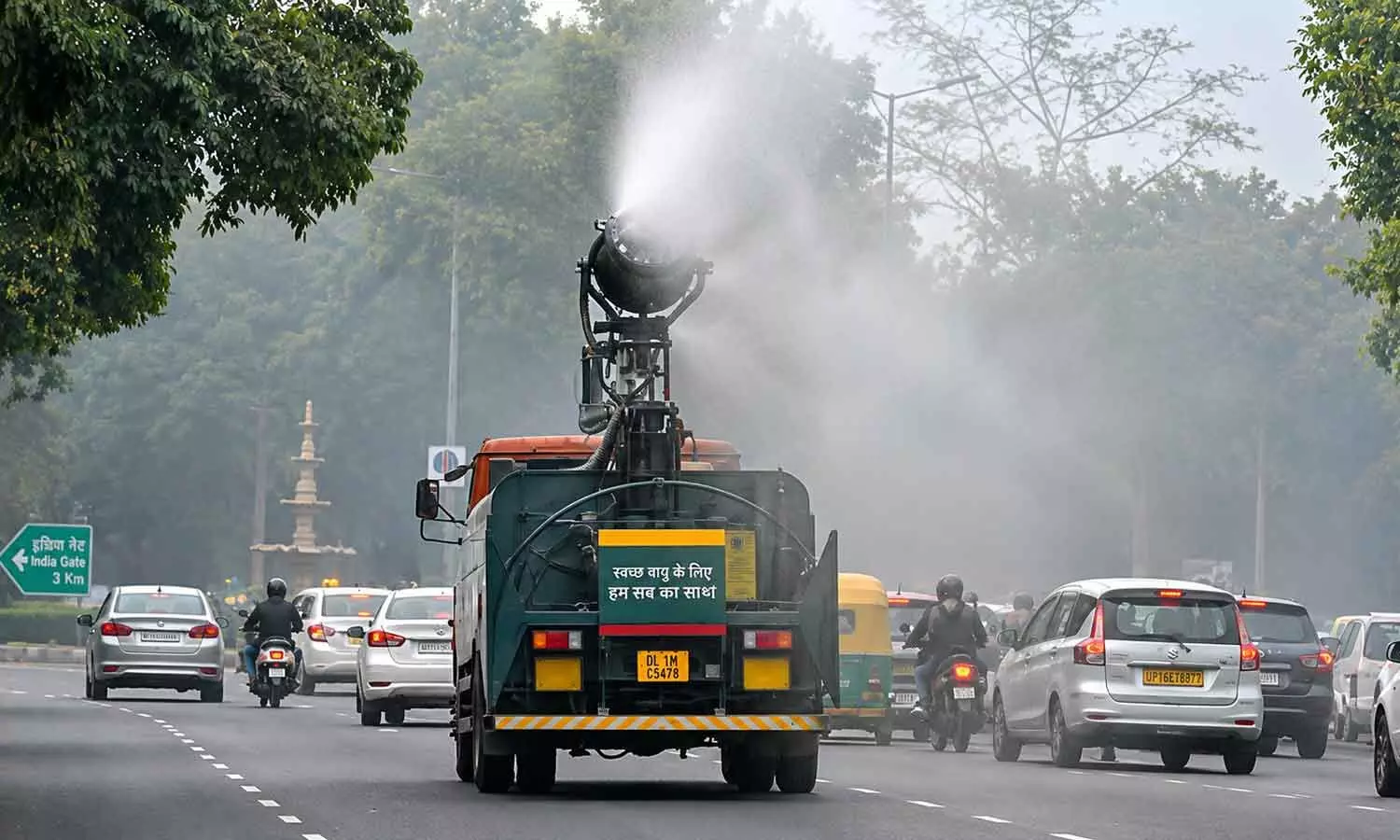
Like every post-Diwali, news headlines screamed of various parts of the country, especially north India, becoming gas chambers. Delhi and the surrounding National Capital Region (NCR) being the worst affected with PM2.5 readings, which capture levels of smoke, flying off the charts. Many of the capital’s air monitoring stations went blank on Diwali night. The missing hours were partially filled the next day by the Delhi Pollution Control Committee (DPCC), showing the smoke level peaked at 3,744 µg/m³, more than 60 times the national 24-hour standard of 60.
Another news report said that in Delhi, which recorded its worst Diwali-day air quality in five years, pollution levels touched nearly 5,000 µg/m³ at some monitoring stations—that is, over 80 times the safe limit. Even the peninsular region was not spared, with Hyderabad’s average air quality index (AQI) zooming to 509. Although, coastal Chennai and Mumbai were better, Kolkata was not spared, as AQI spiked above 600. Coastal centres in Gujarat too had very high AQI numbers.
At the heart of the problem is the lack of concern in the quarters that matter. Our political elite, cutting across party lines, have almost zero regard for real issues like pollution. Despite harsh commentary in public discourse, media outcry, and severe reprimands by the higher judiciary, the powers that be are insouciant about the lives and health of millions of people who suffer because of debilitating pollution. Little, if anything, has been done to ameliorate the conditions; if there are any short, medium and long-term measures to address the issue, they are not perceptible.
It is time our political masters woke up and took effective steps to rectify the situation. This requires moving beyond the ritualistic responses that follow every Diwali, when governments issue advisories, announce restrictions, hold meetings, and promise action, only for the problem to resurface with renewed intensity the following year. What is needed is a comprehensive, coordinated, and time-bound strategy that addresses every significant source of pollution throughout the year, rather than treating it as a seasonal emergency.
Governments must invest in public transport, strengthen last-mile connectivity, enforce emission standards, ensure scientific disposal of municipal and agricultural waste, and penalise industrial violators. Stubble burning, construction dust, vehicular emissions, and firecrackers all demand sustained attention, not selective outrage. Equally important is the creation of an institutional framework that assigns clear responsibility to specific authorities and holds officials accountable for measurable outcomes.
Political leaders must also lead by example, instead of shifting blame or indulging in partisan point-scoring. At the same time, people too must do their bit. They must adhere to the norms specified by the authorities regarding bursting of crackers. They need to realise that every government intervention will fail without their support. Environmental protection is everyone’s responsibility.


