




- Jagan’s approach challenges democracy: Dinakar
- TDP alliance candidate Aparna files nomination
- Nodal officers told to discharge poll duties responsibly
- Selection reflects party workers’ views: Pemmasani
- YS Jagan meets Guv, seeks Central forces for municipal polls
- Godavari changes colour from copper to blue at Polavaram
- Air-cooled technology to limit water use at Vizag data centres
- Chittoor mayoral race heats up as TDP, YSRCP vie for political edge
Trump’s decision will boost Indo-US ties
In Short
US President Donald Trump’s decision to waive Graham Act sanctions provides key strategic relief for India. Analyze how New Delhi's measured diplomatic restraint protected bilateral trade and national interests.

Share :
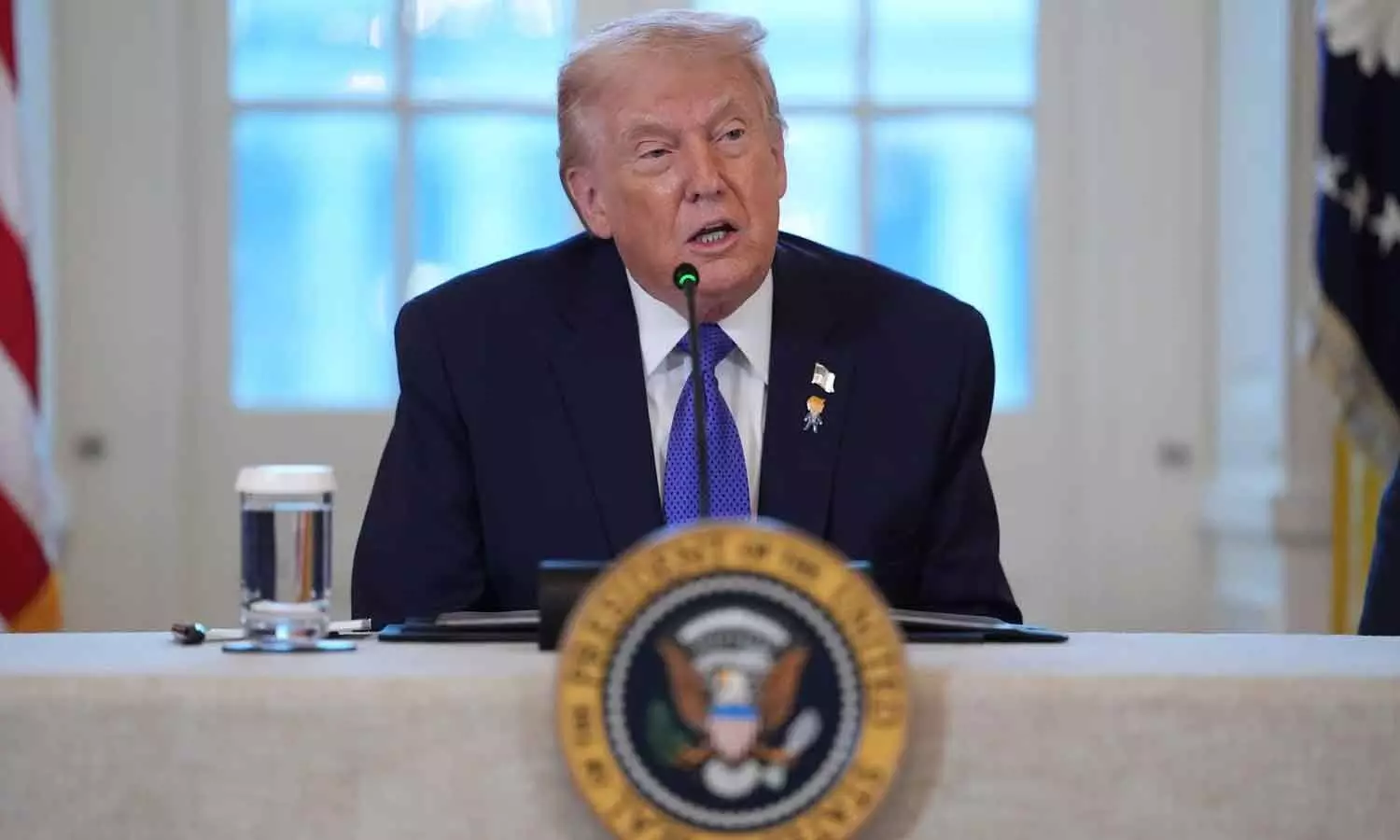
US President Donald Trump
US President Donald Trump’s decision to pause the Russian sanctions legislation is a welcome development, especially from the Indian point. It benefits not just India, which would have suffered grievously if its biggest export destination were cut off, but also the US, whose long-term economic, political, and strategic interests are closely linked to that of India. “I am hereby waiving the application of such sanctions, restrictions, and duties provided for in the Graham Act. I have submitted to Congress a certification that the issuance of such a waiver at this time is in the national interest of the United States,” he said in an executive order released late Friday.
The national interest is also the reason the supposedly mercurial Trump’s announcement is unsurprising. And in a country where institutions are strong, as they are in the US, the top political leader’s whims and fancies cannot sway them beyond a point. While Trump’s trade actions are aimed at China, whose trade surplus with the US goods was $202.7 billion in 2025, a 31.8 per cent decrease ($94.4 billion) over 2024, he also targets countries that sell more products to America than buy from there; India is one of them, though its trade surplus with the US is much lower.
In 2025-26, the bilateral trade between India and the US stood at a record $140.79 billion, with India enjoying a trade surplus of $33.82 billion. The US is India’s top export destination; it is also the 4th largest import partner for India. Besides, the US is the 3rd largest investor in India with cumulative foreign direct investment (FDI) inflows of $81.82 billion in the period April 2000-March 2026. Indo-US relations are not confined to trade and commerce; they also encompass political (the two countries being democracies), strategic (both wary of Chinese hegemonic designs), and diasporic (over five million Indians living in the US). The vicissitudes of domestic politics will impact both US trade policy and Indo-US ties, but the national interest and institutional assertion will also have their say. Trump threatened penalties but didn’t do so because such an action would have been inconvenient.
Similarly, despite the Graham Act coming into force on September 18, the US signed a Russia diesel agreement on October 9. So, while politicking plays a role, so do national imperatives. This brings us to an important point: the Narendra Modi government has done well overall by refusing to react sharply to many provocations by Trump himself and his administration.
This was even though the Modi government was slammed widely for being pusillanimous and ‘had’ compromised. The need of the hour is to stay the course. New Delhi must resist the temptation to let personal pique, domestic political pressures, or nationalist posturing dictate its response to Trump’s provocations. Diplomacy is not a test of machismo, nor does restraint necessarily signify weakness. On the contrary, a country confident of its interests knows when to push back and when to let circumstances work in its favour.
India must continue to diversify its export markets, attract investment, deepen strategic partnerships, and strengthen its domestic manufacturing capabilities, thereby reducing its vulnerability to American pressure. Simultaneously, New Delhi should keep open channels of communication with Washington, making it clear that a partnership between the world’s two largest democracies cannot be sustained through threats and unilateral diktats. A calibrated approach will be the best course for India.


