




Highlighting the eternal connect between humanity and the cosmos
In Short
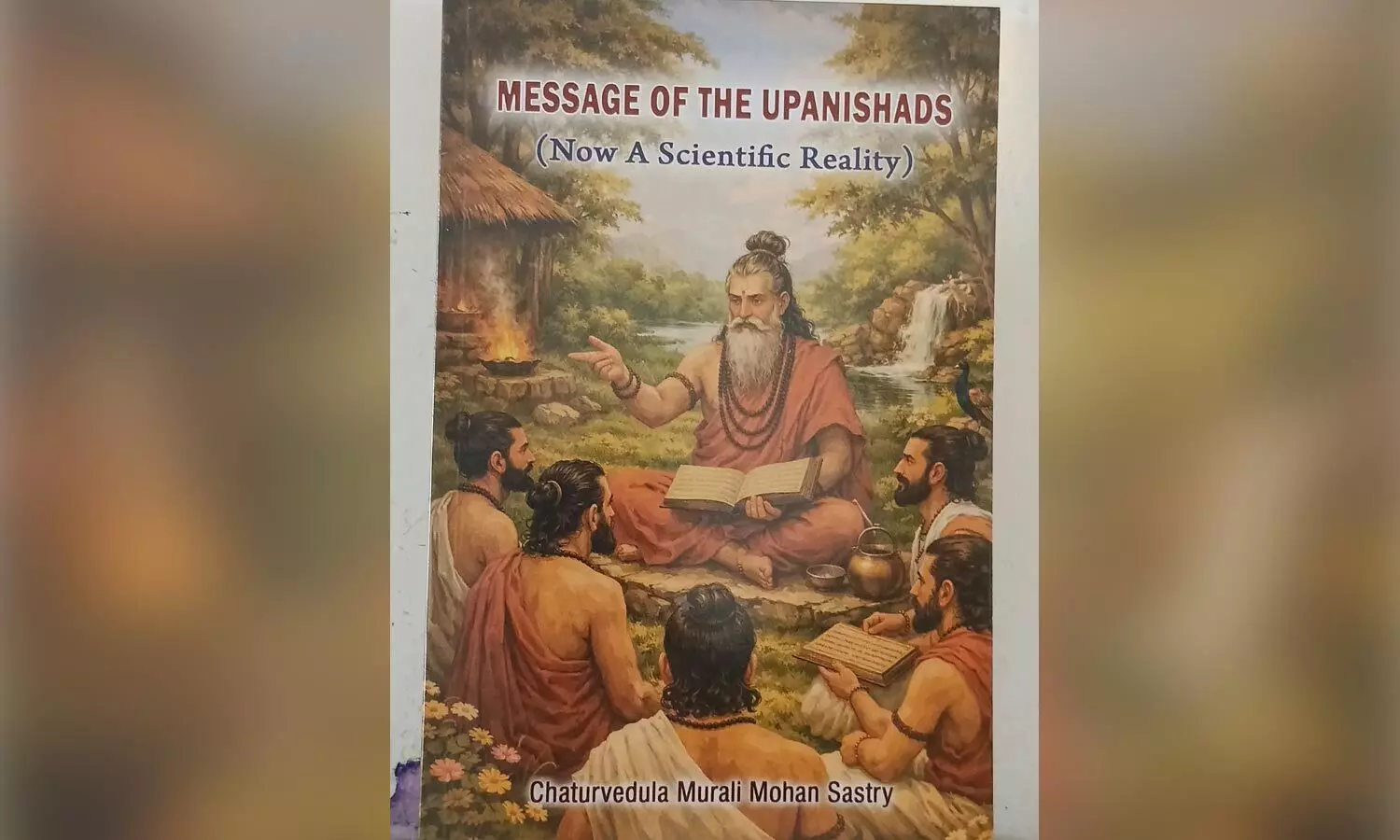
‘Message Of The Upanishads’ (Now A Scientific Reality) by Chaturvedula Murali Mohan Sastry explores the connection between ancient Sanatana Dharma, Advaita philosophy and modern science. Through ten essays, the author introduces young readers to the timeless wisdom of the Upanishads and its relevance to understanding life, the universe and the self
Share :
Highlighting the eternal connect between humanity and the cosmos
The central message of the Upanishads is that the ultimate reality of the universe and the innermost core of every human being are one and the same. Its core concepts being, Brahman: The single, unchanging, and infinite spiritual power that creates and holds the universe together, Atman: The true inner self or soul of an individual and Unity: The profound truth that Atman is identical to Brahman, meaning humanity and the cosmos are deeply interconnected.
Its key teachings are fearlessness as the texts reject weakness and call on people to realize their inner strength and spiritual freedom, overcoming delusion since the word Upanishad means sitting near a teacher to destroy ignorance and clear up false views of reality and end of rebirth by knowing this shared divine identity frees a person from the endless cycle of birth, death, and suffering.
Chaturvedula Murali Mohan Sastry, the author of this book ‘Message Of The Upanishads’ (Now A Scientific Reality) has his target audience as the youth ‘to know the greatness and the scientific pedestal on which the eternal Sanatana Dharma stands’. However, as he elucidates in his foreword in the book, this publishing effort of his is an initiative comprising 10 essays to give the youngsters ‘basic knowledge in their pursuit of both mundane and spiritual goals’.
Sastry takes a very straight route to explain the close relationship between modern science and the Advaita philosophy as enunciated in the Upanishads. His illustration to depict how this is true is the case of three scientists who won the Nobel Prize for Physics four years ago (2022) by proving through an experiment that the universe is unreal and it appears because ‘we observe it’.
Hence as his earlier book ‘Jiva is Siva’ (2021) was written in Telugu, he decided to write the new one in English as the modern youth do not possess a proficiency in their own mother tongue. Using the Q&A format and lacing his essays with shlokas, Sastry goes into a detailed explanation to make his point lucidly. Quoting Romain Rolland, a French philosopher who says ‘Religious faith in the case of Hinduism has never been allowed to run counter to scientific laws. Moreover, the former is never made a condition for the knowledge they teach. But they are scrupulously careful to take into consideration the possibility that by reason both agnostic and atheist may attain the truth in their own way’.
Not surprising then, Sastry affirms: ‘All this means jagat (nature) itself is the best guru to a human being. Observing the universe that is ever changing, transient, and full of miseries, a serious seeker must take it as a guru, get himself detached from the temporary happiness and seek the permanent, deathless and 100% happy state that is the realisation of his self.’ This is where, it all begins, one can
conclude, for sure.


