






- Vaccinate on time and stay protected for a lifetime: Dr Bharath Reddy
- Dumping yard on Ravvala Konda to be shifted soon
- Collector Himanshu Shukla issues panchayat poll guidelines
- SP encourages students to focus on studies, maintain discipline and aim high
- Dedicated sanitation efforts earn Atmakur hospital state-level recognition
- Libraries are true treasure of knowledge: Waqf Board chief
- Prevent public hardships and protect public property: MLA
- Childrens’ Green Festival celebrated
Measuring creativity, mapping prosperity: A new policy direction for Bharat
In Short
As Bharat advances towards Viksit Bharat 2047, the creative economy presents an opportunity to integrate cultural capital with economic planning
Share :
Measuring creativity, mapping prosperity: A new policy direction for Bharat
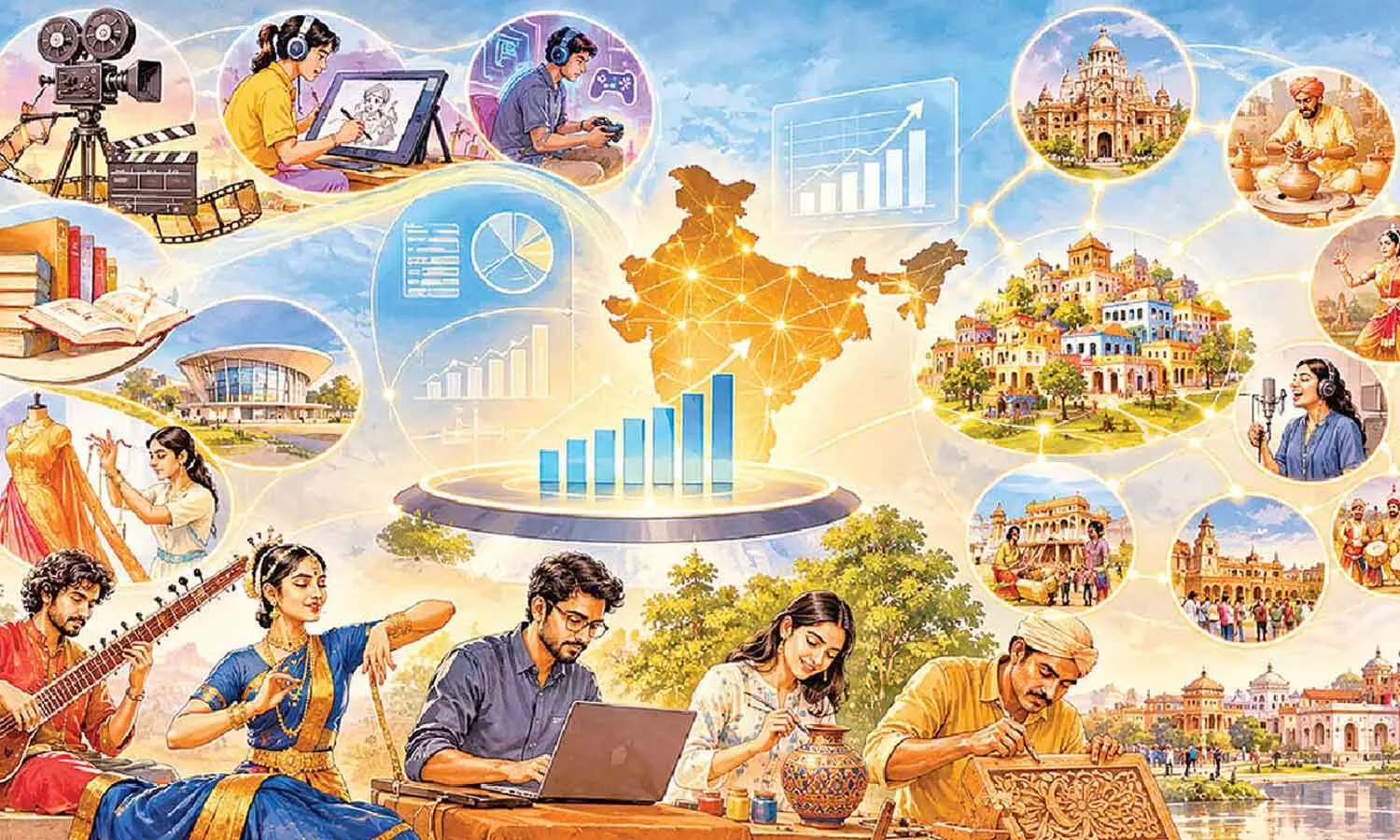
Bharat’s creative strength extends from the stories told in its villages to the digital worlds developed in its technology studios. Cinema, music, publishing, design, architecture, advertising, animation, gaming, performing arts, handicrafts and cultural tourism together represent a vibrant ecosystem of knowledge, imagination, enterprise and employment.
As Bharat advances towards Viksit Bharat 2047, the creative economy presents an opportunity to integrate cultural capital with economic planning. Two policy interventions can accelerate this transformation: a Creative Economy Satellite Account to measure the sector’s contribution and District Creative Economy Clusters to translate local creative potential into sustainable economic activity.
Recognising the Economic Power of Creativity
The creative economy brings together activities in which ideas, intellectual property, cultural expressions and artistic skills generate economic value.
Bharat already demonstrates considerable strength across several creative sectors. According to the Ministry of Information and Broadcasting’s Statistical Handbook on Media and Entertainment Sector 2024–25, the media and entertainment industry was valued at approximately ₹2.5 lakh crore in 2024, encompassing television, digital media, print, filmed entertainment, animation, gaming and other segments.
The Union Budget 2026–27 has further recognised the potential of emerging creative technologies through its proposal to establish Animation, Visual Effects, Gaming and Comics content creator labs in 15,000 secondary schools and 500 colleges.
These developments highlight the increasing importance of creativity as an economic capability.
Yet the complete creative economy extends beyond media and entertainment. It includes independent designers, architects, writers, musicians, performing artists, craftspeople, photographers, digital creators, heritage professionals and numerous microenterprises.
A comprehensive measurement system can bring these diverse contributions into a common economic framework.
Creative Economy Satellite Account: Making Creativity Count
Bharat can consider developing a Creative Economy Satellite Account (CESA) within its national statistical architecture.
Satellite accounts are internationally recognised statistical frameworks that help measure economic activities distributed across conventional industrial classifications. Bharat already uses this approach in areas such as tourism.
A Creative Economy Satellite Account could identify the economic contribution of creative activities through indicators such as gross value added, employment, enterprise formation, exports, intellectual property revenues and household livelihoods. Importantly, it could capture both organised creative industries and informal creative occupations.
Such a framework would help answer fundamental policy questions: How many people depend on creative occupations? Which creative sectors generate the greatest employment? What proportion of economic value reaches individual creators? How do creative activities contribute to district and state economies?
Reliable measurement would enable governments to design targeted interventions, evaluate investments and establish realistic growth objectives.
District Creative Economy Clusters: Local Talent, Global Opportunity
The second policy priority is the establishment of District Creative Economy Clusters (DCECs).
Every district possesses a distinctive combination of cultural resources, creative skills, knowledge traditions and entrepreneurial capabilities. These may include local cinema and theatre, music, publishing, craft production, architecture, festivals, food traditions, heritage experiences, digital design and contemporary content creation.
District Creative Economy Clusters could bring these activities together through a coordinated development framework.
A cluster could connect creators with educational institutions, production facilities, digital infrastructure, financial services, intellectual property support and market platforms.
For example, a district with strong performing arts traditions could develop opportunities in cultural production, sound recording, costume design, event management, digital documentation and cultural tourism. Another district with emerging digital talent could support animation, gaming, design and audiovisual entrepreneurship.
Existing initiatives such as One District One Product, PM Vishwakarma, Startup India and district-level skilling programmes offer opportunities for convergence.
The objective would be to strengthen locally relevant creative value chains while enabling participation in national and international markets.
Connecting Culture, Technology and Entrepreneurship
Creative enterprises increasingly operate at the intersection of traditional knowledge, contemporary design and emerging technologies.
Artificial intelligence, immersive media, digital distribution and virtual production are creating new possibilities for cultural expression and commercial innovation.
Bharat’s creative economy framework can encourage collaboration among artists, technologists, educational institutions, startups and cultural organisations.
Museums and heritage institutions can become centres for research, experiential learning, digital storytelling and creative incubation. Universities can introduce interdisciplinary programmes combining Indian Knowledge Systems, design thinking, intellectual property, entrepreneurship and digital production.
Such partnerships would enable cultural knowledge to inspire new products, services and experiences while maintaining respect for its origins.
A Coordinated Policy Architecture
The creative economy intersects with the responsibilities of multiple ministries and institutions, including culture, information and broadcasting, education, textiles, commerce, tourism, MSMEs and electronics and information technology.
An integrated policy framework could strengthen coordination across these domains.
A national creative economy mission, supported by state-level implementation mechanisms, could establish common definitions, statistical standards, enterprise support systems and measurable development indicators.
The Creative Economy Satellite Account would provide the evidence base, while District Creative Economy Clusters would create the local implementation ecosystem.
Together, these initiatives could support informed investment, inclusive entrepreneurship, intellectual property protection, skill development and export promotion.
Creativity as a Development Multiplier
The economic value of creativity reaches beyond individual products and services. A film production generates opportunities for technicians, designers, performers and local businesses. A heritage destination supports guides, hospitality, transport, crafts and digital services. A gaming studio brings together storytelling, software development, visual design, music and marketing.
This interconnected character makes the creative economy a powerful contributor to regional development.
For Bharat, the next opportunity is to make these economic relationships visible, measurable and productive.
A Creative Economy Satellite Account can reveal the value Bharat creates. District Creative Economy Clusters can expand the opportunities through which that value reaches its people.
Together, they can provide a policy foundation for transforming Bharat’s creative diversity into sustainable prosperity.
(The writer is a Creative Economy Expert)


