




‘Trust Before Intelligence’: Colaberry CEO Ram Katamaraja’s book explores the future of trust in enterprise AI
In Short
Flt. Lt. Bipin Pendyala, President, HYSEA, said confidence is fundamental to human life from the moment we are born.

Share :
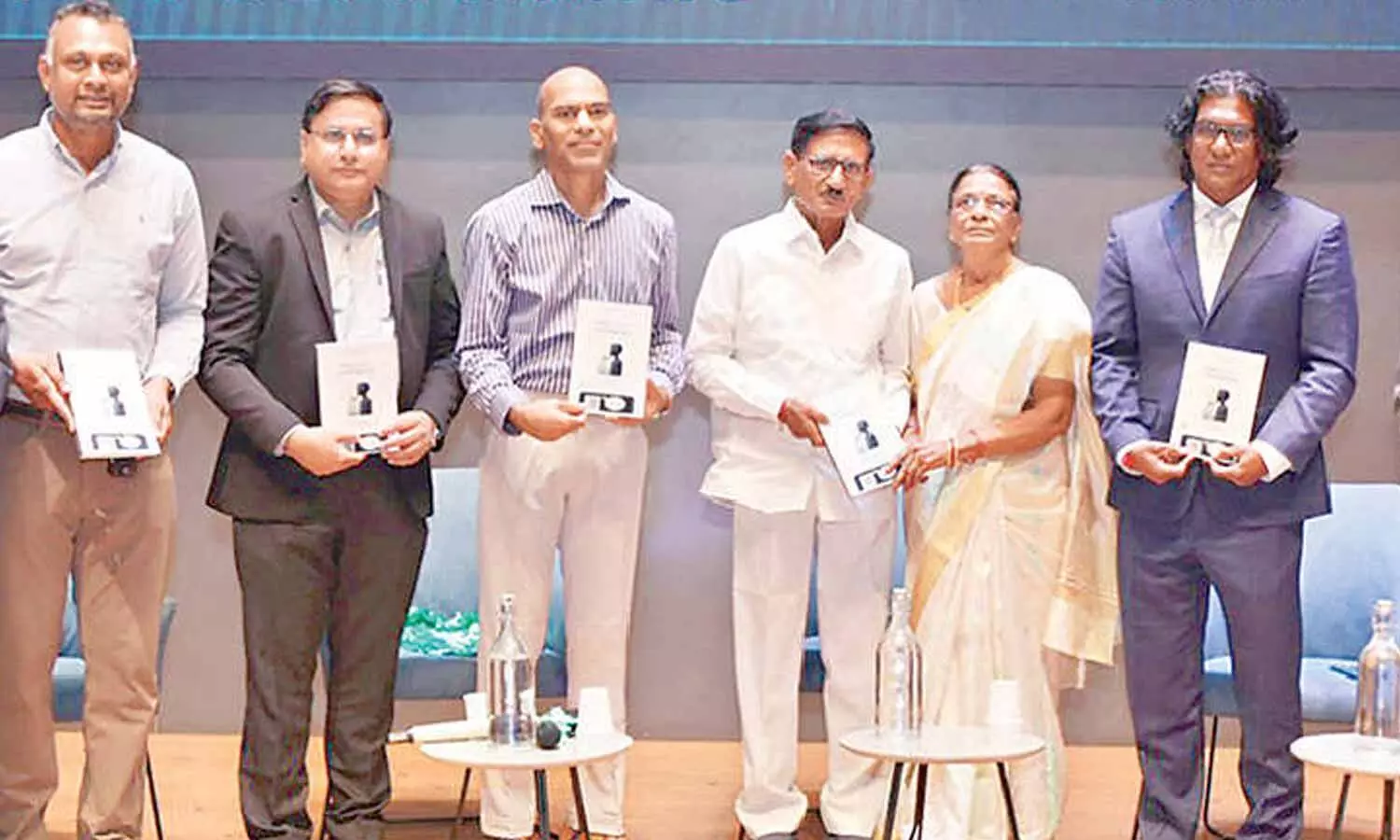
Flt. Lt. Bipin Pendyala, President, HYSEA, said confidence is fundamental to human life from the moment we are born. As companies increasingly replace human interactions with AI agents, it becomes the company’s responsibility to build that same confidence and trust in users, not the user’s responsibility to accept the technology.
He addressed the event as the chief guest at an event organised on Friday to release ‘Trust Before Intelligence’, a book authored by Ram Katamaraja, CEO, Colaberry, at T-Hub, bringing into focus a critical question for enterprises in the age of agentic AI: Can we trust AI to act?
Colaberry and CaiRL hosted the programme. Rama Mohan, MD, Colaberry, and Co-Founder of CaiRL, also graced the occasion. The event brought together business and technology leaders to examine the shift from AI systems that predict and recommend to AI agents capable of independently reasoning, making decisions, taking actions and influencing business outcomes.
Flt. Lt. Bipin Pendyala said AI agents are inevitable, and over the next 3 to 5 years, governments will likely introduce regulatory frameworks across sectors such as finance, healthcare, banking, and accounting. The technology will mature, but technology alone is not enough. The real question is: Are we simply building AI agents, or are we building trust in those agents? Because if consumers don’t trust and use the technology, its value is limited. That is why this book is so timely and relevant. It addresses not just how to build AI agents, but also how to create the confidence and trust necessary for people and enterprises actually to adopt them.
According to the author Ram Katamaraja, “The question for enterprises is no longer whether AI is intelligent enough. The question is whether we can trust it enough to let it act. That is the central argument behind Trust Before Intelligence.” The book raises a pertinent question: Why do 95% of AI pilots fail, while only 5% succeed? I’ve been working in data science, machine learning, and AI for nearly 15 years.
A key highlight was a fireside chat between Bala Prasad Peddigari and Dr Rajesh Dhuddu, PhD, titled “AI Agents in the Real World: From Reasoning to Action.” The conversation explored AI agents and multi-agent systems, MCP and A2A interoperability, Physical AI, and the role of human oversight as increasingly autonomous systems enter enterprise environments.
A leadership panel featuring Dr Ratnakar Palakodeti, Rajesh Gali Mangara, Sowjanya Ananthuni, Flt. Lt. Bipin Pendyala and Ram Katamaraja examined “From Predictive to Autonomous Supply Chains: The Rise of Agentic Logistics” and “Trust Before Autonomy: Who Is Accountable When AI Acts?”
The discussions explored how AI could move beyond forecasting to independently sense events, make decisions, coordinate stakeholders, and execute supply-chain workflows, while addressing the critical question of accountability when AI-driven decisions have financial or operational consequences.


