






- TG SAFE raids fish markets, seizes 858 kg of rotten seafood
- Hyderabad to roll out contra-flow BRTS within a week
- No takers for HMDA auctions for Moosapet, Neopolis lands
- Overseas job dreams get wings with government subsidy
- Hyderabad: School rush chokes Cyberabad roads
- Results come through hard work, honesty, not through speeches: UP CM Adityanath's jibe at Opposition
- India and Philippines review ongoing military engagements, identify new avenues for tri-service cooperation
- K’taka govt detects excess ethanol delivery, short supply of petrol
Delimitation battle takes a new turn: Congress loses grip as regional allies slip away
In Short
Centre’s revised formula exposes cracks in INDIA bloc as regional parties reassess their positions, leaving Congress struggling to enforce a common Opposition line
Share :
Delimitation battle takes a new turn: Congress loses grip as regional allies slip away
The Centre’s decision to accommodate the Opposition’s demand for a uniform 50 per cent increase in Lok Sabha seats and freeze the expanded strength for the next 25 years has significantly altered the political equations ahead of the special session of Parliament.
The revised formula seeks to address apprehensions, particularly among southern states — Tamil Nadu, Kerala, Karnataka, Telangana and Andhra Pradesh — that a delimitation exercise could diminish their relative political influence in the Lok Sabha. In doing so, the government appears to have taken the sting out of one of the Opposition’s strongest objections to the proposed legislation.
However, Kerala, Telangana and Karnataka MPs from the Congress party will be voting against the bill in line with the party’s decision.
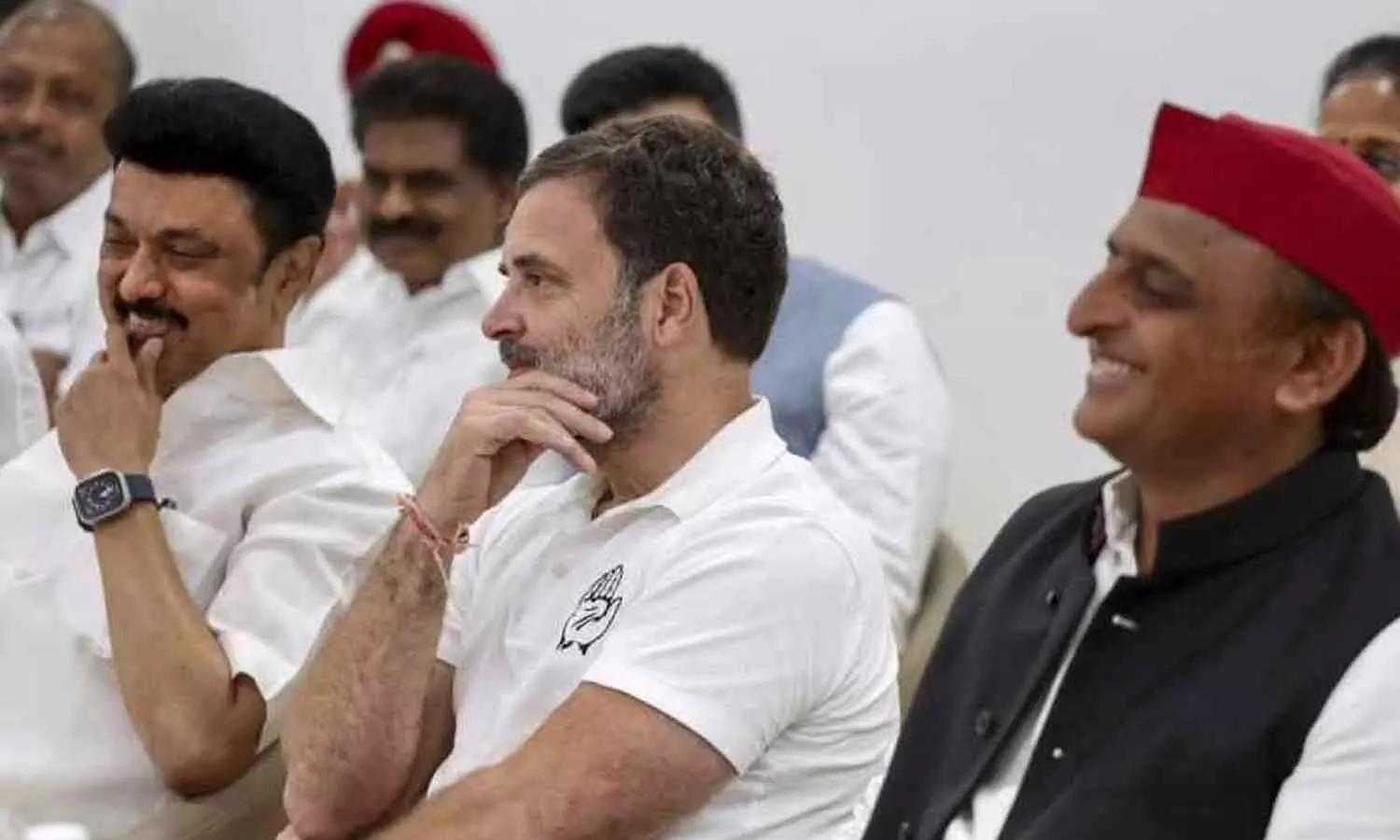
What appeared to be a united Opposition campaign against the legislation following its defeat in April is now showing signs of strain. Several regional parties are reassessing their positions, leaving the Congress with the difficult task of keeping the INDIA bloc together.
With the DMK and the NCP (Sharad Pawar faction) indicating a willingness to reconsider their earlier positions, the political battle is no longer as straightforward as it was when the legislation was defeated.
The government seems to have recognised that the principal stumbling block was not women’s reservation itself, but the apprehensions surrounding delimitation and its possible implications for a federal balance. By addressing these concerns through a revised formula, it has attempted to separate the issue of women’s empowerment from the contentious question of regional representation.
Under the proposed arrangement, the number of elected Lok Sabha seats would increase by 50 per cent, taking the strength from the present 543 to approximately 815. The expanded strength would then remain frozen for the next 25 years.
It may be recalled that the Constitution (131st Amendment) Bill, 2026, was defeated in the Lok Sabha on April 17. Of the 528 members present, 298 supported the Bill, while 230 opposed it. It fell 54 votes short of the required two-thirds majority of 352. It was the first major legislative setback for the Modi government since it came to power in 2014.
The Opposition’s objections were rooted in both political calculations and concerns about federal representation. Most parties feared that delimitation would not only require them to accommodate a substantially larger number of women candidates in future elections but also lead to changes in the geographical boundaries of Assembly and Lok Sabha constituencies. Such changes could upset established electoral equations and affect their political prospects.
While insisting that they were not opposed to women’s reservation, the Congress, Samajwadi Party, DMK and several other parties demanded that it be delinked from delimitation. They also wanted the existing Lok Sabha strength of 543 to remain frozen for another 25 years. They also questioned the need to link the implementation of a law already passed by Parliament in 2023 to a fresh delimitation exercise.
During the April debate, Prime Minister Narendra Modi and Home Minister Amit Shah had sought to allay these apprehensions, assuring the House that the proportional representation of states would not be disturbed. However, the Opposition insisted that such assurances should find a place in the actual legislative provisions rather than remain verbal commitments. The failure to bridge this gap eventually led to the breakdown of consensus.
The DMK, one of the most vocal opponents of the earlier proposal, had insisted on two conditions: a uniform 50 per cent increase in seats and a guarantee that Tamil Nadu’s relative share of representation would not decline. The revised formula addresses these concerns, prompting the party to indicate that it is willing to examine the fresh proposal before taking a final call.
This is a significant political development. With 22 Lok Sabha members, the DMK’s position could influence the government’s efforts to secure the required majority. Its willingness to reconsider the legislation has also complicated the Congress’s task of maintaining a common Opposition position.
The Shiv Sena (Uddhav Balasaheb Thackeray), which had also favoured a uniform increase in seats, could similarly soften its opposition. The NCP (Sharad Pawar faction) is another potential supporter, provided the revised legislation addresses its concerns, including those relating to the composition of the proposed Delimitation Commission.
The government is also looking beyond these parties. The YSRCP and BRS, among others, have decided to support the government. The YSRCP has indicated that protecting regional balance is important to its position. However, its support also reflects its political calculations. Despite being opposed to the NDA government in Andhra Pradesh, it may not want to antagonise the BJP-led government at the Centre.
The Congress, meanwhile, finds itself in a difficult position. Its stated stand is that there should be no increase in Lok Sabha and Assembly seats until the Census exercise is completed. It must now contend with regional allies whose immediate concerns appear to have been addressed by the revised formula.
The Samajwadi Party has also expressed reservations. Party chief Akhilesh Yadav has described the government’s decision to bring back the legislation as a major mistake. The party is particularly concerned about the possible impact of delimitation on the political composition of Uttar Pradesh.
The AAP and RJD may abstain from voting, according to political indications. While the TMC (Mamata) continues to oppose the legislation, the breakaway faction would support the bill. The possibility of regional parties taking independent positions has thus emerged as a major challenge for the Congress.
The government, on its part, has not been sitting idle since the April setback. It has held back-channel consultations with individual MPs and political leaders, sought to understand their reservations and explored ways of securing broader support. The revised formula is clearly the outcome of these efforts.
If the DMK and the NCP (Sharad Pawar faction) move towards supporting the legislation, while some other parties such as the SP, RJD and AAP abstain, the government’s prospects could improve considerably.
The Congress has meanwhile convened a meeting of the INDIA bloc on Saturday and is expected to deliberate on how to prevent further erosion of Opposition unity. Mamata Banerjee and Akhilesh Yadav are among the leaders expected to participate in the bloc’s consultations.
But the larger question is whether the Congress can insist on a common position when regional parties feel that their specific concerns have been addressed. For many of them, protecting their state’s political representation may take precedence over maintaining Opposition unity.
There is also a larger issue that should not get lost in the political confrontation. Women’s representation in the Lok Sabha remains far below the proposed 33 per cent quota. The 2023 legislation was widely welcomed, but its implementation was linked to a future Census and delimitation exercise. The government now wants to advance the process so that women can benefit from reservation before the 2029 general election.
The Centre has clearly made a political adjustment by accepting a formula that addresses several of the concerns raised by regional parties. Whether this translates into the numbers needed to get the legislation through Parliament remains to be seen. But one thing is becoming evident: the delimitation debate has begun to expose the differing political priorities within the INDIA bloc, and keeping the Opposition united may prove as difficult as defeating the legislation.
(The author is former Chief Editor of The Hans India)
Telangana urges Centre to approve Rs 25,096 crore for power sector development
Delimitation: Naidu Urges Parties to Rise Above Politics; Don’t Deny Women Their Due
J&K L-G directs universities to transition towards skill-centric, employment-oriented curriculum
Shashi Tharoor 'disappointed' with DMK's stance on Delimitation
Tamil Nadu CM is anti-Sanatan, Alleges BJP
'Delimitation Bill being brought in to win Uttar Pradesh': Akhilesh attacks government


