




A tale of two cities: Unmasking the reality of Hyderabad’s urban boom
In Short
Explore Hyderabad's dual urban reality as rapid IT corridor growth meets critical infrastructure gaps, examining the shift toward polycentric development.

Share :
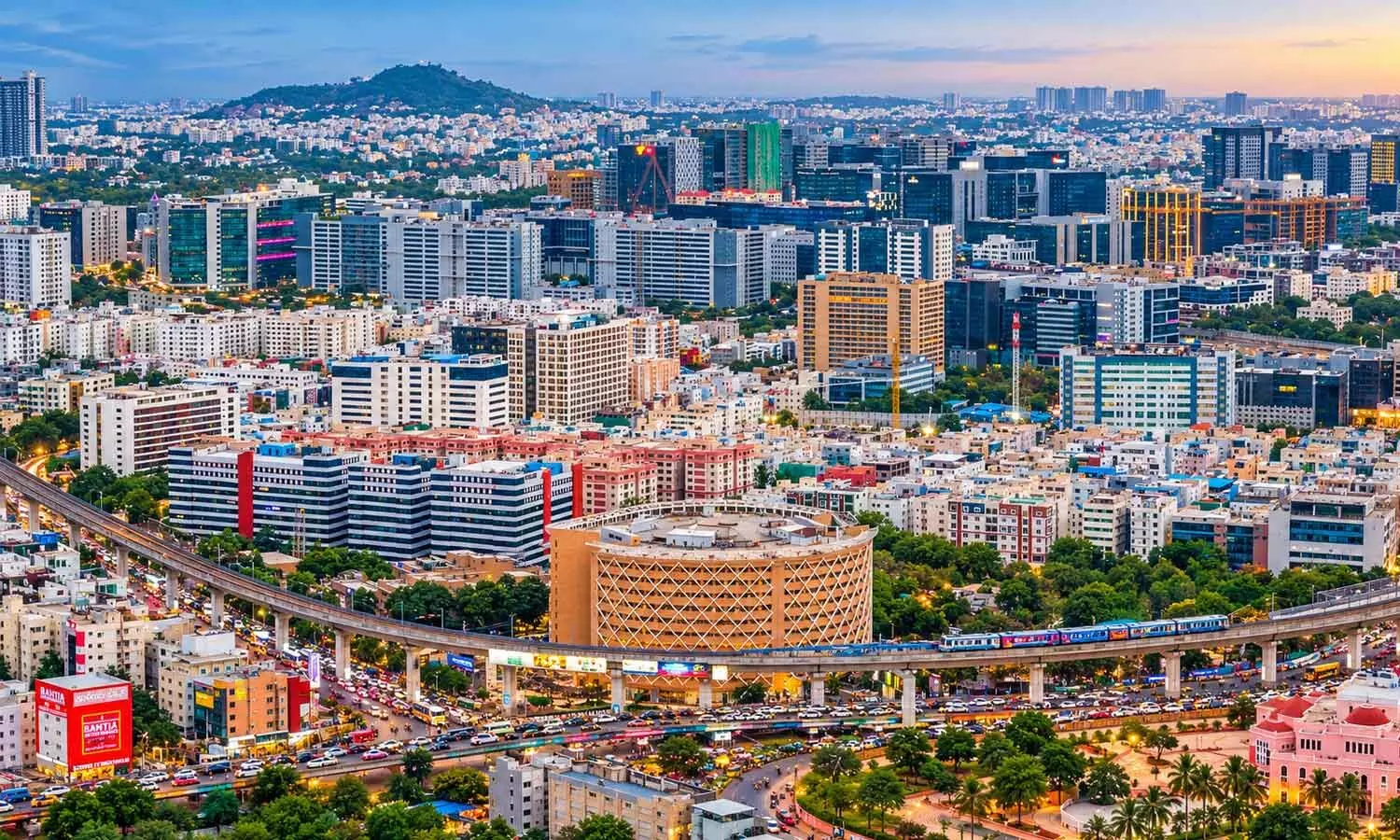
A tale of two cities: Unmasking the reality of Hyderabad’s urban boom
“Cities have the capability of providing something for everybody, only because, and only when, they are created by everybody.” — Jane Jacobs
Walk through the glass-and-steel corridors of Narsingi or Kokapet at dusk, and you are greeted by an unapologetic spectacle of global ambition. Towering residential skyscrapers slice into the horizon, their reflective facades catching the fading light. High-speed flyovers, sleek metro lines, and multi-lane expressways weave through the western sector like the arteries of a hyper-modern metropolis. This is the headline-grabbing face of Hyderabad’s real estate narrative: a booming IT-driven economy, soaring property valuations, and luxury gated communities that promise an international lifestyle wrapped in urban convenience.
Yet, just a few kilometers away, a parallel reality unfolds—one of narrow lanes, aging stormwater drains, and sprawling historic neighborhoods straining under the weight of rapid, uneven growth. This stark duality forms the complex ground reality of modern Hyderabad: a city racing toward a futuristic ideal while navigating the frictional drag of infrastructure gaps and socio-spatial division.
The western engine and the capital surge:
Over the past decade, Hyderabad’s growth engine has pulled decisively toward its Western Corridor. Driven by the influx of Global Capability Centres (GCCs), tech giants, and pharmaceutical heavyweights, regions like Gachibowli, the Financial District, and Tellapur have witnessed unprecedented capital appreciation.
The modern homebuyers in Western Hyderabad are no longer simply buying square footage; they are purchasing an ecosystem. Integrated townships offer private power backups, water filtration, private parks, and walk-to-work proximity. However, this self-contained model hints at a broader urban phenomenon: the privatization of civic infrastructure.
The infrastructure paradox:
While projects like the Outer Ring Road (ORR) and expanding Metro Rail corridors have revolutionised long-distance transit across the city, local civic infrastructure frequently struggles to keep pace with high-density construction.
When torrential monsoon downpours hit, the contrast becomes starkly visible. Modern glass towers often find themselves encircled by waterlogged roads as natural catchment zones and historic lake basins (cheruvus) yield to concrete developments. The city’s water supply presents a similar paradox: while smart apartments feature automated tap systems, many outlying clusters remain dependent on private water tankers to meet daily needs.
Furthermore, property prices—averaging around ₹8,200 to ₹8,300 per square foot citywide, with premium pockets reaching far higher—have created a distinct affordability gap.
Middle-class buyers and long-time residents are increasingly pushed toward distant peripheral zones like Bachupally or Kollur, trading reasonable commute times for affordable square footage.
Toward a polycentric tomorrow:
To view Hyderabad strictly through the lens of its challenges, however, is to miss its extraordinary resilience and potential. Unlike cities constrained by geography, Hyderabad possesses a natural advantage: radial room to expand.
The ongoing push toward a polycentric urban model aims to decentralize growth away from a single western cluster. Key initiatives are reshaping the landscape:
Regional Ring Road (RRR): A planned 340-km mega-loop designed to connect satellite towns directly, reducing core city congestion.
Transit-Oriented Development (TOD): Densifying commercial and residential spaces directly along Metro Phase 2 corridors to decrease reliance on private vehicles.
Industrial and health clusters: Strategic investments in southern and eastern corridors—such as life sciences nodes and AI hubs—to distribute employment opportunities evenly across the metropolitan region.
If these macro-planning efforts successfully integrate basic municipal services—drainage, public green spaces, and reliable water networks—with private development, Hyderabad can bridge the divide between its glitzy present and an inclusive future. The urban reality of Hyderabad is neither a pure real estate paradise nor a cautionary tale of unplanned expansion.
It is a dynamic, evolving metropolis in the middle of a massive structural transition. As high-rises continue to alter the skyline, the city’s true measure of success will not lie merely in the height of its towers or the speed of its stock market returns, but in how seamlessly it blends its historic soul with its high-tech future.
We shape our buildings; thereafter, our buildings shape us - Winston Churchill
(The writer is a former OSD to Union Civil Aviation Minister)


