






- SAD-BJP alliance step towards peace and progress: Kewal Singh Dhillon
- PM Modi highlights India’s growing focus on skill development
- Delhi HC refuses bail to man accused of robbing Rapido driver
- Hema Malini Remembers Dharmendra On His First Death Anniversary
- Anthropic Launches Claude Ship to Review and Approve Code Changes
- Drone strikes in Sudan threaten humanitarian operations: UN
- Schools across Denmark receive bomb threats, police say threats not 'credible'
- ‘Takes a toll on bowlers’ bodies; we were happy’: Daryl Mitchell on India’s decision to settle for draw in 1st Test
An autobiography without introspection: A journey of lies
In Short
Examining debates around Congress internal democracy, historical episodes involving P V Narasimha Rao, Sitaram Kesri, and Pranab Mukherjee, and how dynastic narratives shape modern Indian politics.

Share :
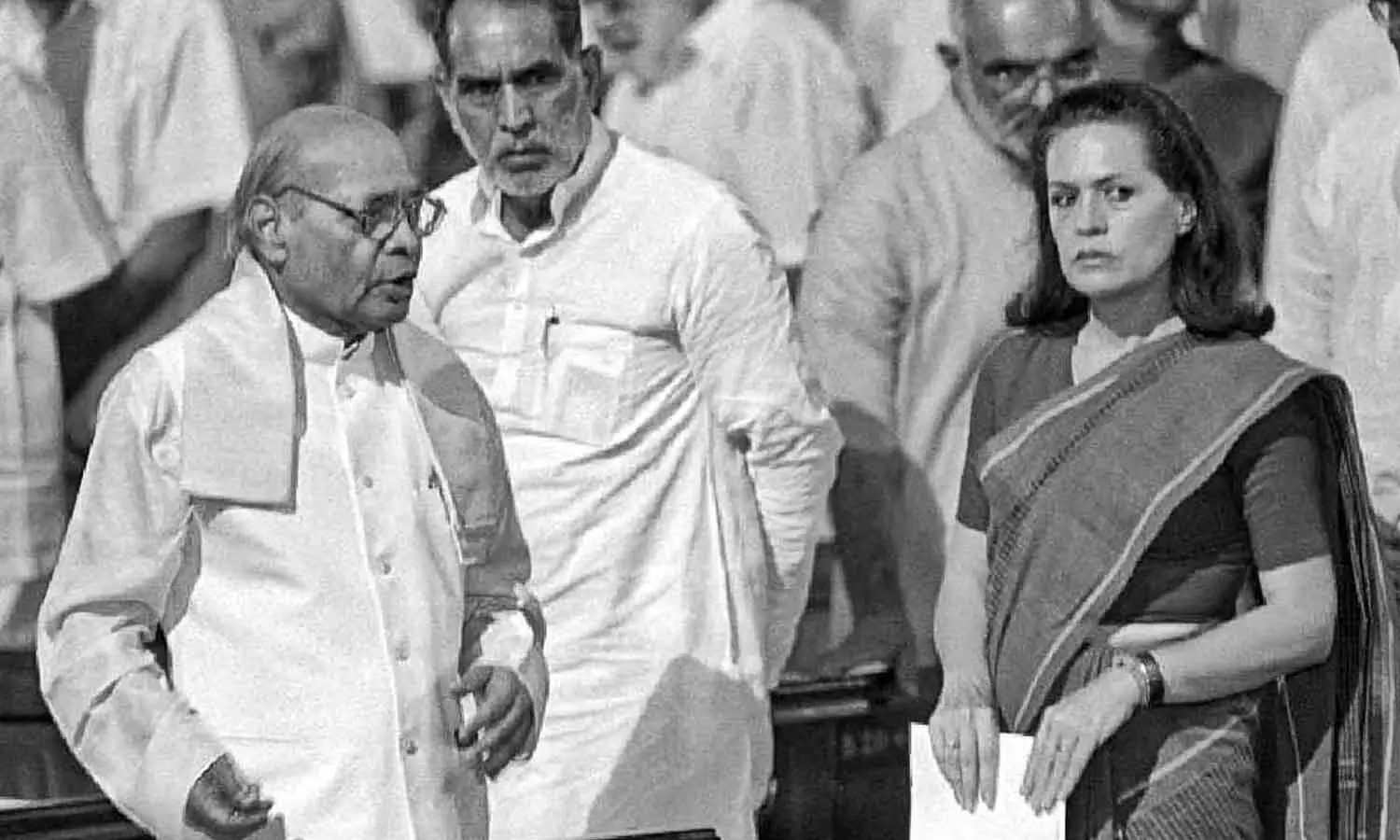
An autobiography without introspection: A journey of lies
The way P V Narasimha Rao was held solely responsible for the party’s electoral defeat and the subsequent treatment of him are often cited as examples of political vindictiveness. The efforts to isolate a formidable leader such as Rao, allegedly because the party’s leadership wanted to preserve the dominance of the family, have left a lasting impression on political observers.
The treatment meted out to Rao after his death was particularly shocking. The reported refusal to allow his mortal remains into the Congress Party headquarters in Delhi, resulting in the gates being closed, remains a deeply controversial episode. What does such an act signify?
A leader who had served the country with distinction as a Prime Minister and as Congress Party president deserved the dignity and respect matching his stature. Denying even basic dignity to his mortal remains on account of political differences raises serious questions about the conduct and values of the party leadership. The incident in Delhi remains, for many, a symbol of the vindictive politics associated with the family.
In the face of such historical episodes, claims in an autobiography that no injustice was ever done to anyone appear to be an attempt to mislead the public.
Internal democracy within the Congress Party has for decades remained more of a decorative phrase than a functioning reality. In a party with such a long history, the concentration of power around a single family has repeatedly marginalised talented and senior leaders. Rather than encouraging leaders who work hard and demonstrate merit, the party has often been accused of rewarding those who remain loyal to the family.
From the party presidency to the highest positions in government, the tendency to ensure that everything operates under the family’s control has, according to critics, become a serious challenge to democratic principles.
The Sitaram Kesri episode is often cited as a glaring example of how internal democracy was undermined within the party. The alleged abrupt and humiliating removal of a senior Dalit leader who was serving as party president from the AICC headquarters, in an atmosphere reminiscent of an emergency-style operation, remains one of the most controversial episodes in the party’s history.
A party that frequently speaks about social justice and the empowerment of marginalised communities must answer a fundamental question: what kind of respect did it show to a senior leader from a disadvantaged community who had placed his trust in it? The episode involving Kesri continues to be cited as a painful reminder of the party’s internal power struggles, yet the family has never openly acknowledged responsibility for the humiliation he allegedly suffered.
Similarly, the injustice allegedly meted out to Pranab Mukherjee, a highly accomplished leader with exceptional knowledge of the country’s economy and political affairs, deserves attention. Critics argue that he was denied the opportunity to become Prime Minister despite his experience and capabilities, allegedly because he was not considered sufficiently pliable to the interests of the family.
By denying capable and experienced leaders the positions they deserved within the party and government, and by prioritising loyalty over merit, the Congress leadership is accused of imposing a culture that weakened both the party and democratic institutions. The perception that family interests took precedence over national interests contributed to accusations of undemocratic conduct.
The question of who exercised influence behind the scenes during Dr Manmohan Singh’s tenure as Prime Minister has been widely debated. Sanjay Baru’s book ‘The Accidental Prime Minister’ has brought considerable attention to this issue.
The book describes the political dynamics between Manmohan Singh and Sonia Gandhi and alleges that the Prime Minister’s authority was constrained by an influential political centre at 10 Janpath. It also highlights the role of the National Advisory Council, which critics argue exercised considerable influence over policy and governance. The perception that the Council wielded influence beyond what was ordinarily expected of an advisory body, while the elected Prime Minister’s authority was constrained, raises questions about the functioning of democratic institutions. The alleged exercise of power through extra-constitutional centres, alongside an elected Prime Minister, was seen by critics as an affront to democratic accountability.
There have also been instances in which historical facts have allegedly been obscured or presented selectively. In the Godhra train-burning incident, the court convicted 33 individuals in connection with the burning of the train coach in which Hindu kar sevaks were killed. If judicial findings have established the culpability of individuals in the case, why should the incident continue to be described as “controversial” without acknowledging those findings?
Why distort facts even after a judicial verdict has been delivered? History cannot be altered for political convenience. How can those who fail to acknowledge the sacrifice of victims and respect judicial findings claim to uphold the Constitution?
When so many historical realities are visible, portraying the period of one’s own political dominance as an era of prosperity and success, without acknowledging its failures, amounts to little more than deception, critics argue. The history of weakening constitutional institutions, suppressing political talent and exercising influence through remote-control governance cannot be erased through books or emotional appeals. History does not favour anyone; it preserves the difficult truths of the past.
Today, the Congress Party is struggling to regain its political footing across the country. Under the leadership of Prime Minister Narendra Modi, the electorate has increasingly expressed its preference for development-oriented politics and governance. Against this backdrop, Sonia Gandhi’s book appears to many as an attempt to revive the fortunes of a Congress Party that has been steadily losing political ground.
The effort to generate public sympathy through the recollection of past glory and family history appears to be an attempt to conceal the party’s political setbacks and regain relevance. The underlying objective, critics argue, is to revive the party’s fortunes and ultimately pave the way for Rahul Gandhi to become Prime Minister, relying on the legacy and influence of the family.
Despite repeated electoral setbacks, Rahul Gandhi has struggled to secure widespread acceptance as a leader among sections of the electorate, including the youth. The use of emotional narratives and books to generate sympathy and political advantage, rather than confronting the electorate with a convincing political vision, appears to be a desperate strategy. Unable to effectively counter political opponents on the electoral battlefield, resorting to emotional literature and behind-the-scenes political manoeuvres may be viewed as an attempt to compensate for the party’s declining fortunes.
At the time of the book’s release, the Congress Party’s internal situation was reportedly deteriorating further. There are claims that ordinary party workers and grassroots cadres are being pressured by the leadership to purchase the book and aggressively promote it on social media platforms. Instead of focusing on ideology, public issues and grassroots political struggles, the party leadership is allegedly placing the burden of promoting the family’s narrative on its own cadres.
How long can a leadership that prioritises family glorification and artificial publicity continue to mislead ordinary party workers and the public? Such questions are reportedly being raised even within the party.
Modern India, however, is politically more mature now. The days when people could be easily swayed by emotional tears or selective interpretations of history are long gone. Electoral outcomes repeatedly demonstrate that public opinion cannot be manipulated indefinitely through autobiographies or publicity campaigns.
The younger generation and ordinary citizens who seek national development, employment opportunities and transparent governance have increasingly become aware of the limitations of family-centred politics. Regardless of the strategies employed by the Congress Party, or the emotional narratives it attempts to promote, voters continue to assess its performance through the prism of their own experiences and expectations.
An autobiography filled with selective accounts cannot erase history. The people of India cannot be indefinitely misled. With the masks increasingly falling away, the public, particularly the youth, is prepared to reject dynastic politics and political manipulation.
People have long questioned personality cults and hereditary political leadership. No amount of publicity or emotional campaigning can indefinitely arrest the decline of a political party that fails to address the aspirations of the people. (Concluded)
(The writer is BJP National Party All Cells Joint Coordinator, New Delhi)
Revanth to launch 'Indiramma sarees’ distribution tomorrow
Union ministers, CMs likely to attend Invest Telangana
Invest Telangana Summit to further elevate Telangana's brand image, says Minister
Intensify search for missing fishermen: CM Naidu
Who Is Above the Supreme Court? Can Governments Violate SC Orders and Do What Suits Them
'Lies': Delhi BJP on CJP leader Saurav Das claiming curbs on flying to Britain


