






- BRS blames Congress for looming drinking water crisis
- Hyderabad: Park visitors cry foul over proposed fee hike
- Sonia Gandhi recalls fear of Indira, urges more youth to join politics
- Indian envoy meets Jakarta Governor, discusses sister city cooperation and Little India redevelopment
- FM Sitharaman chairs 2nd pre-Budget consultation with leading agriculture, rural development experts (Lead)
- Amit Shah unveils bust of Ajit Pawar in Pune; reveals the 'secret' behind his entry into Mahayuti
- Anbumani Ramadoss seeks urgent recruitment as TN govt colleges face faculty shortage
- Trinamool infighting: Ritabrata faction's X account suspended, blames Mamata group
Do not cause ‘one’s own constitutional destruction’
In Short
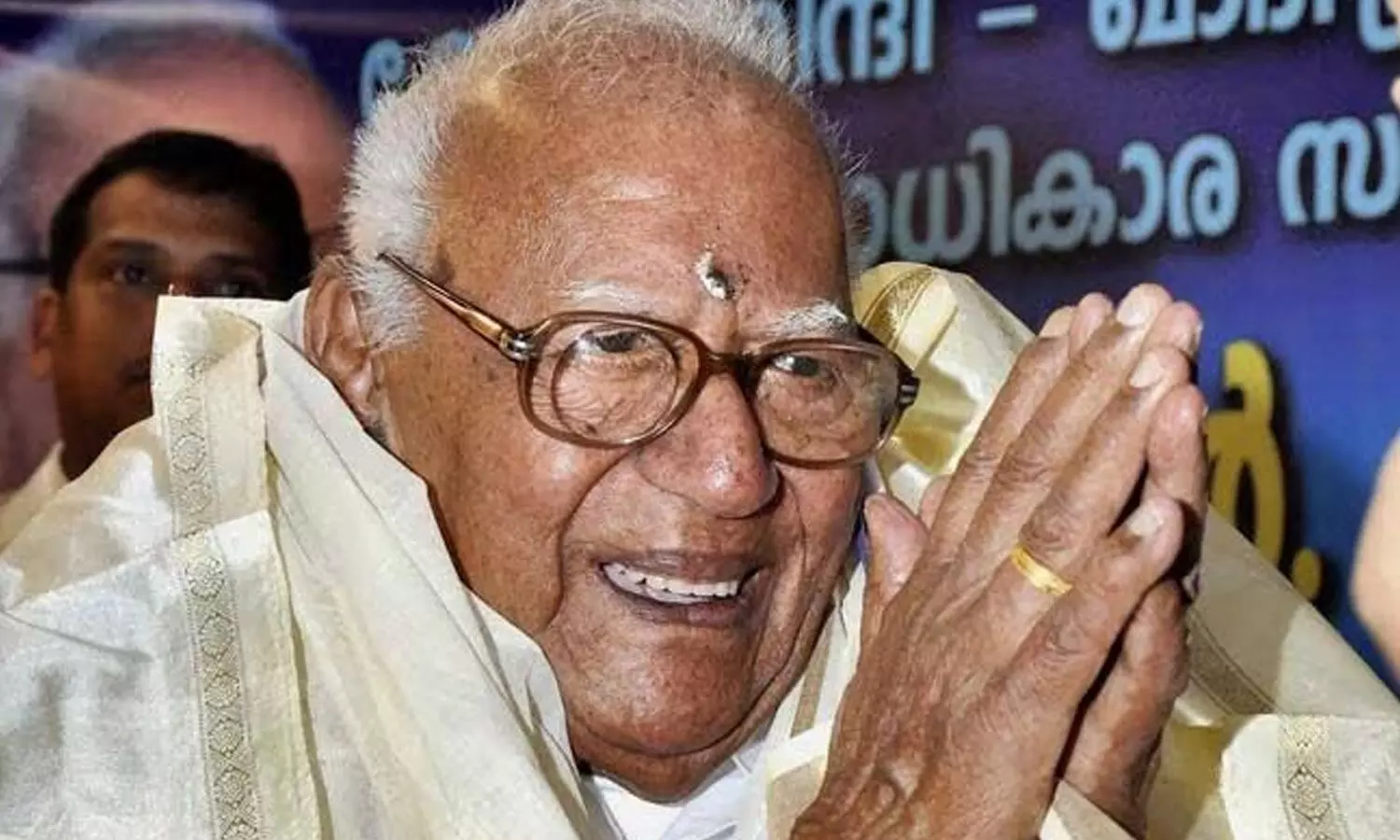
November 15 was the 111th birth anniversary of Justice V R Krishna Iyer
Share :
Do not cause ‘one’s own constitutional destruction’
Justice V R Krishna Iyer occupies a distinguished position as an eminent jurist. First among the great judicial minds who gave life, meaning and human purpose to our Constitution, his contribution was particularly significant in developing a constitutional philosophy that placed human dignity, individual liberty, social justice and the protection of weaker sections at the centre of constitutional interpretation.
After our Constitution, a great addition is the basic structure doctrine. The Supreme Court developed this theory in Kesavananda Bharati v State of Kerala (1973), establishing that Parliament’s power to amend the Constitution under Article 368 is not unlimited. But you cannot destroy it. Parliament could amend any constitutional provision, but it could not destroy the Constitution’s basic structure. Although Justice Iyer was not a member of the 13-judge bench in Kesavananda Bharati, his subsequent judgments and constitutional pronouncements gave this doctrine an important humanistic and socially transformative dimension. The bench, by a 7:6 majority, held that Parliament could amend the Constitution, including fundamental rights, but could not alter its basic structure or destroy its essential identity.
Can a parliamentary majority, merely because it has the numbers, change the character of the Republic, eliminate judicial review, abolish democracy or extinguish the rights and freedoms of citizens? The answer was no.
His most important contribution-N M Thomas
One of Justice Krishna Iyer’s most important contributions came in State of Kerala v N M Thomas, (1976) 2 SCC 310. The case concerned equality of opportunity in public employment and the constitutional validity of special measures benefiting Scheduled Castes and Scheduled Tribes. Justice Iyer’s concurring opinion rejected the narrow understanding that equality meant treating everybody identically, regardless of historical and social disadvantages.
He understood equality as a substantive constitutional promise requiring the State to address entrenched inequalities. His celebrated description of the Constitution was:
“A great social document, almost revolutionary in its aim of transforming a medieval, hierarchical society into a modern, egalitarian democracy.”
The Constitution as a social revolution
This statement captures the social philosophy underlying his constitutional interpretation. He drew attention to the contradiction identified by Dr B R Ambedkar: political equality could not survive indefinitely alongside social and economic inequality. The Constitution therefore had to be interpreted as an instrument for removing historical disadvantages and creating conditions in which every citizen could enjoy meaningful equality. Justice Iyer explained that: “Equality of opportunity is not simply a matter of legal equality.”
Its existence depends not merely on removing disabilities but also on creating abilities and opportunities. This approach strengthened the constitutional relationship between Articles 14, 15 and 16 and the Directive Principles, particularly Article 46, which requires the State to promote the educational and economic interests of weaker sections.
The significance for basic structure jurisprudence is considerable. Equality cannot be understood merely as a formal legal arrangement. Social justice and an egalitarian order are integral to the constitutional identity of India. The Supreme Court itself recalled Justice Krishna Iyer’s description of the Constitution in its 2024 judgment in Property Owners Association v State of Maharashtra, 2024 INSC 835, while discussing the constitutional commitment to social justice and an egalitarian social order.
Iyer against majoritarianism: Maneka Gandhi.
Yet another landmark contribution came in the Maneka Gandhi v Union of India, (1978) 1 SCC 248. The dispute was about the impounding of Maneka Gandhi’s passport without furnishing adequate reasons or providing a meaningful opportunity to be heard. It raised important questions about personal liberty under Article 21 and the relationship between Articles 14, 19 and 21. In his concurring opinion, Justice Iyer gave an expansive interpretation to constitutional liberty and procedural fairness. It is highly relevant even now: “The compulsion of constitutional humanism and the assumption of full faith in life and liberty cannot be so futile or fragmentary that any transient legislative majority in tantrums against any minority, by three quick readings of a bill with the requisite quorum, can prescribe any unreasonable modality and thereby sterilise the grandiloquent mandate.”
For constitutional morality
Iyer was warning against the possibility that a temporary legislative majority could use formal legislative procedures to undermine the substance of constitutional liberty. It extends beyond passport restrictions. It articulates a fundamental principle of constitutional democracy: numerical majority cannot be a substitute for constitutional morality.
But that procedure under Article 21 must be fair, reasonable and just. A law cannot become constitutionally acceptable merely because it has passed through the prescribed legislative process. Justice Iyer’s interpretation contributed to the development of the post-Maneka Gandhi understanding of Article 21, under which personal liberty is protected through an integrated reading of Articles 14, 19 and 21.
This idea was referred to by the Delhi High Court in this very passage in Naz Foundation v Government of NCT of Delhi, 160 DLT 277 (2009), while discussing the constitutional obligation to protect minorities against majoritarian encroachment. Justice Iyer’s constitutional humanism and the basic structure principle hold that democracy, fundamental rights, and judicial review must remain protected.
Part III & Part IV: Two inseparable commitments
The Basic Structure doctrine received further reinforcement in Minerva Mills Ltd. v. Union of India, (1980) 3 SCC 625. The Supreme Court invalidated Sections 4 and 55 of the Constitution (42nd Amendment) Act, 1976, which attempted to give primacy to all Directive Principles over specified Fundamental Rights and remove limitations on Parliament’s amending power. The judgment, delivered by a five-judge bench, reaffirmed two fundamental constitutional propositions:
1. Limited amending power is itself an essential feature of the Constitution.
2. Judicial review is indispensable to maintaining constitutional limitations.
Justice Y V Chandrachud, writing the principal judgment, made a particularly important observation: “The Indian Constitution is founded on the bedrock of the balance between Parts III and IV.”
He explained that Parts III and IV are like two wheels of a chariot. One cannot be sacrificed in the name of the other. The Court further observed: “Anything that destroys the balance between the two parts will ipso facto destroy an essential element of the basic structure of our Constitution.” These are statements from the Minerva Mills judgment, not quotations from Justice Krishna Iyer. Nevertheless, they express a constitutional philosophy closely associated with his approach in N M Thomas: fundamental rights and social justice must reinforce each other.
The Constitution is an organic document
Justice Krishna Iyer in N M Thomas explained that constitutional law must respond to the changing social realities of the country, saying: “Law, including constitutional law, can no longer go it alone” but must be illumined by sociology and allied fields of knowledge. He also emphasised that constitutional interpretation must take account of ethics, economics, politics and sociology. The basic structure doctrine is not confined to a closed list of words or provisions. This approach is important because the Constitution was framed not merely to regulate the government of 1950 but to guide the future development of an evolving nation. Courts identify essential constitutional features by examining the Constitution as a whole, including its Preamble, institutional arrangements, Fundamental Rights and Directive Principles. Justice Iyer’s approach encouraged courts to look beyond literal provisions and examine the human and social consequences of constitutional interpretation.
Justice H R Khanna’s opinion was particularly important in establishing the distinction between the power to amend and the power to destroy the Constitution. Justice Krishna Iyer was not a member of that bench, nor was he a member of the Minerva Mills bench. His contribution was through other landmark judgments, especially N M Thomas and Maneka Gandhi, and through a broader constitutional philosophy that enriched the meaning of liberty, equality, social justice and human dignity. His jurisprudence helped explain why the Constitution must be protected and what that protection must mean to the people.
(The writer is former Registrar, NALSAR University of Law, Hyderabad)


