






- Bihar: Six killed, six others injured in two separate road accidents in Buxar and Bhagalpur
- Pakistan’s top courts under executive control after 26th, 27th amendments: ICJ
- Chhattisgarh promotes senior IAS officers to higher ranks
- MP: Male tiger carcass found in Bandhavgarh buffer zone, cause under probe
- Agitating hospital workers stage unique protest
- RTI Kitchen: Meals served to 250 poor people
- No ‘muhurtham’ for holy dip in Pushkarams
- Gram panchayat Phase 3 polls set for December 2
How limiting beliefs stifle growth
In Short
Limiting beliefs are among the most powerful barriers to human development.

Share :
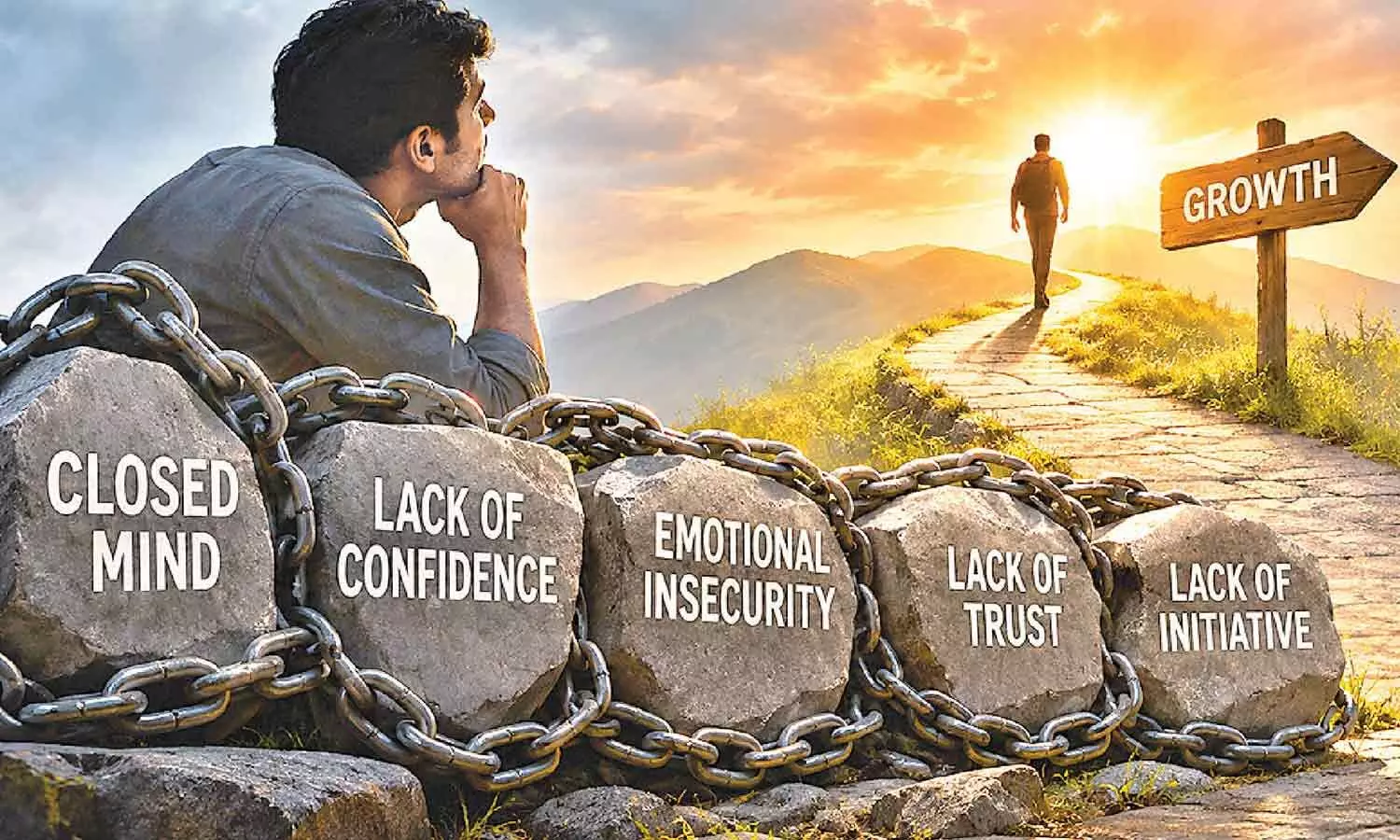
How limiting beliefs stifle growth
Human growth is an interesting phenomenon. We spend considerable time pursuing opportunities, acquiring knowledge, developing skills and seeking recognition. Yet, despite all these efforts, many remain confined to the same levels of personal and professional development for years. We blame circumstances, lack of opportunities, unsupportive environments and sometimes even other people for our inability to progress. But have we ever paused to examine whether the biggest obstacle to our growth is actually within us?
Limiting beliefs are among the most powerful barriers to human development. They are deeply ingrained assumptions about ourselves, our abilities, other people and the world around us. Often, we are not even conscious of their influence. They silently dictate how we think, respond, make decisions and approach opportunities. Over time, these beliefs become behavioural patterns that restrict our ability to evolve.
What makes limiting beliefs particularly dangerous is that they often masquerade as practical wisdom, caution or experience. We convince ourselves that we are being realistic when, in reality, we may simply be protecting ourselves from discomfort, uncertainty or the possibility of failure. There are five behavioural manifestations of limiting beliefs that deserve particular attention.
Closed Mind: The resistance to new perspectives
A closed mind is perhaps one of the most significant impediments to growth. People with closed minds often develop an exaggerated sense of certainty about their knowledge, experiences and opinions. They become uncomfortable with alternative viewpoints and perceive disagreement as a challenge to their intelligence or authority.
The problem is not that they have opinions. Everyone is entitled to one. The problem begins when opinions become rigid beliefs and the individual loses the willingness to reconsider them. In an organisational environment, this behaviour can be particularly damaging. Leaders who refuse to listen to younger colleagues, managers who dismiss unfamiliar ideas and employees who resist changing established practices eventually become liabilities to progress. They may have experience, but experience without openness can become an obstacle rather than an advantage.
Growth demands intellectual humility. We must recognise that our knowledge is never complete and that there is always something worth learning from another person’s perspective. The ability to unlearn is as important as the ability to learn.
Lack of confidence: The fear of our own potential
It is surprising how many capable people underestimate themselves. They possess the knowledge, skills and competence to perform, yet hesitate to pursue opportunities because they doubt their own abilities. This lack of confidence often manifests through excessive self-questioning, fear of judgement, dependence on external validation and an unwillingness to step outside familiar territory.
Consider an employee who consistently delivers good results but refuses to take up a challenging assignment because of the fear of failure. Or an individual who has valuable ideas but remains silent in meetings because of the apprehension that others might disagree. Such people are not necessarily lacking in ability. They are allowing self-doubt to dictate their possibilities.
Confidence does not mean believing that we are capable of everything. It means having the courage to attempt something despite not knowing whether we will succeed. We must understand that competence grows through experience, and experience requires participation. Waiting until we feel completely prepared before taking the first step can become a lifelong excuse for inaction.
Emotional Insecurity: When the ego comes in the way
Emotional insecurity is another deeply restrictive behavioural condition. It often emerges through jealousy, hypersensitivity, defensiveness, fear of rejection and an excessive need for approval. Emotionally insecure individuals tend to interpret situations through the lens of their vulnerabilities. A difference of opinion becomes a personal insult. Constructive feedback is perceived as criticism. Another person’s achievement becomes a source of discomfort rather than inspiration. This behaviour can seriously undermine personal relationships as well as professional environments. People become more concerned about protecting their egos than improving themselves. They spend their emotional energy comparing, competing and questioning others instead of investing it in their own development.
Emotional maturity requires us to recognise that not every disagreement is disrespect, not every criticism is an attack and not every success achieved by someone else diminishes our own worth. We need to develop the ability to manage our emotions rather than allowing our emotions to manage us. Self-awareness, emotional regulation and the willingness to accept our vulnerabilities are essential ingredients of personal growth.
4. Lack of trust: The inability to build meaningful relationships
Trust is fundamental to human relationships and collective achievement. Yet, many individuals operate with a persistent suspicion about other people’s intentions. They find it difficult to delegate, collaborate, share responsibilities or give others the benefit of the doubt.
Such behaviour often originates from past disappointments, insecurities or an exaggerated fear of being taken advantage of. Unfortunately, when these experiences become permanent filters through which we judge everyone, they restrict our ability to build meaningful relationships.
In organisations, a lack of trust creates dysfunctional teams, weakens collaboration and discourages people from taking ownership. Leaders who insist on controlling every decision eventually undermine the very people they are expected to empower.
Trust does not mean being naive or abandoning judgement. It means developing the maturity to assess people fairly, establish healthy boundaries and create relationships based on mutual respect and accountability. No individual or organisation can achieve meaningful growth in an environment where suspicion replaces cooperation. Progress is a collective exercise, and trust is one of its essential foundations.
5. Lack of initiative: The paralysis of inaction
Perhaps the most visible consequence of limiting beliefs is the inability to take initiative. Many people spend their lives waiting for the right opportunity, the right circumstances or someone else’s approval before taking action.
They hesitate because they fear failure. They avoid responsibility because it brings uncertainty. They prefer instructions because independent decisions expose them to accountability. This attitude creates a culture of dependency. People become accustomed to being told what to do rather than thinking about what needs to be done. They wait for problems to be assigned instead of identifying them. They see opportunities but hesitate to pursue them.
In the workplace, this behaviour affects productivity, innovation and organisational competitiveness. In personal life, it prevents individuals from exploring their capabilities and pursuing aspirations. Initiative is not about taking reckless risks or acting without thought. It is about developing the confidence to recognise possibilities, assume responsibility and translate intentions into action. We cannot expect different outcomes while continuously repeating the same patterns of behaviour. Growth requires movement, and movement requires initiative.
Breaking Free: The responsibility to evolve
The real challenge with limiting beliefs is that they become deeply embedded in our behavioural conditioning. We begin to accept them as part of our personality. We say, “That is how I am,” without recognising that many of our attitudes and responses are learned behaviours that can be challenged and changed.
Breaking free requires conscious effort. It begins with honest self-examination. We must develop the courage to question our assumptions, acknowledge our insecurities and recognise the behavioural patterns that hold us back.
We need to cultivate intellectual openness, strengthen self-confidence, develop emotional intelligence, build trust and demonstrate initiative. These are not qualities that develop overnight. They require consistent practice, feedback, reflection and a willingness to step beyond familiar boundaries.
Organisations also have an important responsibility. Leaders must create environments where questioning is encouraged, mistakes become learning opportunities, diverse perspectives are respected and people are empowered to take ownership. A culture that punishes every failure or discourages independent thinking will inevitably produce individuals who are afraid to grow.
Ultimately, growth is a personal responsibility. No amount of external opportunity can compensate for an unwillingness to challenge our own thinking. We cannot expect others to change our lives when we are unwilling to examine our own behaviour.
The biggest prison we can inhabit is the one created by our own beliefs. We may not always have control over our circumstances, but we certainly have a responsibility to examine how we respond to them. The journey towards growth begins when we stop making excuses for our limitations and start challenging them. After all, our potential is not necessarily defined by what we have achieved so far. It is also defined by what we are willing to overcome within ourselves. Sometimes, the greatest breakthrough in life is not discovering a new opportunity. It is discovering that the beliefs holding us back were never insurmountable in the first place.
(Author is a senior BJP leader, Chairman of Nation Building Foundation & a Harvard Business School certified Org.Strategist)


