




- Pilot project to build houses using 3D printing technology launched in Andhra
- UP CM urges teachers to stand up against forces attempting to 'divide India'
- Facts over fearmongering: BJP counters Cong over 13 crore 'deletions', shares 'explainer' on SIR
- Build Businesses at Home, Don’t Just Seek Jobs: CM DK Shivakumar
- Bihar MLC polls: Nitish's son rallies behind JD-U's Neeraj Kumar after Anant Singh's support for JSP nominee
- Pawan Kalyan responds on 3D-printed rural houses, says new era begins
- Satavahana University Students Demand Better Hostel Facilities
- Good governance, an invisible infrastructure that sustains investors' faith: V-P Radhakrishnan at ICSI foundation day
Love, romance and courtship through the ages
In Short
Explore the timeless art of courtship through history’s most iconic romances, from mythological epics like Savitri and Satyavanta to the inspiring, real-life partnership of Durgabai and C.D. Deshmukh.
Share :
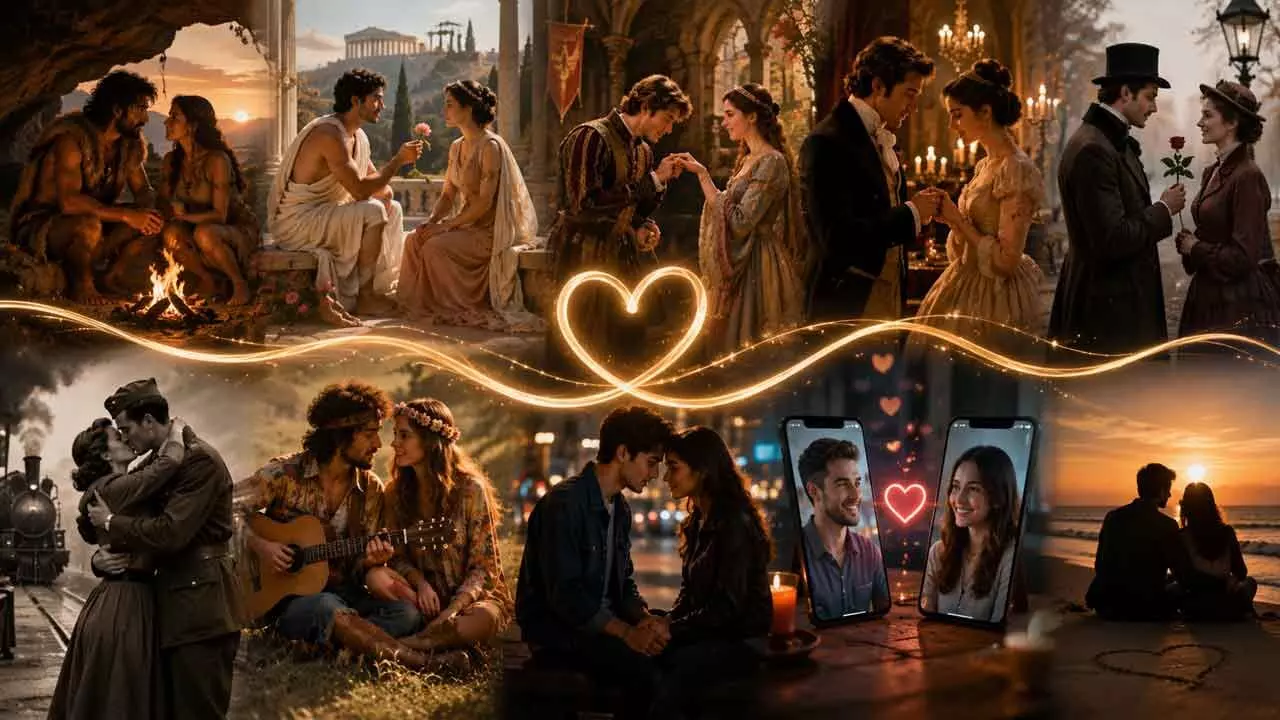
Love, romance and courtship are themes that have been the subjects of events described in mythologies, in fictional writings of great authors and in real life too.
There is, for instance, the story of Savitri and Satyavanta in Mahabharat, which stands out for its fierce devotion. Princess Savitri, known for her beauty and brilliant intellect, refuses to be married off in a traditional ‘swayamvara’ or an event arranged by the girl’s father where eligible suitors are invited to compete for the bride. Savitri, instead, travels the country on a golden chariot to find her equal. She falls in love with Satyavanta, an exiled Prince living as an ascetic in a forest. Even when the divine sage Narada prophesies that Satyavanta has only one year to live, Savitri stands by her choice, boldly stating that a person’s life can only be given once. When Yama, the God of Death, comes to take her husband’s soul, Savitri follows Yama and outsmarts him through her wisdom, winning Satyavanta’s life back.
Another such instance, which occurs in a classic Greek tale, represents the ultimate courtship of the soul. Psyche, a mortal woman so beautiful that she rivals Aphrodite, the Goddess of Beauty, is fated by an oracle to marry a monster. Instead, the invisible Eros, the Greek God of Love, the equivalent of the Roman God Cupid, falls in love with her and secretly marries her on the condition that she never looks upon his face. Tricked by her jealous sisters into lighting an oil lamp to see her husband, Psyche accidentally spills hot wax on the sleeping God, and he flees. To reunite with her divine lover, Psyche undergoes a series of seemingly impossible tasks set by Eros’s mother, Aphrodite. Proving her absolute determination and love, Psyche is granted immortality, and the two are wed on Mount Olympus.
One finds another example in the Shahnameh, a long epic poem written by the Persian poet Ferdowsi and the national epic of Iran. The legendary romance is often compared to Romeo and Juliet, though with a much happier ending. Zal, a warrior born with white hair and raised by the mythical Simurgh bird, falls in love with Princess Rudabeh of Kabul. Their courtship is complicated by politics and opposing lineages. In one of the most iconic scenes in Persian literature, Rudabeh lets down her exceptionally long, dark tresses from her tower to serve as a ladder for Zal to climb up and visit her. The union results in the birth of Rostam, Persia’s greatest mythological hero.
Laila and Majnu is a classic, tragic Arabian romance. It follows two young lovers, Laila and Qays. When Qays goes mad with obsessive love, he is dubbed “Majnu” (the madman). Separated by feuding families and forced into other marriages, their tale ultimately ends in heartbreak and death.
We have, in more recent times, the 1950s, the exciting and highly inspiring example of a courtship in real life, that of the firebrand freedom fighter and champion of the welfare of women, Durgabai and the quintessential and patriotic civil servant C D Deshmukh. Their courtship was a quiet, intellectual, and poetic romance that culminated in their marriage. Despite their differing backgrounds, hers in grassroots activism, his as a refined civil servant, their mutual respect grew into a unique proposal. After their paths crossed while both were working in New Delhi, Durgabai in the then Planning Commission and Deshmukh as the Union Finance Minister, their shared dedication to nation-building brought them close.
Durgabai candidly confessed to Deshmukh that she was ‘almost a rustic’ and feared she lacked the social graces for his world. In response, Deshmukh took her to a eucalyptus tree in his garden and inscribed two Sanskrit shlokas (verses) on its bark, formally proposing to her. She accepted, and he kissed her, beginning a partnership that lasted until her passing away.
The wedding itself was a remarkably frugal civil ceremony, with Prime Minister Jawaharlal Nehru serving as their first witness. Eschewing a honeymoon, the couple went straight back to work the very next day, Durgabai setting off for famine relief work in Pune, and Deshmukh returning to budget preparation. The legend of Farhad and Shirin is another immortal, tragic Persian love story that recounts the devotion of Farhad, a humble stonecutter, who falls deeply in love with the beautiful Armenian Princess Shirin. She is already caught in a complicated romance with King Khosrow of Persia. Unwilling to let a commoner vie for her affections, King Khosrow devises what he believes is an impossible task. He challenges Farhad to carve a massive tunnel through the treacherous Behistun Mountain. If Farhad succeeds, the King promises to give up his claim to Shirin.
Driven by unyielding devotion, Farhad labours day and night and successfully carves an impressive path through the rock. Terrified that Farhad would complete the task, the King sends an old woman to deliver false news to the stonecutter that Shirin has died of grief. Overcome with utter despair, Farhad takes his own life by throwing himself from the mountaintop. When Shirin learns of his tragic death, she rushes to his side and, out of profound sorrow, ends her life. The two are said to have been buried together in the unfinished canal. Faced with a cruel king and an impossible quest, their tale is one of passion and ultimate sacrifice. The story has inspired countless adaptations in Persian, Turkish, and Indian literature.
The story of Rukmini and Lord Krishna is one more celebrated Hindu epic of devotion and divine romance. Rukmini is the beautiful daughter of King Bhishmaka of Vidarbha. Although she longs to marry Krishna, having heard tales of his valour, her eldest brother Rukmi, a cruel ally to evil kings, is strictly against it. Instead, he arranges for her to marry the arrogant King Sisupala. Desperate, and defying her family’s plans, Rukmini sends a trusted Brahmin messenger with a heartfelt letter to Krishna in which she expresses her unyielding love and begs him to rescue her, leading to their dramatic elopement and subsequent marriage.
Talking of courtships reminds me of a joke I heard. A young man had been courting his girlfriend for over a couple of years. Finally, he took the courage of conviction in his hands and approached the girl’s father. He somehow managed to summon enough courage to say, “Sir, I have been courting your daughter for over two years now. “Okay. So what?”, said the irritated father, “What do you want, a pension?”!
(The writer was formerly Chief Secretary, Government of Andhra Pradesh)
Illegal arms & explosives network busted in Punjab, AK-47 assault rifle seized
Pilot project to build houses using 3D printing technology launched in Andhra
Centre hands over 3 lakh houses worth Rs 3,600 crore for rural poor in Andhra Pradesh
Pharma plant in Ukraine, owned by Indian group, hit in Russian drone attacks
Centre hands over 3 lakh houses worth Rs 3,600 crore for rural poor in Andhra Pradesh
DDA conducts month-long 'Swachhata Hi Seva' campaign at parks, sports complexes
'Rahul Gandhi has turned into a comedian': CM Dhami
100 per cent housing by 2029, says Andhra Pradesh CM Chandrababu Naidu
Kavitha urges PM Modi to save 60 lakh drought-hit farmers of Telangana
Congress Reduces Smit’s Valour to a Political ‘Event’


