






- Govt reveals what redrawn electoral map could look like
- Narasimha Reddy is new HMDA Commissioner
- Uttam backs Rahul Gandhi’s opposition to delimitation
- Sonia Gandhi's name figured in electoral rolls before acquiring citizenship: Delhi Police to court
- Mamata heads to Delhi to meet INDIA Bloc leaders ahead of LS session
- President Droupadi Murmu arrives in Mizoram on three-day visit
- Abhishek issues whip to Trinamool MPs as CM Adhikari seeks NCPI support for Delimitation Bill
- Rift in MVA: Maha Congress reminds Sharad Pawar of RS backing amid delimitation row
Ponnala Lakshmaiah still cherishes a 1991 conversation with Sonia Gandhi
In Short
One such experience in my political journey concerns my interactions with Smt. Sonia Gandhi in 1991, following the tragic assassination of former Prime Minister Sri Rajiv Gandhi.

Share :
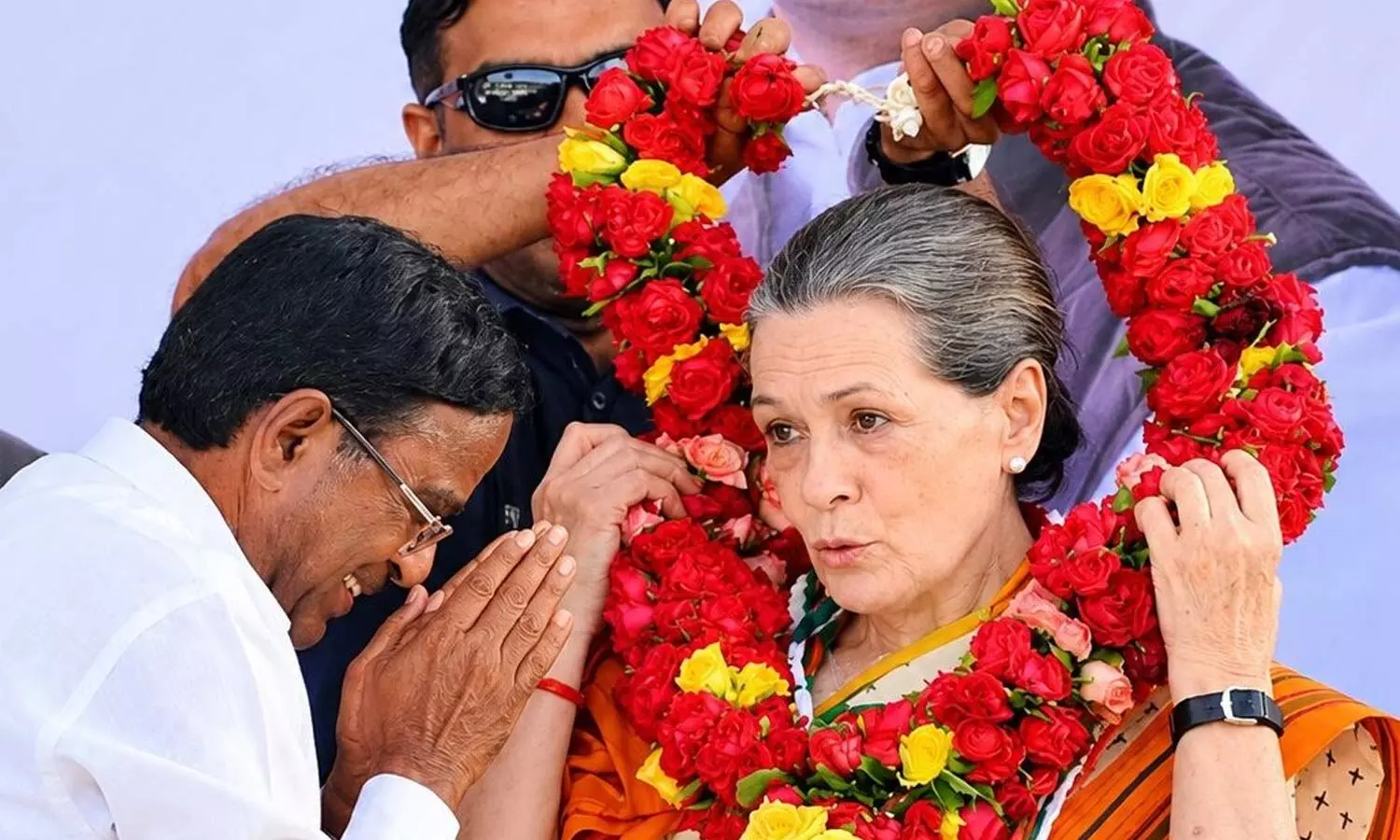
Ponnala Lakshmaiah still cherishes a 1991 conversation with Sonia Gandhi
Some moments in public life remain etched in one’s memory, not because of the positions one held, but because of the circumstances, convictions and conversations associated with them.
One such experience in my political journey concerns my interactions with Smt. Sonia Gandhi in 1991, following the tragic assassination of former Prime Minister Sri Rajiv Gandhi.
Rajiv Gandhi’s assassination and a personal memory
The assassination of Rajiv Gandhi on 21 May 1991 was a devastating moment for the nation and particularly for those of us associated with the Indian National Congress.
Our Member of Parliament Kamaluddin Ahmed, who represented the constituency during 1989–1994, enjoyed a close personal association with Rajiv Gandhi and his family.
It was because of this association that Kamaluddin and I had the rare and deeply emotional experience of sitting immediately behind Sonia Gandhi and her children at the cremation site of Rajiv Gandhi in New Delhi.
We were also among those who went around the mortal remains immediately after the family members had paid their respects. That solemn occasion remains an unforgettable memory in my public life.
The political situation after 1991
Following Rajiv Gandhi’s assassination, P V Narasimha Rao assumed the presidency of the Indian National Congress and subsequently became Prime Minister of India on 21 June 1991. It was a period of considerable political uncertainty and transition within the Congress Party.
I observed that several senior Congress leaders were hesitant to meet Sonia Gandhi. They had their own reasons that were best known to themselves.
My approach, however, was different. I believed that respect for the family of Rajiv Gandhi and support for the leadership of Narasimha Rao was not mutually exclusive.
My Association with P V Narasimha Rao
My political association with Rao went back several years. I had served as an in-charge for his parliamentary election campaigns in 1980 and 1984. I had also closely followed his political career, his administrative abilities and his commitment to reforms. His contribution to land reforms in Andhra Pradesh, his political experience and his understanding of national and international affairs had always impressed me.
After becoming a Cabinet Minister in the government of Chief Minister N Janardhana Reddy, I visited New Delhi to call on Rao. During the same visit, I decided to call on Sonia Gandhi at her residence, 10 Janpath, New Delhi.
My meeting with Sonia Gandhi at 10 Janpath
My meeting with Sonia Gandhi was cordial and memorable. During our conversation, I spoke about the political situation in the country, the Congress Party and Rao’s leadership. I expressed my appreciation of his reform-oriented approach and the economic liberalisation measures being initiated under his leadership. I also referred to his earlier contributions to land reforms and his considerable administrative experience.
Sonia Gandhi listened attentively. During the conversation, based on my assessment of the political circumstances and the future interests of the Congress Party, I urged Sonia Gandhi to consider becoming President of the Indian National Congress, in the larger interests of the party and the country.
She smiled and responded: “No, no. P V is okay.” I respected her response and took leave of her.
It was a brief exchange, but one that has remained in my memory all these decades. My suggestion was not an expression of opposition to Rao. On the contrary, I respected his leadership and supported his economic reforms.
I believed that Sonia Gandhi’s association with the Congress leadership could contribute to the party’s long-term unity and political strength.
Seven years later — Sonia becomes party President
In the years that followed, the Congress Party experienced several political changes. Sonia Gandhi formally entered active politics in 1997 and assumed the presidency of the Indian National Congress in March 1998, approximately seven years after our conversation at 10 Janpath. I naturally recalled the suggestion I had made to her in 1991.
What I had proposed during a personal conversation had, years later, become a political reality. I do not claim that my suggestion influenced her eventual decision. That decision was entirely her own, shaped by the political circumstances and developments within the Congress Party.
Nevertheless, I felt a sense of personal satisfaction that the leadership role I had suggested in 1991 was eventually undertaken by her.
She remembered our conversation
There is another aspect of this experience that I particularly cherish. Over the years, whenever I had an opportunity to meet her, I would occasionally remind her of my suggestion during our 1991 meeting. These interactions continued until the early 2020s.
Whenever I reminded her, she would smile and acknowledge that she remembered my request. Her response was always gracious and reassuring.
For me, this was a meaningful acknowledgment of a conversation that had taken place many years earlier, during a particularly difficult period in her personal life and in the history of the Congress Party.
The longest-serving Congress President
Sonia Gandhi subsequently went on to become the longest-serving President in the history of the Indian National Congress. The Congress Party, established in 1885, has a history extending over 140 years.
Against this long historical background, Sonia Gandhi’s tenure as party president stands out for its duration.
She served continuously from 1998 to 2017 and again from 2019 to 2022, amounting to approximately 22 years. Whatever one’s political assessment of different periods of Congress history, her extraordinary length of service as party president remains a significant historical fact.
My reflections
Looking back, I remember three distinct moments.
1. First, the deeply emotional experience of being present near Sonia Gandhi and her children during the last rites of Rajiv Gandhi in May 1991.
2. Second, my personal meeting with her at 10 Janpath, when I spoke appreciatively about P. V. Narasimha Rao’s leadership and suggested that she consider assuming the presidency of the Congress Party.
3. Third, her gracious acknowledgment, over the following decades, that she remembered my suggestion.
These memories are not about claiming credit for subsequent political developments. They are about the importance of independent judgment, personal conviction and the courage to express one’s views at the appropriate moment.
I have always believed that political leadership must be guided by the larger interests of the people, the party and the nation, rather than by considerations of personal advancement.
In 1991, my suggestion was based on my conviction. Seven years later, Sonia Gandhi became Congress President. In the decades that followed, she remembered our conversation.
For me, that remains a cherished personal memory and a meaningful chapter in my long political journey.
(The writer is a former minister of Andhra Pradesh)


