




- PM: Uri surgical strikes set bold example of counter-terror policy
- Bangladesh police seize bomb-making materials in Dhaka, arrest one
- Women's football team to make historic Kolkata debut with two friendlies against Russia
- Omar Abdullah welcomes tourists as Gulmarg gears up to hold national-level golf tournament
- India delivers medical supplies in Afghanistan, reaffirms humanitarian support
- Sanjay Gupta questions smoking posters of leading men in Bollywood: What about anti-smoking ads
- Nitin Nabin listens to ‘Mann Ki Baat’ with party workers at Biswa Bangla Convention Centre in Bengal
- Don’t just raise allegations, present facts: Bihar CM slams Opposition over SIR
The broken roster: On judicial transparency, power, and public trust
In Short
Examine the brewing controversy surrounding Supreme Court roster allocation, muted virtual hearings, and institutional transparency in a high-profile National Security Act detention case.

Share :
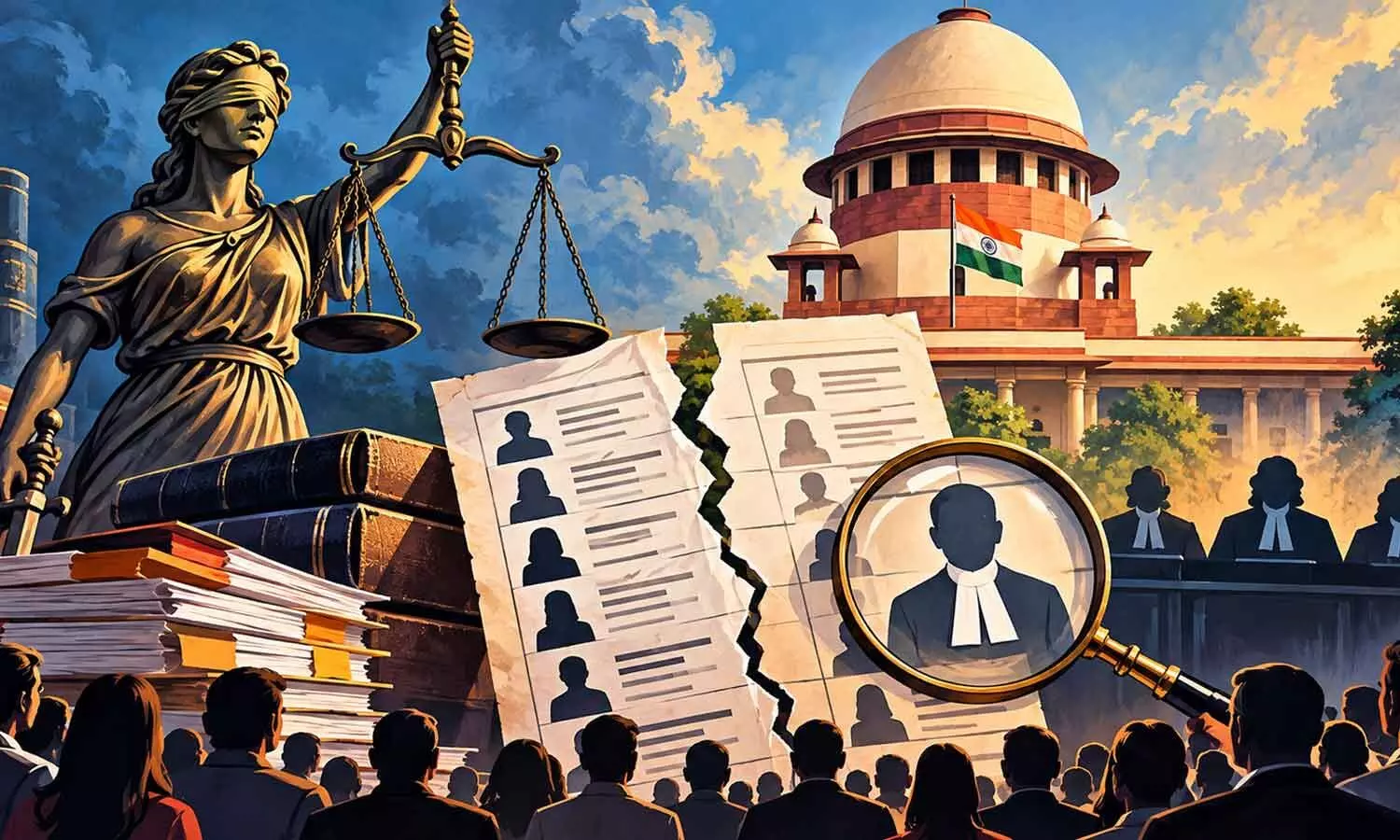
There is a quiet but seismic disturbance in the citadel of Indian justice. Not from dissenting judgments, not from dramatic reversals, but from an administrative anomaly so routine it should be invisible, yet so consequential it cannot be ignored. The Supreme Court’s recent listing of a fundamental rights case, one challenging the preventive detention of a student activist under the National Security Act (NSA), before a bench outside its designated roster has ignited a firestorm of concern, and rightly so.
The case filed by the Noida District Magistrate Medha Roopam (daughter of India’s Chief Election Commissioner Gyanesh Kumar) and the Uttar Pradesh government against the Allahabad High Court’s judgment quashing the NSA order, was heard on September 13 by a bench, comprising Justices Satish Chandra Sharma and N K Singh, neither of whom are part of the four senior-most benches traditionally assigned habeas corpus and preventive-detention matters. According to the Supreme Court’s July 13 roster, such cases were meant to be heard only by the CJI and the next three most senior judges. Yet this case was listed elsewhere. And worse, the audio of the hearing was muted, denying public access. This is not a minor procedural glitch. It is a constitutional alarm bell.
The roster is not just a schedule. It’s a shield:
The master of the Roster, the Chief Justice of India, holds immense power over judicial administration. This includes assignment of cases to benches, a function essential to maintain impartiality, consistency, and transparency. In a democracy where citizens rely on the judiciary as the final arbiter of liberty and law, the ‘process’ of justice is as vital as the ‘outcome’. When the process becomes opaque, the legitimacy of the entire institution erodes.
The Supreme Court’s own internal rules, updated in 2023, clearly designate the first four benches, led by the CJI and his three most senior colleagues, as the primary forums for matters involving preventive detention, habeas corpus, and other high-stakes civil liberties issues. These benches are expected to handle such cases with special care, given their sensitivity and precedent-setting potential. To deviate from this norm without explanation is not just administrative sloppiness. It is a breach of institutional discipline.
Why was this case assigned elsewhere?
The immediate question, raised with urgency by legal scholar Prashant Bhushan and echoed across the Bar, is simple. Who authorised this deviation?
Media reports that Justice Sharma’s roster allows for ‘special assignments’, a provision that exists, but only when justified. The Supreme Court’s internal guidelines do permit such exceptions, but they must be grounded for legitimate reasons. A conflict of interest, a pending matter in another court, or a need for expedited hearing. There is no indication that any such justification existed here.
Worse still, the case was not merely reassigned. It was heard by a bench already engaged in closely related matters concerning the 2025 Noida protests and detentions. One would expect continuity, not fragmentation. Here are some questions raised by the legal scholars: Why did the court not allow the same bench to hear the connected appeal? Was it a fear of bias? Or was it a decision made behind closed doors?
The muted hearing: A symptom of secrecy:
The silence that followed was deafening. The audio feed of the virtual hearing was muted, a rare move even during sensitive proceedings. Journalists, legal observers, and the public were left unable to verify what was said, who spoke, or how arguments unfolded. This is not standard practice. The Supreme Court has long upheld the principle of open hearing, especially in cases involving fundamental rights. The mute button, in this context, feels less like security and more like suppression, point out the legal scholars.
When the court refuses to let the public see or hear its deliberations on a matter of life and liberty, it signals that something is being hidden, not from national security concerns, but from accountability.
Beyond individual judges: The system is at stake:
Critics have been quick to defend individual judges. Justice Sharma, while junior, is a respected jurist. But the issue is not about personal integrity. It is about structural opacity. The real danger lies in the unchecked discretion of the master of the Roster, a role that is unreviewable, unaccountable, and now, seemingly, unexplained.
If a bench can be specially assigned to a case outside the roster without notice, without reasoning, without public record, then the entire system of equitable case allocation collapses. It opens the doors to political influence, favoritism, and manipulation, not through bribery, but through bureaucratic convenience.
Imagine a scenario where a case involving a powerful corporation, a political figure, or a controversial protest is quietly moved to a bench perceived as sympathetic. No media report. No public scrutiny. No transcript. The verdict could be delivered. And the world would never know how or why.
CJI must speak. Not for defense, but for trust:
The public does not demand perfection. It demands transparency. It demands that the system be fair, consistent, and visible. CJI Surya Kant, as the guardian of the roster, must answer the questions being raised by scholars, publicly, clearly, and without evasion.
Why was this case assigned to a bench outside the designated roster? What was the administrative or judicial rationale? Why was the audio muted? Were there any conflicts of interest? Was the bench handling connected cases bypassed intentionally?
These are not rhetorical questions. They are constitutional imperatives:
And these questions are not being raised for the first time in India. On 12 January 2018, four of the Supreme Court’s senior-most judges, Justices J Chelameswar, Ranjan Gogoi, Madan B Lokur and Kurian Joseph, held an unprecedented press conference to allege that the then Chief Justice of India, Dipak Misra, was misusing his administrative power as the ‘Master of the Roster’ by selectively assigning sensitive and important cases to benches of his choice, often comprising junior or preferred judges, without consulting the senior-most judges or following any transparent, rational basis.
They accused the CJI of ‘bench-shopping’, withdrawing matters from certain judges without notice, and unilaterally drawing up the roster. They warned that such practices endangered judicial independence and the integrity of the institution. While the episode led to some cosmetic changes like publishing the roster, the core power to constitute benches and allocate cases remains with the CJI, and many of the structural concerns raised in 2018 continue to be debated.
Justice must be seen, even when it’s unpopular:
The Supreme Court stands at the apex of Indian democracy. Its authority rests not just on its rulings, but on the belief that those rulings are reached fairly, openly, and without favour. When the mechanism of case allocation becomes arbitrary, the people lose faith. Not in one judge, but in the entire judiciary.
People are not asking for a new law. They are asking for a simple act of honesty. An explanation from the CJI, detailing the assignment of this case. Let the public see the logic, not just the outcome. In a country where citizens face state power daily, the right to a fair trial is not a luxury. It is a lifeline. And that lifeline depends on a system that is transparent, predictable, and above suspicion.
(The writer is with the Cholleti BlackRobe Chambers Hyderabad and writes on economy, politics and law)
Noise, Questions and the Missing Answers
Govt is taking steps to address land issues: Minister Ponguleti Srinivasa Reddy
Rains subside in Chinturu Agency, flood relief underway
Karur Stampede Anniversary: CM Vijay Remembers 41 Victims, Says Pain Has Not Faded
Godavari breaches 40-feet mark at Bhadrachalam
Students From LPU Vandalise Campus After Unverified Gang-Rape, Suicide Rumours; Police Deny Claims


