




UPI charges: Who should pay, and what is the alternative?
In Short
A progressive structure based on transaction value and the capacity of businesses to pay could be more appropriate than a uniform charge. Willingness to pay must be taken note of. The revenue collected should be transparently linked to the costs of maintaining payment infrastructure, strengthening cybersecurity, preventing fraud and supporting technological innovation. Since UPI providers already operate within the tax system, any additional taxation should be carefully assessed rather than simply being added to transaction costs.

Share :
UPI charges: Who should pay, and what is the alternative?
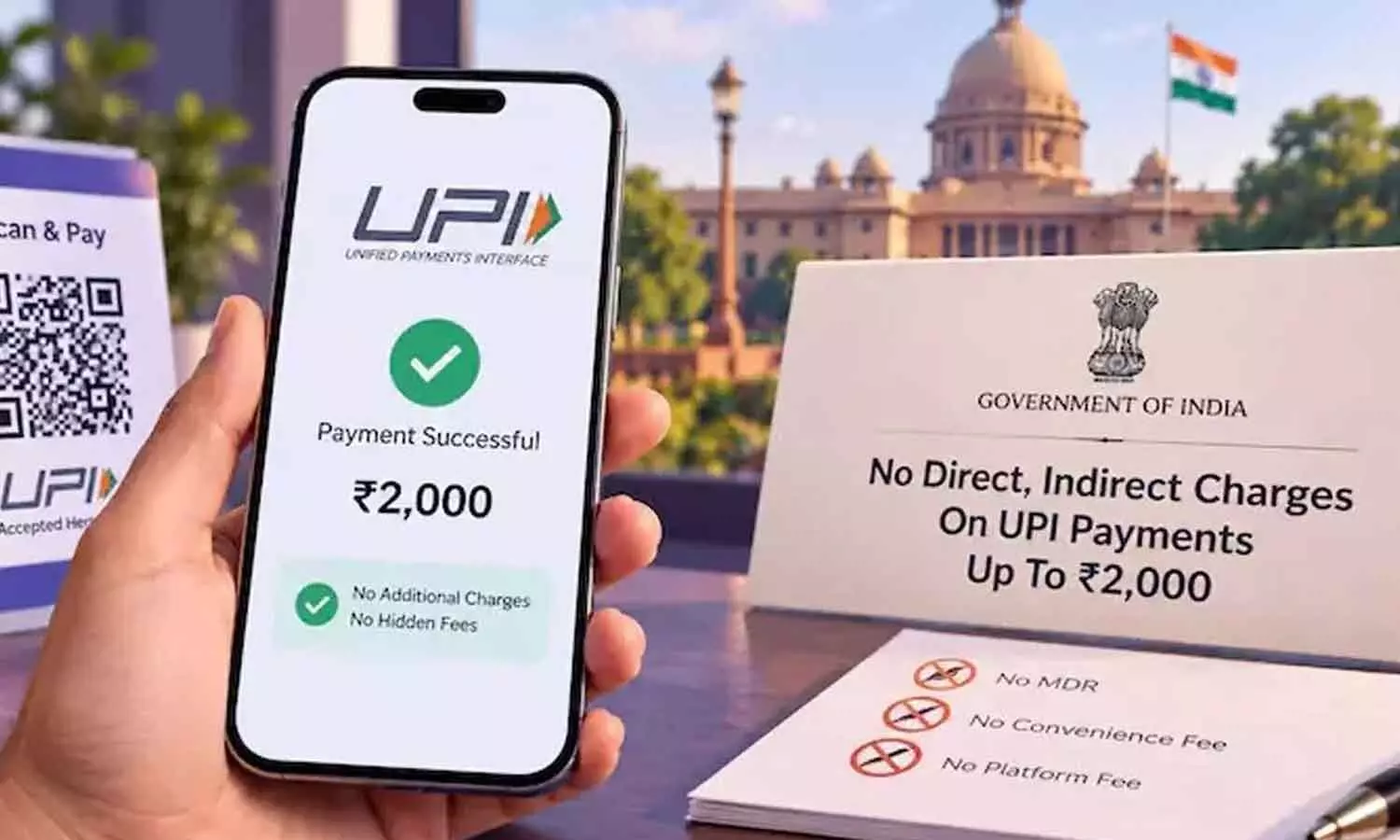
India’s Unified Payments Interface (UPI) has transformed the country’s payment system, becoming an essential digital infrastructure for consumers, small merchants, businesses and public institutions. In 2025-26, it processed about 24,162 crore transactions worth ₹314.23 lakh crore, with more than 55 crore users, including from metropolitan cities, small towns and villages. The proposed 0.4 per cent charge on transactions above ₹2,000 from October 15 has raised concerns among consumers and merchants.
Reports of some businesses discouraging high-value UPI payments or considering passing the cost to customers have revived a crucial question: how can India keep UPI affordable and inclusive while ensuring its long-term financial sustainability?
Why introduce charges?
For users, UPI payments appear almost costless, but behind every instant transaction lies spending on servers, cybersecurity, fraud prevention, customer support and technology. The zero-MDR model has helped UPI expand rapidly, while government incentives have supported low-value digital payments. However, as the system grows, its long-term financial sustainability needs attention.
Should taxpayers continue to bear the entire cost, or should those benefiting most from large commercial transactions contribute to the infrastructure? A limited, carefully designed charge on high-value transactions could help, but the crucial questions are who should pay, how much, and who will ultimately bear the burden.
Is UPI a public good?
In strict economic sense, UPI may not be pure public good per se because payment processing requires infrastructure, technology and resources that have costs. In principle, therefore, a price can be attached to its use. Yet UPI has many characteristics of digital public infrastructure. UPI need not be treated as an entirely free service for every type of transaction merely because it has public-infrastructure characteristics.
At the same time, pricing it like any other commercial service could undermine some of its wider social benefits. A reasonable approach would therefore be to preserve free or very low-cost access for small-value transactions, while allowing large commercial transactions to contribute a modest share of the cost of maintaining the system.
Willingness to pay and the ability to pay:
Two familiar economic principles can bring greater clarity to the UPI debate: the willingness to pay and the ability to pay.
Willingness to pay refers to the value a user attaches to a service. A big retailer handling thousands of high-value transactions every day receives significant benefits from UPI. Faster settlement, convenience, reduced cash-handling requirements, improved records and lower operational risks all have economic value. Such businesses may therefore have a greater willingness to contribute towards payment infrastructure. Ability to pay is different. It refers to whether an individual or organisation can bear a cost without facing excessive financial pressure.
A street vendor making modest transactions cannot necessarily be treated in the same way as a large retailer processing substantial amounts every day. This is why a uniform charge on every transaction would be difficult to justify. A threshold-based or progressive approach, protecting small-value transactions while charging mainly larger commercial transactions, could better balance efficiency with fairness.
Who eventually bears the burden?
This is perhaps the most important economic question. The party legally responsible for paying a charge is not necessarily the party that ultimately bears its economic burden. A merchant may absorb the cost. Alternatively, the merchant may increase prices, reduce other expenses, encourage customers to use cash or cards, or negotiate with banks and payment service providers. In competitive markets, the final incidence will depend on the relative bargaining power of merchants, consumers, banks and payment platforms.
The present policy approach protects consumers from directly paying UPI transaction charges, particularly for small-value payments. But indirect effects cannot be ruled out. If merchants face higher payment-processing costs and pass part of those costs into the prices of goods and services, households could eventually experience a small reduction in purchasing power.
Impact on govt revenue:
MDR should not be confused with a government tax. It is essentially a payment-system charge that can be distributed among different participants in the digital payment ecosystem. The government could nevertheless benefit indirectly. If payment-related services attract GST where applicable, additional tax revenue could also rise. More importantly, if payment-system participants generate sufficient revenue to finance a greater share of infrastructure, cybersecurity and technological improvements, the government may eventually need to provide fewer financial incentives.
Thus, the government could potentially gain through both additional tax revenue and reduced dependence on subsidies. But increasing government revenue should not be the primary purpose of MDR. Its central objective should be to create a financially sustainable payment ecosystem without weakening access to digital payments.
UPI revenue and consumer interests:
UPI participants need sustainable revenue to support cybersecurity, fraud prevention, infrastructure and innovation. Reasonable charges could reduce dependence on government support, but excessive fees may burden small merchants, raise consumer prices and encourage cash use. Therefore, charges should reflect service costs and value, with safeguards to protect UPI’s accessibility.
What is the ground-level experience?
UPI has fundamentally changed the way we handle everyday payments. Surveys on the issue suggest that 57 per cent of users prefer UPI to cash, while about 65 per cent make at least one UPI payment every day. Around 59 per cent report making fewer cash payments since adopting UPI, while 62 per cent say they visit ATMs less frequently. The merchant response will therefore matter.
If businesses pass charges directly to customers or refuse UPI for higher-value transactions, some consumers may carry more cash or use ATMs more frequently. For a country that has invested heavily in moving towards a less-cash economy, this would be an unintended consequence worth avoiding. The objective should not be simply to maximise revenue from digital transactions. It should be to preserve the convenience and trust that brought millions of people into the digital payment system in the first place.
A better alternative:
India’s digital-payment revolution has been built on affordability, accessibility and network effects. Any new pricing model must preserve these foundations while gradually ensuring that the infrastructure can meet its own costs. Person-to-person payments and small-value transactions should ideally remain free. Larger commercial transactions could, where appropriate, bear a modest MDR. Small businesses and essential services could receive exemptions. A progressive structure based on transaction value and the capacity of businesses to pay could be more appropriate than a uniform charge.
Willingness to pay must be taken note of. The revenue collected should be transparently linked to the costs of maintaining payment infrastructure, strengthening cybersecurity, preventing fraud and supporting technological innovation. Since UPI providers already operate within the tax system, any additional taxation should be carefully assessed rather than simply being added to transaction costs.
Conclusion:
The real measure of success should not be how much revenue MDR generates. It should be whether UPI remains affordable for ordinary people, viable for small businesses, reliable for large enterprises and financially sustainable for the ecosystem that supports it.
Willingness and the ability to pay should be the guiding principle. India’s digital payment revolution has been built on trust and convenience. Any reform should strengthen those foundations rather than inadvertently driving people back towards cash.
(Prof Ramakrishna Gollagari is a retired Professor from Osmania University; Prof (Dr) M Ramulu is Head of Department, (Economics) University College of Arts and Social Sciences, OU)


