




Wars and turmoil in Europe adding to global economic uncertainty
In Short
An expert analysis on how growing social unrest and economic stagnation in Europe could disrupt global supply chains, financial stability, and Indian exports.

Share :
Wars and turmoil in Europe adding to global economic uncertainty
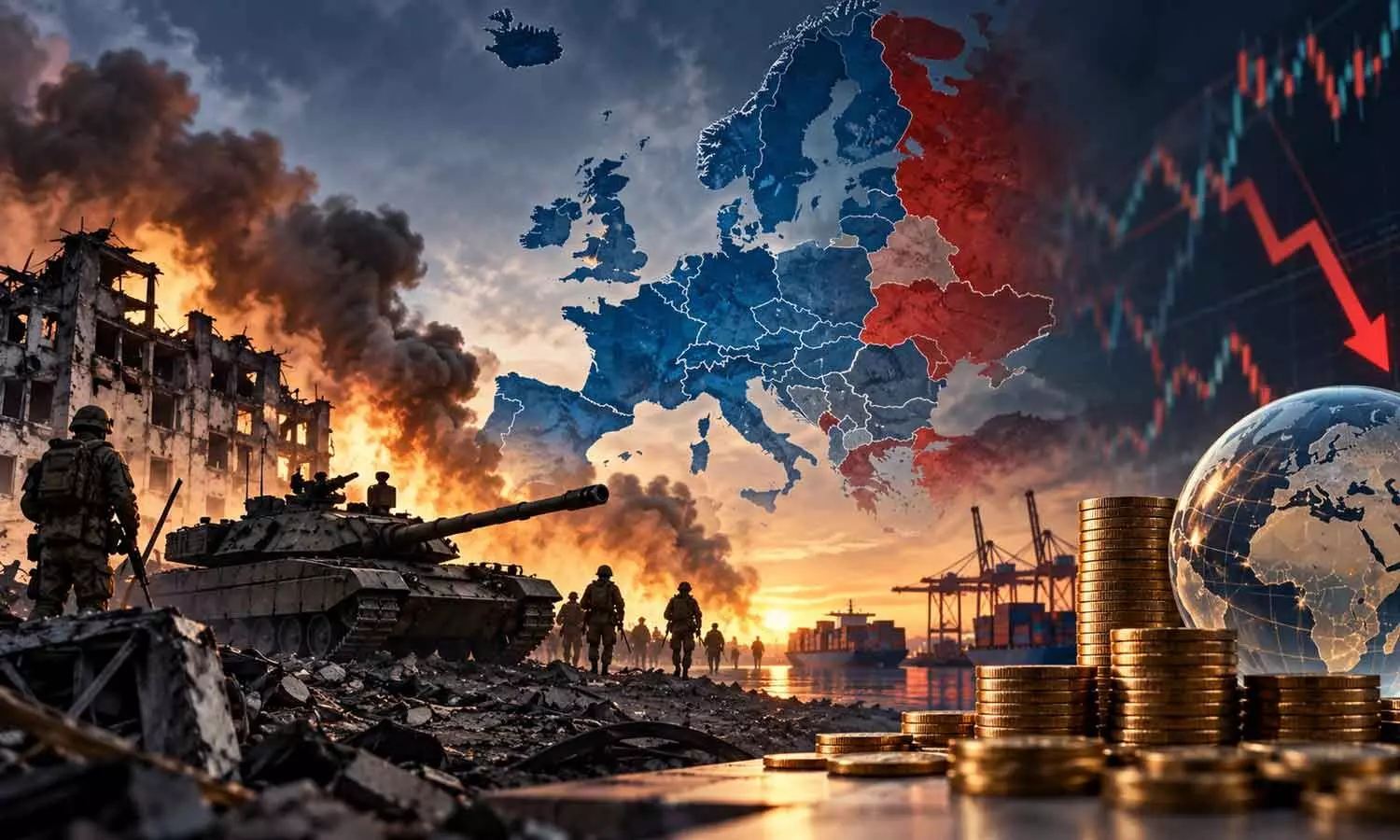
The global economy is already under severe strain from the Russia–Ukraine war and the West Asian crisis. Growing unrest across Europe adds uncertainty, threatening economic growth, trade, investment and financial stability. Europe, long associated with political stability and prosperity, faces social unrest, political polarisation and security concerns.
France has witnessed protests over pension reforms, immigration, policing and living costs. Similar tensions in Germany, the United Kingdom, Italy and Belgium reflect economic pressures, migration policies, political extremism and declining institutional trust. The Russia–Ukraine conflict has increased defence spending and complicated energy and trade relations.
Clashes in Italian cities and protests over fuel prices, public services and housing in Spain, Portugal and Belgium highlight widespread dissatisfaction. Although most demonstrations remain peaceful, looting, arson and police confrontations threaten public safety and business activity. Prolonged instability could weaken consumer confidence, delay investment, disrupt supply chains and increase financial market volatility, worsening Europe’s economic challenges and affecting the global economy.
Europe has long been a pillar of the global economy, driven by industrial strength, technological innovation, skilled workers, advanced infrastructure and financial institutions. Since the Industrial Revolution, European nations have shaped global manufacturing, trade, transport and banking. The European Union (EU), comprising 27 member states, operates one of the world’s largest single markets, while the euro is the second-most important international currency after the US dollar.
Europe hosts major automotive, aerospace, pharmaceutical, machinery, luxury-goods and renewable-energy industries. Germany leads manufacturing, France has diversified economic sectors, and the Netherlands serves as a major trade and logistics hub.
However, Europe faces slow productivity growth, ageing populations, high public debt, geopolitical conflicts and competition from the United States and China. EU GDP reached €18.8 trillion in 2025, while the International Monetary Fund (IMF) projected euro-area growth of 1.1 per cent in 2026.
Rising living costs, fuel prices, housing unaffordability and inadequate public services have fuelled protests across several countries, sometimes escalating into violence. These developments highlight growing insecurity over employment, purchasing power and future opportunities despite Europe’s global economic influence.
Possible economic consequences at the global level:
Unrest across Europe could have global economic consequences if protests, strikes and political instability persist. As of this month, demonstrations in France, Belgium, Italy and Portugal reflect concerns over living costs, housing and public services. The IMF projects 2026 growth of 1.1 per cent in the euro area, 1.4 per cent in the EU and 3.1 per cent worldwide.
Prolonged instability could delay business investment, weaken employment and productivity, and disrupt transport, ports and manufacturing, increasing logistics and insurance costs. Reuters reported that France’s 10-year government bond yield reached 4.9 per cent on October 19, while its Customer Acquisition Cost (CAC) 40 index fell 1.5 per cent.
Rising borrowing costs could constrain public spending on essential services and infrastructure. Meanwhile, euro depreciation and financial-market volatility could affect European exports, imported energy and global commodity prices. Prolonged European instability could reduce demand for imported goods, machinery, automobiles, pharmaceuticals and IT services, affecting exporters across Asia and beyond.
Supply-chain disruptions may hinder global automotive, aerospace, chemical and industrial equipment production. Increased security and defence spending could intensify fiscal pressures while benefiting selected industries. If unrest coincides with geopolitical conflicts or energy supply disruptions, rising oil and gas prices could increase global transport, electricity and manufacturing costs.
However, these effects depend on the duration and severity of unrest; peaceful demonstrations would have considerably smaller economic consequences. The EU is a major trading and investment partner for India, with bilateral goods trade reaching €118 billion and services trade exceeding €67 billion in 2025.
Prolonged European unrest could reduce demand for Indian textiles, pharmaceuticals, engineering goods, chemicals and IT services, while delaying payments, investments, technology partnerships and job creation. T
he EU’s foreign direct investment stock in India reached €132.8 billion in 2024. Financial volatility and a weaker euro could further affect Indian exports, equities and capital flows. However, supply-chain diversification could create opportunities for India in manufacturing, digital services and renewable energy.
India should diversify export markets, strengthen domestic demand, improve supply-chain resilience and deepen international trade cooperation. Ultimately, prolonged violence, weak growth and political polarisation could transform Europe’s social crisis into a wider global economic setback.
Need for new measures:
Addressing unrest in Europe requires economic relief, democratic dialogue, accountable governance and international cooperation rather than policing alone. Governments should support low-income households facing rising living costs, expand affordable housing and regulate speculation. EU house prices rose approximately 60 per cent between 2013 and 2024, while rents increased by around 20 per cent.
Quality employment, vocational training, apprenticeships and reskilling can improve job security. Dialogue among workers, employers, trade unions and policymakers should resolve disputes over wages, pensions and public services. Governments must protect peaceful protests, ensure proportionate policing and investigate misconduct independently.
Transparent fiscal policies, anti-corruption measures, better healthcare, education, migrant integration and renewable energy development can reduce inequality and rebuild public trust. The EU should coordinate social assistance, employment programmes and infrastructure investment, prioritising vulnerable regions.
Internationally, cooperation with the World Trade Organization (WTO), India and other partners can preserve predictable, rules-based trade, resolve disputes peacefully and prevent protectionism. Such measures can reduce supply-chain disruptions and investment uncertainty, protecting global economic stability and India’s export-dependent economy.
(The writer is a professor at School of Commerce and Management, Mohan Babu University)


