




What if man becomes a ‘man-God’?
In Short
For much of human history, the goal was not to physically become god-like, but to inwardly ‘unite’ with the divine through spiritual sadhana and catharsis of consciousness.

Share :
What if man becomes a ‘man-God’?
There is mounting evidence that twenty-first-century humanity is approaching the proverbial Lakshman Rekha—a forbidden boundary that permanently alters what it means to be human. For millennia becoming a ‘god’ was a mystical pursuit of spiritual perfection; it was an effort to become what Sri Aurobindo called a Gnostic being.
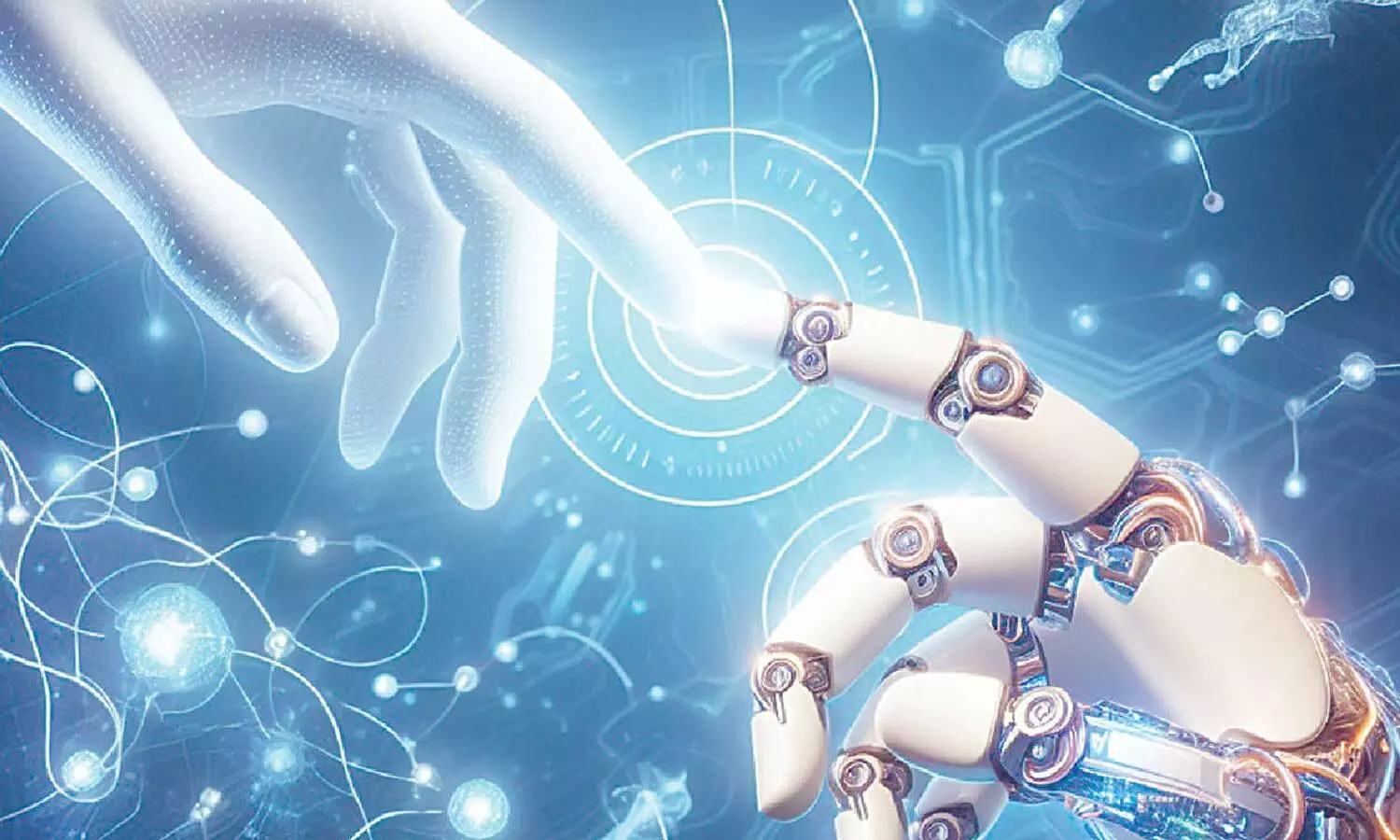
Empowered by the Promethean power of technology, man—having already become a geological force—is now aiming to become a god-like organic being, whom historian Yuval Noah Harari calls Homo Deus. Although some might question the use of the word ‘Deus’, it is this that brought this highly diffused but most foundational project to public notice. It is tantamount to nothing short of a mechanical modification of the human operating system, blurring the boundaries between man and god, biology and technology. Today, we already possess the preliminary ability to design babies, practically extend youth, and hypothetically bring the almost-dead back to life through cryonics.
There have always been two contrasting schools of thought regarding this evolutionary leap. The first argues that there is nothing inherently wrong with this transition, viewing it as a natural part of man ‘finishing’ or completing himself, whether the chosen means are scientific or spiritual. The counterview cautions that meddling with our fundamental biology and trying to redesign human nature will trigger unforeseeable, apocalyptic consequences.
Thinkers like Martin Hägglund argue that it is life’s fragility and finitude that makes existence worth living. Others posit that the ultimate issue is not how much we enhance our capabilities, but whether we possess the collective wisdom to use that power safely.
For much of human history, the goal was not to physically become god-like, but to inwardly ‘unite’ with the divine through spiritual sadhana and catharsis of consciousness. In Vedantic philosophy, the objective was not to transform into something new, but to remove the egoic obstacles that stand in the way of realizing a foundational truth: everyone and everything in creation is nothing but the authentic, absolute Reality. As the Brihadaranyaka Upanishad declares: Aham Brahmasmi—atman, the individual self, is the same as the Paramatma (Brahman). Understood properly, it is the highest as well as humbling level of human thought.
The great Adi Shankara applied the Upanishadic technique of neti, neti (“not this, not this”) to strip away all temporary and mutable layers of existence, recognizing that any attempt at positive identification necessarily limits the limitless. In his Nirvana Shatakam, he wrote: “Mano Buddhi Ahankara Chittani Naham,” which broadly translates to, “I am not the mind, the intellect, the ego, nor the memory.” What modern man is doing is the exact opposite of what Adi Shankara taught. We are hyper-identifying the very things he sought to de-identify—the ego, the mind, and the physical body—in a desperate bid to acquire godly power.
We must pay heed to another dimension. A massive portion of this project is dedicated to making the human body impregnable to the biological imperatives of ageing, sickness, and death, bankrolled by billionaires with a personal stake. There is nothing intrinsically wrong with wanting to alleviate physical suffering in any form; indeed, the example Buddha legitimizes this aspiration. It was factually the jolting ‘sighting’ of sickness, old age, and death—characterized by Edwin Arnold as “the vastness of the agony of earth”—that moved the sheltered Siddhartha to renounce his royalty. He went wandering into the world and ended up finding not a physical cure for any of the three but founding a great ‘religion’.
What is being prophesied today, however, is far more ambitious: an intent to replicate, manipulate, or disturb the many-splendored, almost mystical niche of the divine within the human psyche. As Yuval Noah Harari explains: “This cosmic data-processing system would be like God. It will be everywhere and will control everything, and humans are destined to merge into it.”
Left entirely to market forces, the man-god project will inevitably split humanity into two distinct species: an enhanced post-human elite (Homo Deus) and an unenhanced majority, separated solely by access and affordability. Selective enhancements of body parts, or what Harari calls ‘bio-technological upgrades,’ may emerge as the next frontier of human superiority. A tiny fraction of humanity already exerts extraordinary influence over the world. It is highly likely that they will become the first literal man-gods of the foreseeable future, showing off augmented biology to demonstrate that they are indeed, like Steinbeck’s Gatsby fancied himself, fundamentally “different” from the rest of us.
With his present state of consciousness, man cannot be trusted with his own capabilities, be it Artificial General Intelligence (AGI) or, even more dangerously, the man-god project. Sri Aurobindo himself warned that to build a truly perfect world or wield god-like power safely, mankind must transition from the regular mental state to what he termed the ‘Supramental consciousness.’
That evolutionary leap becomes possible only if we can cleanse or contain the dark drives—the internal enemies—that currently dominate our consciousness. These destructive impulses are recognized across major global traditions by various names such as Hinduism’s Arishadvargas and Christianity’s Seven Deadly Sins.
Conquering them is possible only when we become fully conscious of our inward, perennial struggle—the war within. The two opposing forces in this internal ‘Kurukshetra’ are these internal enemies, or the material side, and what Charles Dickens called our “better angels”, or the spiritual side. Both sides are necessary to the holistic human condition. Which side prevails depends on how we feed them through our daily choices. Currently, our internal enemies dominate.
The good news is that while this ‘war’ was for long confined to scriptural and spiritual domains, it is now receiving contemporary scholarly attention. Philosopher David Pearce frames the “war within” as a technical, biological problem that humanity has a moral obligation to solve. Pearce argues that for as long as our brain architecture relies on ‘psychological deficits’, humanity will remain trapped in suffering. He envisions a future where biotechnology can phase out our biological reliance on these destructive drives. If we achieve this psychological shift, the tools of this project could be used to enable the blind to see, the deaf to hear, the paralyzed to walk, and damaged organs to function.
Another contemporary hot-button issue—the future of AI—has a huge bearing on this project. If biotechnology provides the body and bionics provide the limbs of Homo Deus, AI provides its mind—its cognitive engine and central nervous system. In all this debate, what is missed out is that merely retaining ‘human control’ is no safeguard unless the ‘controller’—consciousness—is of the right kind.
If the disposition and coordinates of this project remain unchanged, two fictional scenarios loom large. The first is a technologically sophisticated version of Aldous Huxley’s Brave New World: a biologically stratified, psychologically conditioned, materially mollified, and spiritually comatose humanity. The second is Mary Shelley’s Frankenstein. Tellingly, Victor Frankenstein’s motive was identical to that of this venture: to transcend the “ideal bounds” of life and death and become the creator of a new species. His tragic end should serve as a stark wake-up call.
That ‘call’ translates into a humbling question: has man grown too big for his boots? Has he come to exercise what Rudyard Kipling famously described as ‘harlot-like power without responsibility’? As an Anthropogenic force and with the delusion of rendering divinity directly redundant, he can do catastrophic harm. That being the case, is human existence on earth any longer worthy of survival, paraphrasing Admiral Adama of Battlestar Galactica? Or, more darkly, is the world better off with a ruthlessly rational ‘man-god’ than with a modern man with a warped mindset?
The main message of this probably the most audacious human venture is this: whether it is AI or man-god, they could domore harm than good unless we induce a change in consciousness by ‘winning’ the war within.


