




Choosing M,Tech specialisation: Look beyond the next big trend
In Short
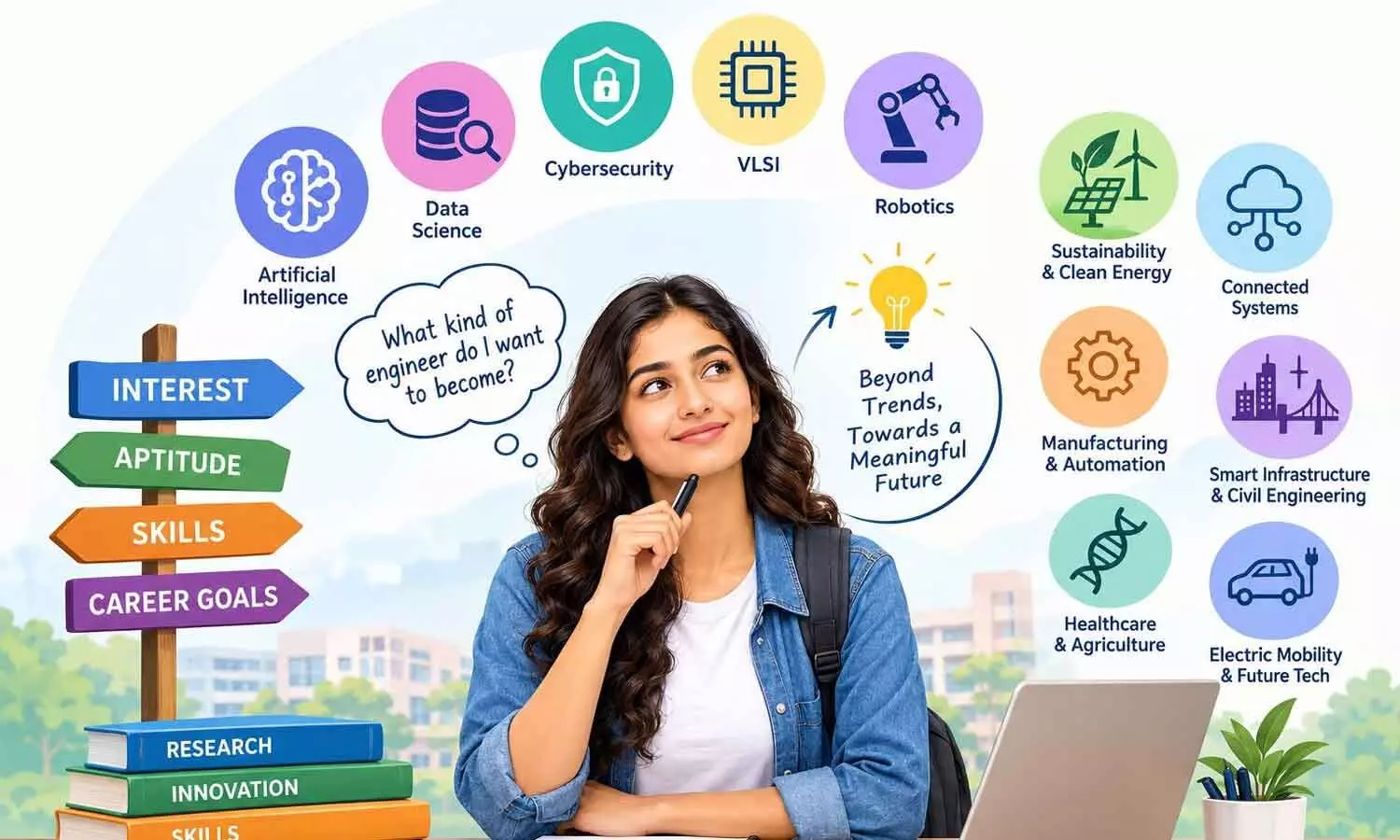
A more useful question is: What kind of engineer do I want to become, and which specialisation can help me develop that capability?

Share :
Choosing M,Tech specialisation: Look beyond the next big trend
Artificial Intelligence, Data Science, Cybersecurity, VLSI and Robotics often dominate these conversations. While understanding industry demand is important, choosing a postgraduate specialisation solely because it is currently popular can be limiting. Technology changes quickly, and the skills in demand today may evolve significantly by the time a student completes an M.Tech.
A more useful question is: What kind of engineer do I want to become, and which specialisation can help me develop that capability?
An M.Tech is more than an additional qualification. It can provide an opportunity to develop deeper technical knowledge, work on complex problems, undertake research and build expertise in a chosen area. The decision, therefore, deserves consideration beyond placement figures and technology trends.
Start with interest, but assess aptitude
Genuine interest is an important starting point. Students can reflect on the subjects, projects and engineering problems that held their attention during undergraduate study.
However, interest needs to be considered alongside aptitude. A student may be interested in Artificial Intelligence but may not enjoy mathematics, statistics or programming. Another student may discover a stronger inclination towards circuit design, electronics or hardware systems. Others may find greater satisfaction in areas such as manufacturing, structures, energy or materials. The right specialisation often lies at the intersection of interest, ability and willingness to develop expertise over time.
Academic performance, project work, laboratory experience and conversations with faculty members, alumni and industry professionals can help students assess where their strengths and interests align.
Engineering disciplines are increasingly connected
Another factor students should consider is the changing relationship between engineering disciplines. The boundaries between computer science, electronics, mechanical, civil and other branches are becoming increasingly interconnected.
AI and machine learning are being applied across healthcare, manufacturing, agriculture, robotics, finance and infrastructure. The growth of connected devices is linking physical systems with digital platforms, while automation is changing processes across manufacturing and logistics.
Developments in the semiconductor sector have also increased attention towards VLSI, chip design, embedded systems and electronic system design. Cybersecurity is becoming relevant across cloud platforms, connected devices and digital services.
At the same time, sustainability is creating engineering applications in renewable energy, electric mobility, smart grids, energy-efficient buildings, sustainable materials and climate-resilient infrastructure.
This makes interdisciplinary capability increasingly relevant. A mechanical engineer with knowledge of robotics and data analytics, for instance, may work across traditional and emerging applications. Similarly, civil engineers can combine their core knowledge with areas such as GIS, digital twins and smart infrastructure.
The question should therefore extend beyond “Which technology is trending?” to “Which emerging technologies can complement my core engineering knowledge?”
Look beyond the degree title
The name of an M.Tech programme does not tell the entire story. Students should examine the curriculum, faculty expertise, laboratories, research opportunities, industry projects, internships and interdisciplinary work available through a programme.
Postgraduate education also needs to develop the ability to work with real-world problems. Research, experimentation, simulation, computational tools and project-based learning can help students connect theoretical knowledge with practical applications. The growing use of generative AI offers an example. AI tools can assist with coding, documentation and analysis, but engineers still need to understand fundamentals, define problems correctly, verify outputs and make informed technical decisions.
Treat industry demand as a signal
Placement figures and hiring trends can provide useful information, but they should not be the sole basis for choosing a specialisation. Technology markets change with economic conditions, automation and new developments. A field experiencing strong hiring today may look different several years later.
Transferable capabilities can provide a stronger foundation. Analytical thinking, problem-solving, mathematical reasoning, research skills, systems thinking, technical communication and the ability to learn new technologies can remain useful across changing professional environments.
Choose a trajectory, not a trend
There is no single M.Tech specialisation that is suitable for every engineering graduate. The choice depends on individual interests, aptitude, career goals, academic foundation and willingness to continue learning.
Students interested in research may prioritise theoretical depth, laboratories and faculty-led projects. Those planning industry careers may look more closely at internships, application-oriented courses and industry exposure. Students interested in entrepreneurship may benefit from interdisciplinary programmes and opportunities to develop technical ideas into practical solutions. The decision can begin with a few simple questions: What do I enjoy learning? What am I good at? Which engineering problems interest me? How is my discipline changing? Which emerging technologies complement my strengths? And what options will this specialisation leave open in the future?
(The author is Professor of Computer Science & Head, Centre for Global Learning Programs, JKLU)


