






- Tourism development proposals submitted
- Twin blast threat puts Hyderabad police on high alert
- Midnight downpour floods Hyderabad roads
- Fire breaks out at GHMC Zonal Office in Khairatabad
- Bhatti seeks Rs 25,096 crore for Telangana power sector upgrade
- Government unveils Rs 10,000 cr drought mitigation plan
- Tunnel-14 breakthrough boosts Rishikesh-Karanprayag rail link
- HYDRAA gives STPs one-month deadline
EFLU and British council conclude international symposium on English education
In Short
EFLU and the British Council brought together education experts, researchers and teachers for a two-day international symposium in Hyderabad. The discussions focused on connecting research with classroom practice, strengthening teacher development, promoting multilingual learning and exploring the responsible use of technology to improve English language education.

Share :
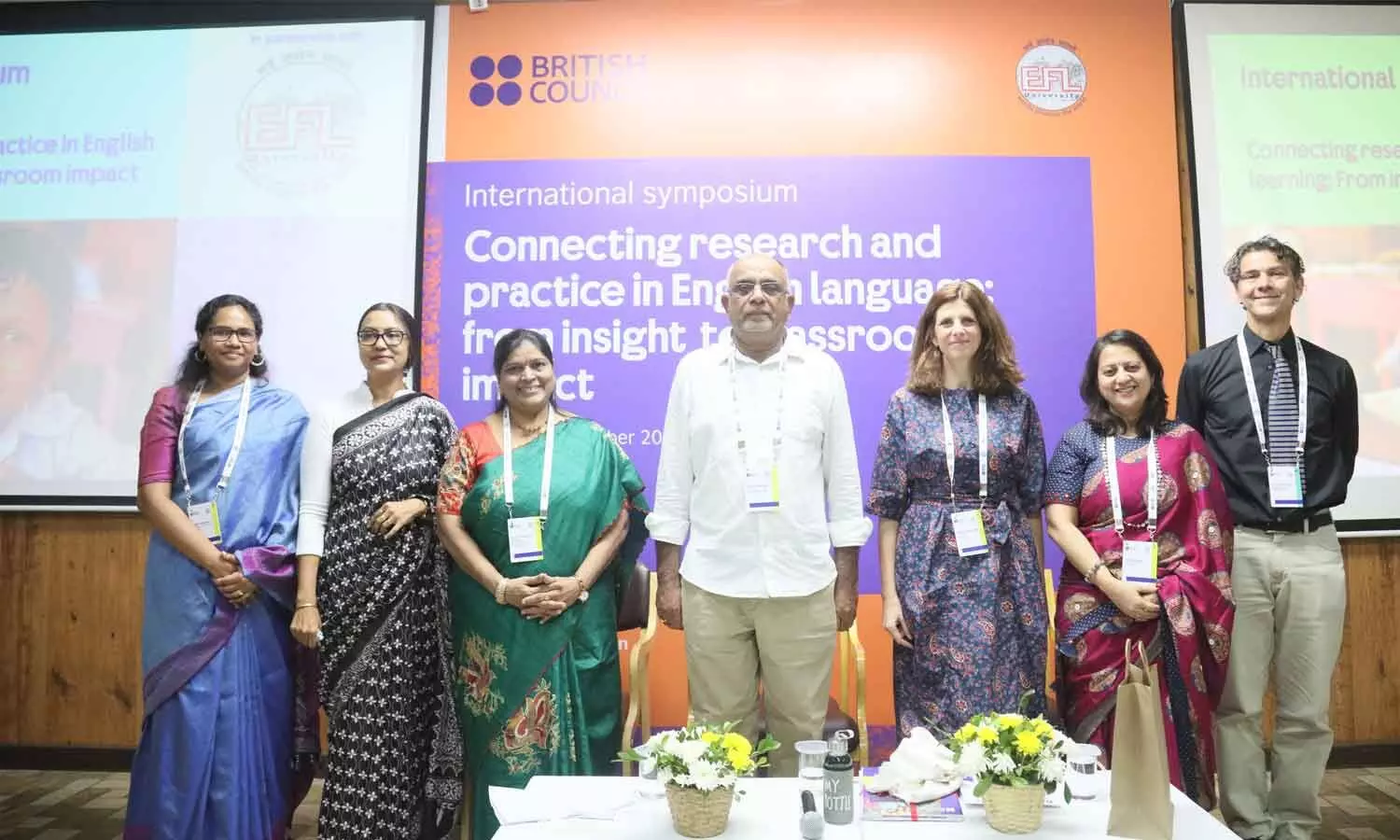
EFLU and British council conclude international symposium on English education
The English and Foreign Languages University (EFLU) and the British Council have concluded a two-day international symposium in Hyderabad, bringing together researchers, teachers, teacher educators, school leaders and policymakers to discuss ways of translating research into effective English language teaching.
Held recently, the symposium, titled Connecting Research and Practice in English Learning: From Insight to Classroom Impact, examined emerging approaches to English teaching, learning and assessment, with a focus on strengthening the connection between educational research and classroom practice.
In his inaugural address, Prof. N. Nagaraju, Vice-Chancellor of EFLU, stressed the need to ensure that academic research leads to meaningful improvements in learning outcomes. He also highlighted the importance of using educational technology ethically and equitably, while recognising learners’ home languages as valuable resources in the classroom.
Referring to the alignment of the symposium with the National Education Policy (NEP) 2020 and the India-UK Vision 2035, he described the event as an opportunity for researchers and practitioners to exchange ideas and build collaborative partnerships. He also emphasised that technology should support educators rather than replace them or deepen existing inequalities.
Alison Barrett MBE, Country Director India, British Council, said that English education must respond to changing learner needs, classroom realities and technological developments. She emphasised the importance of translating research and policy into practical approaches that teachers can apply in their everyday work. She also reaffirmed the British Council’s commitment to working with EFLU and other education partners to strengthen professional practice. Discussions at the symposium focused on five themes: inclusive and language-responsive teaching and learning; teacher education and evidence-informed practice; assessment for learning; human-centred artificial intelligence and responsible innovation; and learner voice, communication and participation.
The sessions examined how research could inform curriculum development, teacher training and language policy implementation. Participants also discussed strengthening the capacity of teachers and teacher educators through improved skills, subject knowledge and pedagogical flexibility.
The programme featured a keynote address by Prof. Graham Hall, along with sessions led by experts including Prof. Padmini Shankar and Dr. Kshema Jose of EFLU, and Purbani Das of the British Council. Other speakers included Dr. Gayathri Raman, Dr. Asma Rasheed, Dr. Madhumeeta Sinha, Dr. Padmini Boruah, Preeti Hingorani and Dr. Vijaya.
Prof. Lina Mukhopadhyay, symposium coordinator at EFLU, acknowledged the support of the university administration and the British Council, as well as the contributions of speakers, delegates and the organising team.


