






- HMWSSB MD calls for wider use of recycled wastewater
- BRS blames Congress for looming drinking water crisis
- Hyderabad: Park visitors cry foul over proposed fee hike
- Sonia Gandhi recalls fear of Indira, urges more youth to join politics
- Indian envoy meets Jakarta Governor, discusses sister city cooperation and Little India redevelopment
- FM Sitharaman chairs 2nd pre-Budget consultation with leading agriculture, rural development experts (Lead)
- Amit Shah unveils bust of Ajit Pawar in Pune; reveals the 'secret' behind his entry into Mahayuti
- Anbumani Ramadoss seeks urgent recruitment as TN govt colleges face faculty shortage
Turning a drone’s failure into a multimodal innovation
In Short
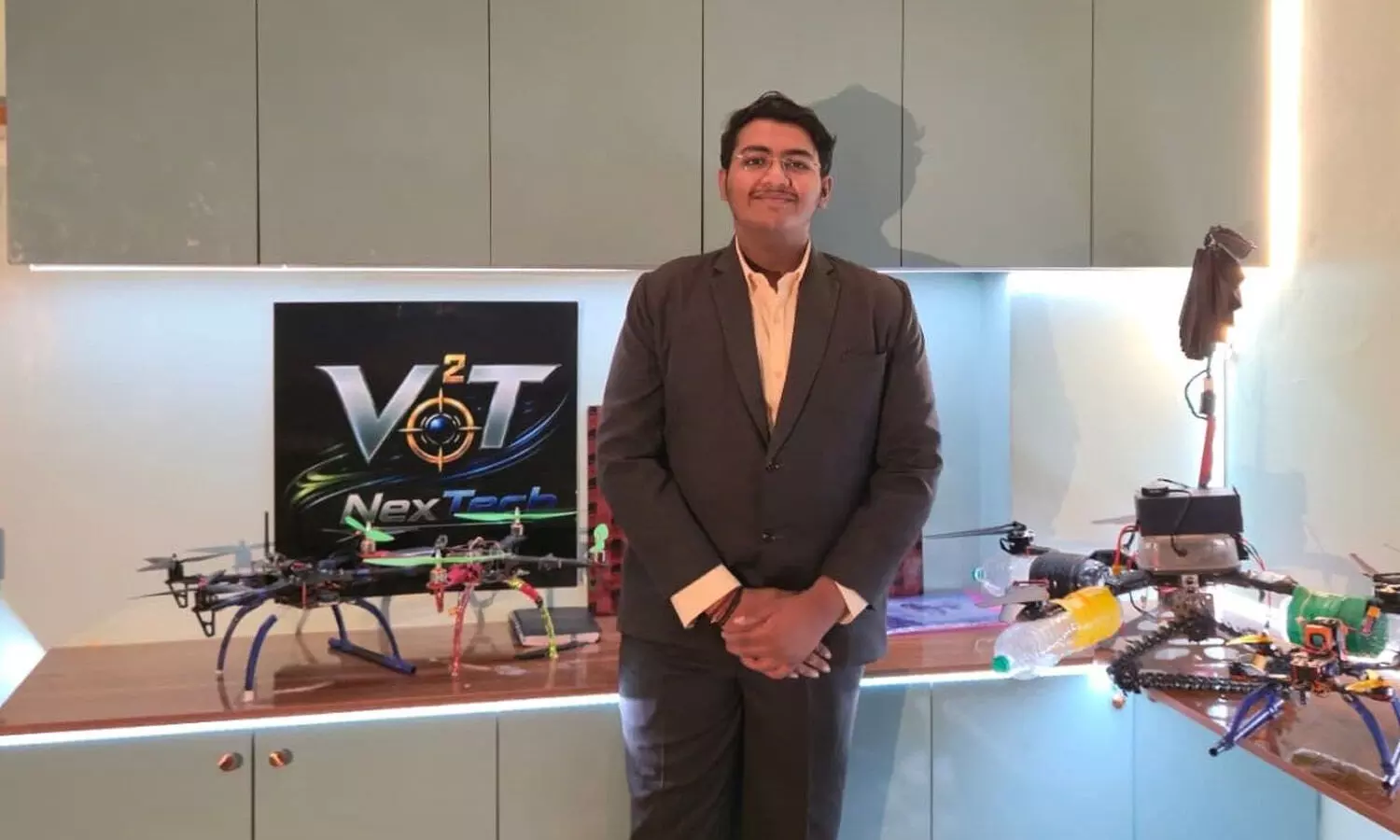
Class 11 student, Thanish Aparajit V. developed an integrated track-paddle mechanism that enables a single robotic platform to navigate land and water
Share :
Turning a drone’s failure into a multimodal innovation
A failed attempt to pick up an object during a drone competition led Thanish Aparajit V, a Class 11 student at Sri S. Badalchand Sugankavur Chordia Vivekananda Vidyalaya, to rethink how unmanned machines could operate. The result was THAHC (Terrain Hydro Aerial Hybrid Cruiser), a multi-modal robotic platform designed to move through the air, across land and on water. Thanish has filed a patent application for the innovation.
During his Grade 8 summer vacation, he decided to build a drone from scratch. Without formal training in robotics or aeronautical engineering, he used online resources, AI tools and independent experimentation. After nearly four months, his first self-built drone took off inside his room.
The idea for THAHC emerged later, during a drone competition in Noida. Participants had to navigate an obstacle course and pick up a small object. Thanish completed the course, but the drone’s propeller wash blew the object away when he tried to lift it. Thanish has also undertaken several projects through KRUU, which have given him opportunities to explore his interests, gain hands-on experience and strengthen his practical problem-solving and innovation skills. These experiences have contributed to his journey as a young innovator and his ability to translate ideas into real-world solutions.
He initially considered landing the drone and using wheels to approach the object. However, the wheels lacked traction on the grass cricket ground. He replaced them with tracks, which led him to consider whether the same machine could also move through water. That question became the starting point for THAHC and its central engineering concept, the Integrated Track Paddle System (ITPS). One mechanism for land and water
THAHC combines a conventional quadcopter-based aerial propulsion system with tracked ground movement and aquatic propulsion. The main engineering challenge was to develop a mechanism that could support both land and water movement without requiring two entirely separate systems.
Thanish designed track links with an L-shaped profile and curved sections. On land, the links function as a conventional continuous track. In water, the curved sections act as individual paddles, pushing water to generate propulsion. This Integrated Track Paddle System forms the core of the platform’s multi-terrain mobility.
Weight optimisation was another major challenge. The initial prototype weighed approximately 6.3 kg. The additional weight of the track system and sail affected its flight efficiency, prompting Thanish to redesign the chassis and experiment with different motors. These changes reduced the weight to approximately 5.2 kg.
He said the process taught him that engineering is not simply about adding features; the entire system must work efficiently. Applying classroom knowledge Physics, mathematics and computer science have all contributed to the development of THAHC. Thanish used physics to understand thrust calculations, motor performance, PID tuning, buoyancy and the efficiency of the track-paddle mechanism. Mathematics helped him calculate motion, thrust and performance, while computer science supported the programming of the onboard flight controller.
He worked with C++ and developed a custom controller for the land propulsion and sail mechanisms. He also used AI tools to assist with analysing and improving the code. Thanish said his experience with KRUU’s project-led learning environment encouraged him to connect classroom concepts with practical challenges. The process required him to acquire skills in 3D design, 3D printing, CAD modelling, programming and mechanical design, often through trial and error.
Potential applications in emergencies
The platform is being developed for possible applications in flood response, search and rescue, disaster reconnaissance and emergency supply delivery. It includes a specialised payload-dropping mechanism designed to release multiple supplies at different locations.
Thanish said he has demonstrated the platform’s movement through water, as well as scouting and surveillance in rough terrain. Its tracked system could help it navigate difficult ground, including areas affected by landslides, while its aquatic mobility could offer another way to approach locations inaccessible to conventional ground vehicles.
However, he said further development and testing would be required before THAHC could be considered for actual rescue operations. His next priorities include improving payload capacity, reducing weight, fine-tuning the energy-harvesting sail and testing the platform under different conditions.
The design also explores the use of solar energy, a foldable three-section sail to harness wind power and the possibility of generating energy from moving water through the track system. These features remain areas for further development.
For Thanish, the project has been a lesson in persistence and problem-solving. He believes innovation develops gradually by identifying problems, testing possible solutions and learning from failures.
‘Mana Doctor Baabe’ will be a grand success, says Raj Tarun
‘Akashamlo Ok Tara’ will be another milestone in Dulquer’s career: Allu Arjun
Shriya Pilgaonkar explores Perth’s cultural walks, street art and stunning sunsets
Raashii Khanna shares glimpse of her workout routine, says ‘Some days, you just have to get yourself there’
Telangana on rain alert as cyclone threat looms
Charminar MLP project remains a non-starter
India-Egypt startup ecosystems can be a ‘force multiplier’: Piyush Goyal
‘Yogi Ki Pati’ completes 50 weeks; exhibition brings UP’s development story closer to youth
'Give me justice before it is too late': Imran Khan urges top Pakistani judges
Rahul Gandhi Calls For ‘Quality Over Quantity’ In Congress-SP Seat-Sharing Talks For UP Polls


