




- Haryana expands Chirayu-Ayushman Bharat scheme to cover more families
- Make Karnataka free of unsafe open borewells: Minister
- Police stations have become Congress offices, BJP-JD(S) complain to Guv
- FIR filed over alleged misuse of Form-7 applications in Jayanagar
- Integrated physio and performance lab to bring services under one roof
- Hanumakonda takes up Rs. 20.52 crore road and drainage works
- Ponnam vows to fight alleged voter purges
- Don’t ignore persistent joint pain & stiffness, warns rheumatologist
UoH researchers study phosphate use and signalling in tomato plants
In Short
University of Hyderabad researchers uncover a molecular mechanism involving the PAP26b gene that regulates phosphate movement in tomato plants, offering new pathways to improve crop nutrient-use efficiency.

Share :
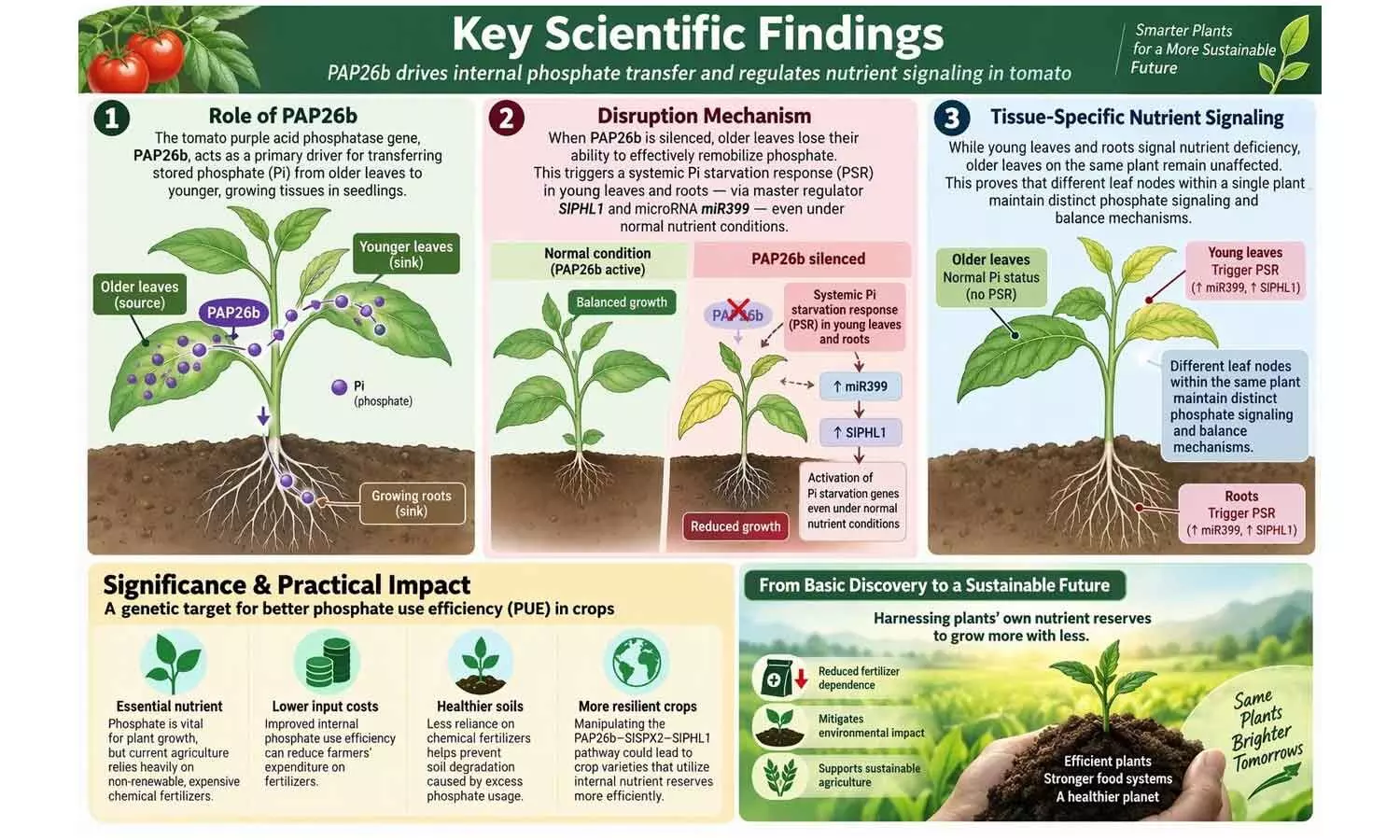
UoH researchers study phosphate use and signalling in tomato plants
Researchers from the University of Hyderabad (UoH) have identified a molecular mechanism that regulates the movement of phosphate within tomato plants, providing insights into how plants manage this essential nutrient under different conditions.
The study, titled “Tomato purple acid phosphatase PAP26b mediates tissue-specific phosphate remobilization by modulating the SlSPX2–SlPHL1 regulatory module,” has been published in the Journal of Experimental Botany. The research was conducted by Abhishek Roychowdhury and colleagues under the guidance of Prof. Rahul Kumar at The Tomato Lab, Department of Plant Sciences, School of Life Sciences, UoH.
Phosphate is an essential nutrient required for plant growth and development. The researchers examined the role of the tomato purple acid phosphatase gene PAP26b in the remobilisation of phosphate from older leaves to younger tissues.
The study found that PAP26b contributes to the transfer of stored phosphate to growing parts of tomato seedlings. When the gene was silenced, older leaves showed reduced ability to remobilise phosphate. This was associated with phosphate-starvation responses in younger leaves and roots, even when plants were grown under normal phosphate conditions. The researchers also examined the SlSPX2–SlPHL1 regulatory module and its relationship with phosphate signalling. The findings indicate that different tissues of the same plant can respond differently to changes in phosphate availability.
According to the researchers, the findings add to the understanding of how plants coordinate nutrient storage, movement and signalling across different tissues. The mechanism could also provide a genetic target for future research into improving phosphate-use efficiency in crops.
Phosphate fertilisers are widely used in agriculture, while phosphate resources are finite. Understanding how crops use and redistribute existing phosphate reserves could therefore contribute to research on improving nutrient-use efficiency and reducing dependence on external fertiliser inputs.


