






- Piyush Goyal to inaugurate 45th India International Trade Fair
- Akhilesh Yadav’s Ram Mandir visit ahead of 2027 UP Assembly polls is opportunistic: BJP
- AP SEC releases notification for 23 pending urban local bodies elections
- Fire breaks out at Srikalahasti Temple Kitchen, no casualties
- Govt Employees Can Get Rs 1.8 Lakh Laptops, Keep Them After 4 Years
- Anirudh Ravichander And Kavya Maran’s Dreamy Greece Wedding Pics Are Here
- Bullet-Riddled Bodies Of Two Missing SPOs Recovered In J&K’s Kishtwar, Search For Terrorists Underway
- Gold and Silver rates today, 12 Nov in Hyderabad, Visakhapatnam, check gold prices of 18K, 22K, 24K
Andhra’s ‘fruitbowl of the world’ plan may require reassessment: IISc study
In Short
The study aims to alter the outlook of policymakers, who often ignore the contribution of poorer farmers towards replenishment of groundwater resources.

Share :
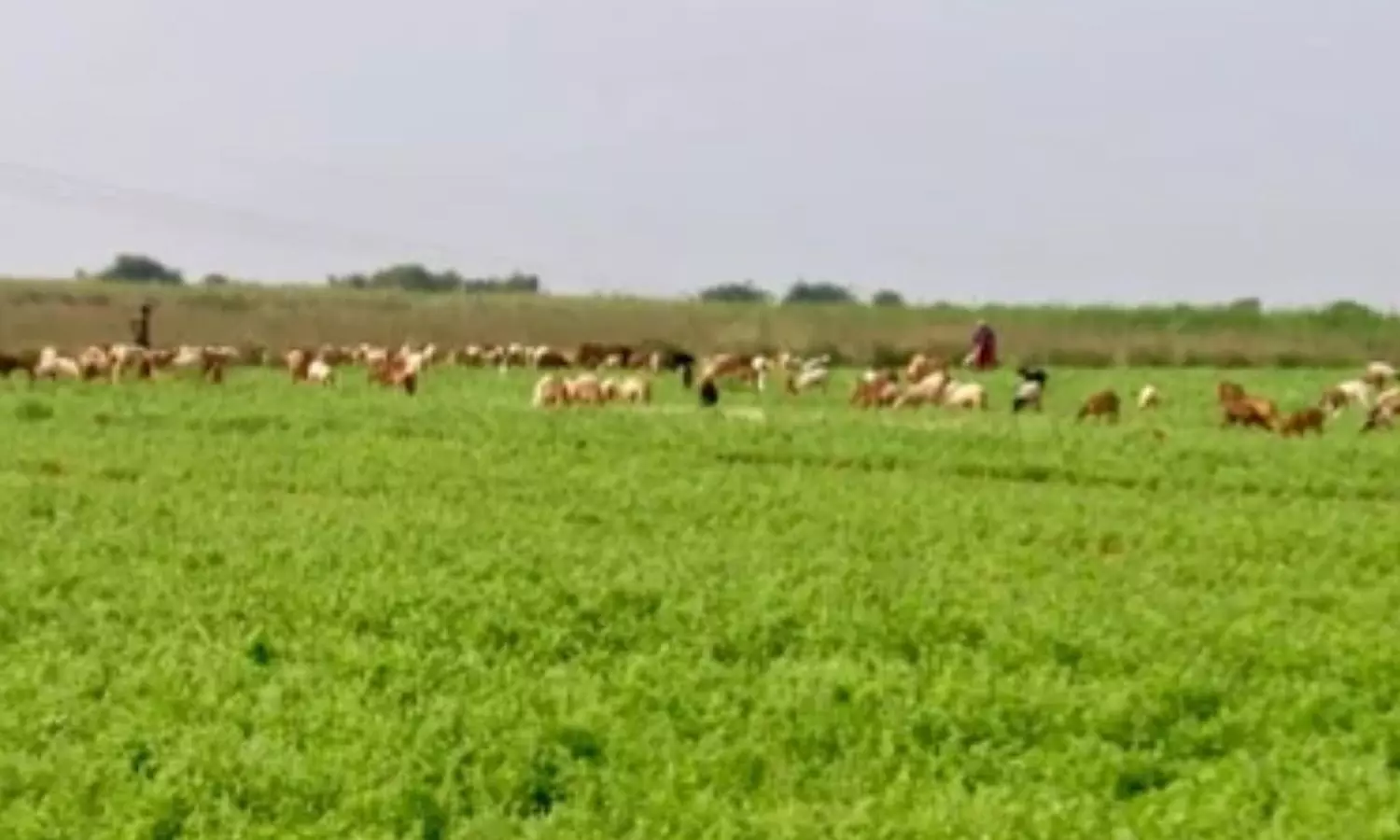
Wealthier farmers exploit most of the groundwater resources
Amaravati: Wealthier farmers exploit most of the groundwater resources, while poorer ones replenish it, a new study by researchers at the Indo-French Cell for Water Sciences (IFCWS) at the Indian Institute of Science (IISc), Bangalore, has revealed.
The study aims to alter the outlook of policymakers, who often ignore the contribution of poorer farmers towards replenishment of groundwater resources.
According to the researchers, the study introduces a new framework for water budgeting in agricultural regions that includes farmers’ social categories. This categorisation is usually neglected.
"Conventional water accounting methods often focus on how much water agriculture consumes, without adequately considering who extracts groundwater and whose farming practices help replenish it. This can obscure the links between groundwater depletion, agricultural livelihoods, and social inequality," the study says.
The team of researchers proposes a new indicator, the Blue Water Potential (BWP), to assess each farmer category’s potential to exploit or replenish groundwater resources.
It estimates the difference between groundwater recharge and the amount of groundwater required for irrigation under assumed optimal farming conditions.
A positive BWP indicates that a farming system potentially contributes more water to groundwater recharge than it requires for irrigation. A negative BWP indicates that its irrigation requirements exceed its estimated contribution to recharge.
The researchers found extremely large variations in BWP at the plot level when carrying out the study at a village in the semi-arid region of Rayalaseema in southern Andhra Pradesh.
It was found that perennial irrigated orchards – such as pomegranate, sweet lime, and grapes – exhibit heavily negative BWP on average, consuming roughly 1,000-1,200 mm/year more water than they return to the aquifer. In contrast, rainfed groundnut crops and grasslands have a positive BWP of 200-300 mm/year.
"Aggregation at the village level reveals stark inequalities. A minority (26%) of wealthier farmers appear to exploit most of the groundwater resource for horticulture, while a large majority of poorer rainfed groundnut farmers and pastoralists replenish it. However, policymakers often ignore the critical contribution of these poor farmers to groundwater resources," the study reveals.
It identifies a hidden interdependence: groundwater-dependent farmers rely, in part, on recharge generated by rainfed farms and grazing lands. These latter groups are often economically disadvantaged, despite contributing to a shared resource on which more profitable irrigated agriculture depends.
“The regional water balance so far seems positive, but our results suggest that small increases in the area of cropping systems with highly negative BWP such as fruit trees would suffice to induce groundwater overexploitation, especially if this increase happens at the expense of the area with positive BWP,” says Charlotte Hemingway, first author and researcher at IFCWS.
IISc says that these findings are particularly timely, as the Andhra Pradesh government recently unveiled an ambitious Rs 1 lakh-crore project to transform the historically parched Rayalaseema region into the “Fruit Bowl of the World” by expanding the region’s horticultural area from 8.41 lakh hectares to 14.41 lakh hectares through major irrigation projects.
“A robust assessment is needed to determine the water that will be imported through canals to improve the current fragile water balance at the village scale against climate risks as well as to sustainably satisfy the future needs of altered crops,” says co-author M Sekhar, Professor at the Department of Civil Engineering, IISc.
The paper includes open-source software, led by co-author and IISc alumna Rutuja Chitra-Tarak, that lets users compute the BWP for any cropping system or region of interest, which the authors hope will help design sustainable agricultural development policies.


