




Talliki Vandanam expanded: The scheme now covers 68.06 lakh students
In Short
- Hostel diet charges raised 10 percent for 6.28 lakh students
- Ministerial panel to fix house site issues within 45 days
- Gratuity for eligible ASHA workers up to Rs 1.50 lakh for
- Private school deregulation, foreign varsity policies cleared

Share :
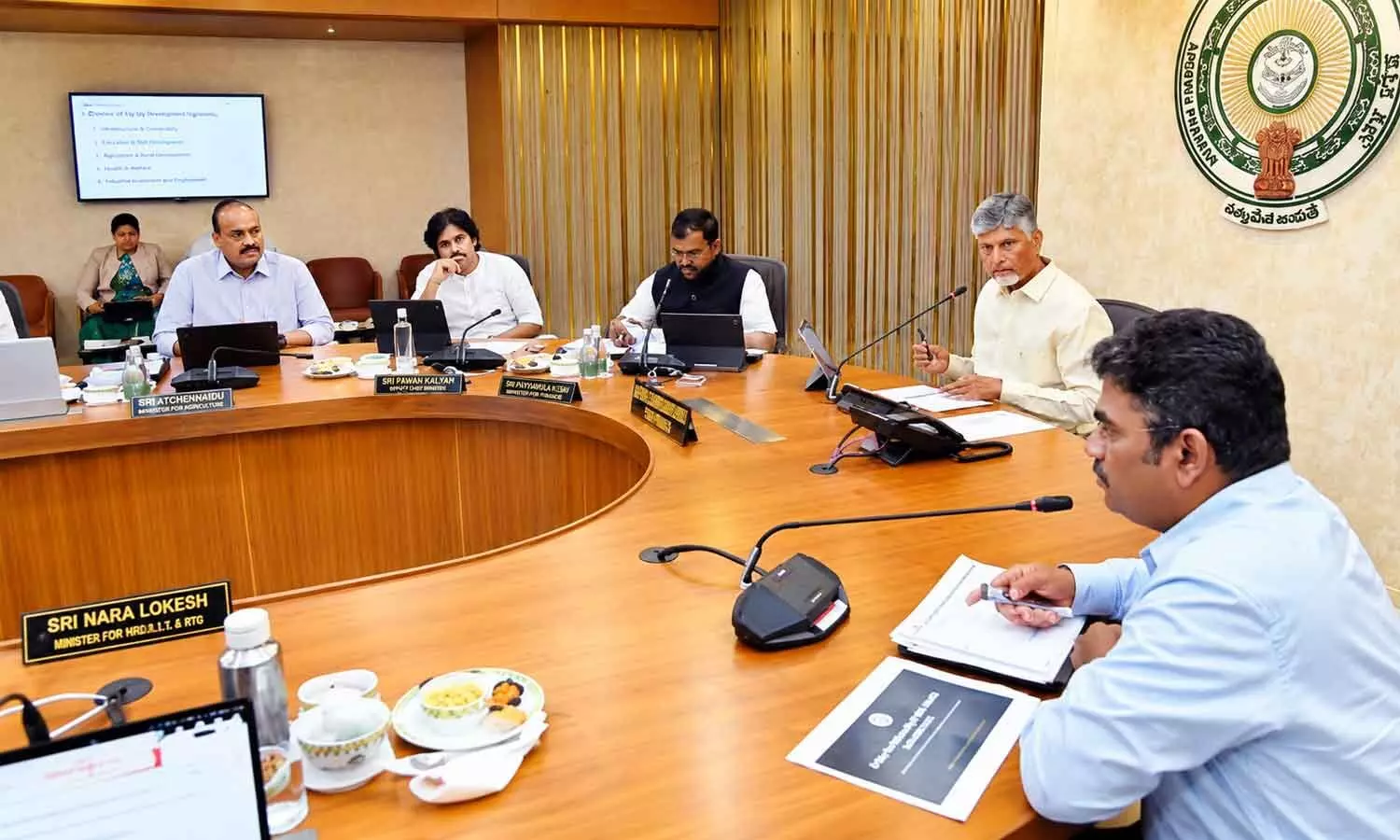
Chief Minister N Chandrababu Naidu chairs the Cabinet meeting in Amaravati on Wednesday
Amaravati: The state government has expanded its flagship Talliki Vandanam educational support scheme to another 58,601 eligible students, taking the total number of beneficiaries to 68.06 lakh, with a Cabinet meeting on Wednesday, chaired by Chief Minister N Chandrababu Naidu, approving additional financial assistance under the programme.
The Cabinet ratified GOs 15 and 16 issued by the School Education Department on July 16 for implementation of the scheme during 2026-27 and accorded revised administrative sanction. The approved outlay has increased from Rs 10,120.78 crore to Rs 10,208.69 crore.
The Cabinet also authorised the release of assistance to 3,29,201 eligible beneficiaries selected in the second phase. With the latest expansion, the number of eligible students has risen from 67,47,190 to 68,05,791. Students and their mothers across all districts will benefit from the programme. The Cabinet followed this up with another significant welfare measure, approving a 10 per cent increase in diet charges for students staying in government welfare hostels, residential and ashram schools, KGBVs, homes and other institutions.
The revised rates, effective from October 1, will benefit 6,28,409 students under the Social Welfare, BC Welfare, Tribal Welfare, Minority Welfare, Differently-Abled Welfare, Juvenile Welfare, and School Education Departments.
For the first time, the government has decided to maintain uniform diet rates across the departments.
The Cabinet also approved the establishment of a Centre of Excellence at the AP Tribal Welfare Residential School at Marikavalasa, Visakhapatnam, to provide specialised residential coaching for tribal students preparing for IIT-JEE and NEET. The centre will admit 600 Intermediate students -300 boys and 300 girls- from across the state.
On the housing front, the Cabinet decided to constitute a three-member ministerial committee to resolve house site issues within 45 days.
The committee will examine the cancellation and reallocation of vacant plots, plots rejected or surrendered by beneficiaries, and the modalities for acquiring land for the 2 lakh people identified as requiring house sites in the recent Awas survey.
The Cabinet also approved for eligible ASHA workers who die while in service Rs 5,000 as gratuity for every completed year of service, subject to a maximum of Rs 1.50 lakh. An estimated Rs 2.19 crore has been sanctioned for the scheme during 2026-27.
As for agriculture, the Cabinet approved the Andhra Pradesh Horticulture Information and Management System (APHIMS) to consolidate crop data, improve services, and offer advice to farmers.
On the education policy front, the Cabinet approved an ordinance amending the AP Education Act, 1982, removing requirements for prior area surveys, notifications, and determination of need before permission is granted for establishment or registration of private schools. The government said safety, fire, sanitation, infrastructure, and other recognition standards would continue to apply.
It also approved the AP Policy for Promotion of Foreign Higher Educational Institutions and Private Universities, 2026, aimed at attracting foreign universities and reputed private institutions to establish campuses in the state.
Other decisions included one-time regularisation of certain long-standing encroachments on government poramboke lands in NTR district, and allocation of land for a BC Welfare residential school in Prakasam district.
The Cabinet also adopted a resolution congratulating Prime Minister Narendra Modi on completing 25 years as head of a government, including his tenure as Gujarat Chief Minister.


