






- Land resurvey to set national benchmark: Ponguleti Srinivas Reddy
- TG SAFE raids fish markets, seizes 858 kg of rotten seafood
- Hyderabad to roll out contra-flow BRTS within a week
- No takers for HMDA auctions for Moosapet, Neopolis lands
- Overseas job dreams get wings with government subsidy
- Hyderabad: School rush chokes Cyberabad roads
- Results come through hard work, honesty, not through speeches: UP CM Adityanath's jibe at Opposition
- India and Philippines review ongoing military engagements, identify new avenues for tri-service cooperation
Hyderabad: School rush chokes Cyberabad roads
In Short
Survey of 526 schools flags narrow roads, peak-hour rush and overdependence on private vehicles

Share :
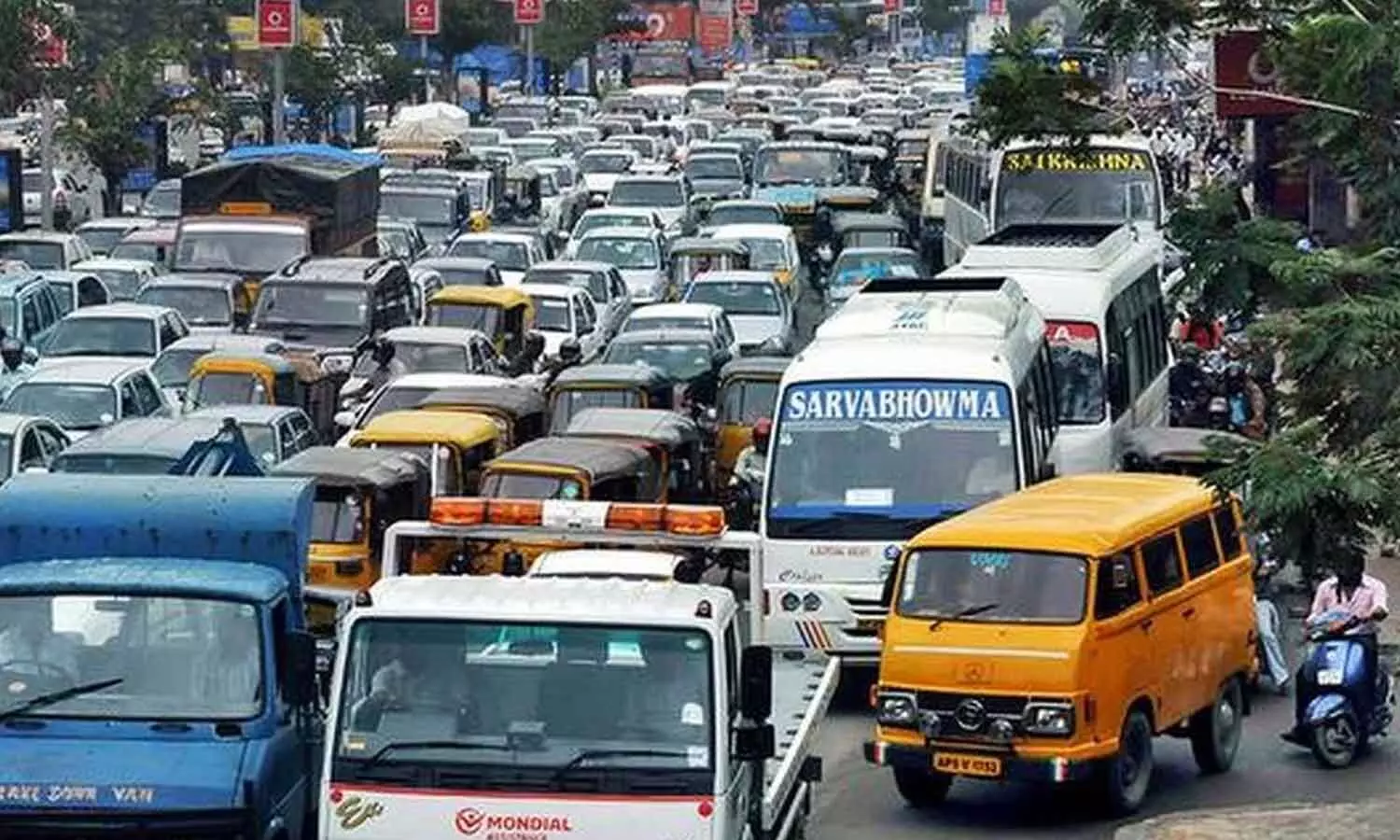
Hyderabad: Traffic congestion around schools in Cyberabad continues to pose a major challenge for motorists, parents and students, with narrow approach roads, overlapping school timings and dependence on private vehicles adding to the problem.
With more than four lakh students travelling to schools every day, a survey conducted across 526 schools found that 64 per cent of educational institutions are located on narrow roads, restricting vehicle movement during school opening and closing hours.
The situation becomes particularly difficult when parents drop their children directly at school gates, resulting in school buses, cars, autos and two-wheelers crowding the same stretches. This not only slows down traffic but also exposes children to the risk of accidents while crossing roads or getting into vehicles.
The survey findings show that only 36 per cent of students use school buses, while 30 per cent walk to school. Around 17 per cent depend on two-wheelers, 11 per cent travel by cars, autos and vans, and just five per cent use bicycles.
Several factors contribute to parents avoiding school buses. Many prefer dropping their children themselves as schools fall along their route to work. Others are reluctant because buses arrive too early or due to concerns over children's safety during transit. Inadequate bus facilities and inconvenient timings further discourage the use of shared transportation.
School timings are another major contributor to congestion. Six out of every 10 schools start between 8 am and 9 am, coinciding with the morning office rush. A 13-km journey that takes around 29 minutes at 7 am increases to 34 minutes by 8 am, with travel time rising further between 9 am and 10 am. Staggered school timings have been proposed to distribute traffic movement across different time slots.
One in five schools is located within 300 metres of roads that experience heavy congestion around 8 am. These locations create difficulties for school buses and pedestrians, particularly younger children navigating through moving vehicles.
The Student Mobility Programme proposes the involvement of five key stakeholders -- police, municipal corporation, education department, transport department and schools -- to address these challenges. The police will focus on traffic regulation and road safety, while municipal authorities will improve road infrastructure, footpaths and pedestrian facilities. The education department will coordinate with schools, and the transport department will oversee school vehicle safety and compliance.
The proposed measures include dedicated student bus routes in coordination with TGSRTC, verified drivers, compliant vehicles and supervised boarding facilities. Live bus tracking, travel alerts for parents and shared taxi facilities are also part of the plan.
However, the report highlights the lack of coordination among schools, parents and traffic authorities. Unless schools regulate entry and exit arrangements and parents avoid unnecessary vehicle movement near school gates, infrastructure improvements alone may not resolve the congestion.
♦ Four lakh-plus students travel daily
♦ Survey covers 526 schools
♦ 64% schools on narrow roads
♦ Only 36% use school buses
♦ 30% walk to school
♦ 17% depend on two-wheelers
♦ 60% schools start between 8 am and 9 am
♦ School and office rush overlap
Telangana urges Centre to approve Rs 25,096 crore for power sector development
Delimitation: Naidu Urges Parties to Rise Above Politics; Don’t Deny Women Their Due
J&K L-G directs universities to transition towards skill-centric, employment-oriented curriculum
Shashi Tharoor 'disappointed' with DMK's stance on Delimitation
Tamil Nadu CM is anti-Sanatan, Alleges BJP
'Delimitation Bill being brought in to win Uttar Pradesh': Akhilesh attacks government


