




Don't Destroy Traders' Livelihoods for Political Gains: Live and Let Live
In Short
The traders' body said it would await a response from Gandhi. However, it added that immediately after Diwali, business leaders from across the country would convene in Delhi for a crucial national meeting to decide their future course of action.

Share :
Don't Destroy Traders' Livelihoods for Political Gains: Live and Let Live
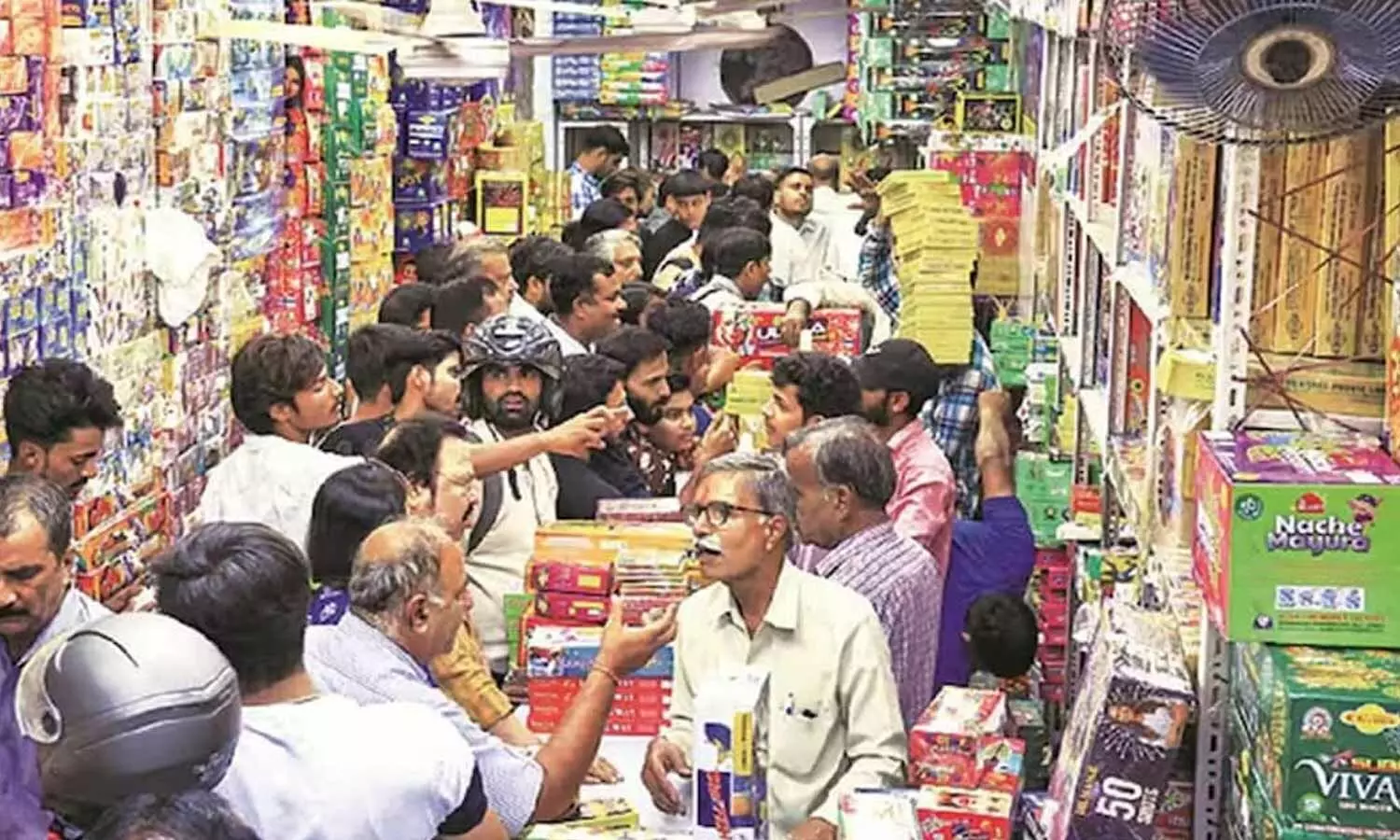
The opposition rally at Ramlila Maidan was over on November 1, but the distress caused to traders does not seem to have ended. The Confederation of All India Traders (CAIT), peeved that opposition parties refused to postpone their rally until after Diwali, has now written to Leader of Opposition Rahul Gandhi, expressing the deep resentment and distress felt by traders across the country over the frequent disruption of business activities in Delhi caused by political rallies, sit-ins and protests over the past month.
The traders' body said it would await a response from Gandhi. However, it added that immediately after Diwali, business leaders from across the country would convene in Delhi for a crucial national meeting to decide their future course of action.
In its letter, CAIT raised serious questions about the rally organised by the Congress and other opposition parties at Ramlila Maidan.
The traders said, "This is no longer an issue confined solely to the traders of Delhi. If such a situation can arise in the national capital today, it could just as easily occur in any other city in the country. Consequently, this has evolved into a serious national issue, and the trading community is not so weak as to continue tolerating such circumstances. The time has come to teach a lesson," CAIT said in a statement.
It further announced that traders would observe a 'Dhikkar Diwas' (Day of Condemnation) across the country, with the date to be finalised at the upcoming meeting in New Delhi.
CAIT National President B C Bhartia said demonstrations supported by the Congress and other opposition parties had severely affected economic activity in the national capital, particularly at a time when the city was witnessing a crucial festive and wedding-related shopping season. He said the Congress and other opposition parties should have recognised their moral responsibility towards the trading community.
"Mr Rahul Gandhi cannot hold two contradictory positions simultaneously. On the one hand, he urges people to shop in local markets, while on the other, he supports political events and demonstrations that prevent customers from reaching those very markets. This is not merely a political contradiction; it is a double standard that directly undermines the livelihoods of ordinary traders," Bhartia said.
Strongly objecting to what he termed the selective interpretation of constitutional rights by political leaders, Bhartia pointed out that while Article 19(1)(a) of the Constitution guarantees every citizen the right to freedom of expression, Article 19(1)(g) guarantees the right to practise any profession or carry on any trade or business. The opposition had effectively deprived traders of this right, he added.
He questioned whether Rahul Gandhi believed that the right to protest took precedence over the right to conduct business and earn a livelihood.
"Is Article 19(1)(g) of the Constitution merely meant for speeches and textbooks, or does it also safeguard the rights of millions of small traders, shopkeepers, street vendors and working-class families whose survival depends on their daily earnings? Political leaders cannot selectively invoke constitutional provisions to suit their convenience while disregarding the rights of others," he added.
Bhartia also asked who would compensate traders and working-class families for the massive economic losses they had suffered, with their livelihoods bearing the brunt of the disruptions.
"Is there any mechanism within the Congress party's political framework under which organisers and supporters of disruptive protests accept responsibility for the economic losses caused by their actions? Or has it become acceptable to sacrifice the livelihoods of ordinary citizens for the sake of a political show of strength? Was it politically and morally justifiable to hold the commercial life of the national capital hostage?" the CAIT president asked.
He wondered how Rahul Gandhi expected people to participate in the rally and go shopping at the same time when such protests often resulted in markets being shut down. Would Gandhi accept such a situation if his own livelihood or daily earnings were affected, Bhartia asked.
Political parties, he said, "must understand that Delhi is not merely a stage for the display of political power; it is also a vital commercial and economic hub for the country. Delhi's markets serve as the foundation for the livelihoods of millions and make a significant contribution to the national economy and government revenue."
"The nation's traders are not 'punching bags' for anyone's political struggle. They are the backbone of the domestic economy, a key driver of job creation and partners in nation-building. They are not seeking any special privileges; they merely expect their constitutional rights to be respected. Rahul Gandhi should understand that while opposing the government politically is a democratic right, destroying someone else's livelihood in the name of political opposition is neither democratic nor justifiable," he said.


