




Raksha Mantri Launches Blistering Attack on Rahul’s ‘Be Battle Ready’ Call
In Short
Defence Minister Rajnath Singh criticises Rahul Gandhi’s “Be Battle Ready” call, alleging that Congress is pursuing a campaign to defame India and destabilise the government. He cites electoral disputes, the Emergency and the 1984 anti-Sikh riots.

Share :
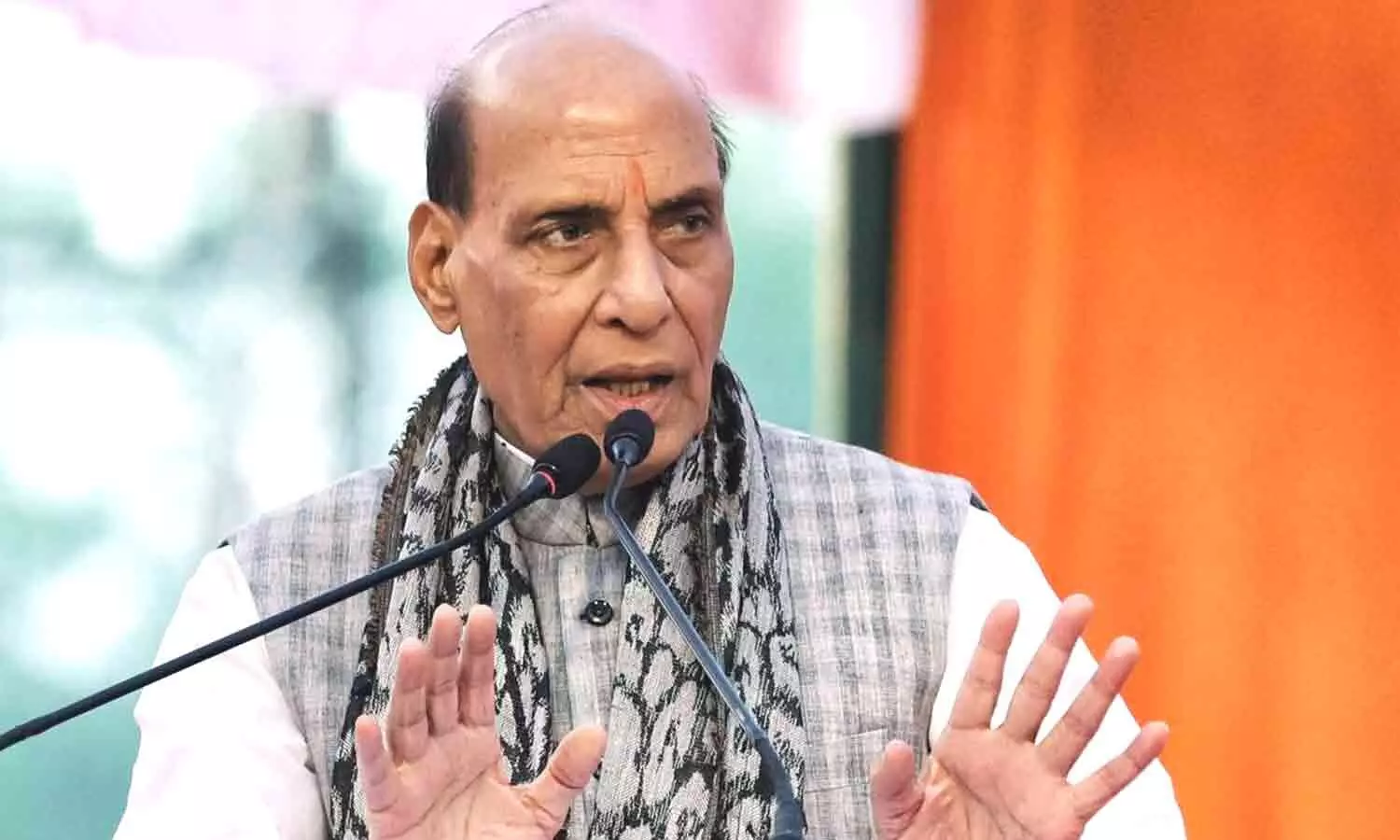
Union Defence Minister Rajnath Singh
Union Defence Minister Rajnath Singh on Friday launched a blistering attack on Leader of the Opposition Rahul Gandhi, alleging that a “toolkit” was at work and that an attempt was being made to defame India.
Addressing a press conference, Singh said Rahul Gandhi’s statements were turning the youth into pawns in a campaign of chaos and seeking to hold democracy hostage. He alleged that the Opposition wanted to topple the government and was therefore using terms such as “regime change”, “resistance” and “perseverance”. This, he said, showed how low the Congress could stoop.
Singh further alleged that the Congress, frustrated by its repeated electoral failures and inability to return to power at the Centre and in several states, was resorting to such tactics. He said the party had lost the moral right to use the Gandhi name.
The Congress, he argued, should ask itself whether it could even win the Rae Bareli Lok Sabha seat in Uttar Pradesh without the support of the Samajwadi Party. He also questioned why Rahul Gandhi had not produced evidence of alleged “vote chori” in Amethi.
Singh recalled that Rahul Gandhi had initially threatened to produce a “hydrogen bomb” of evidence, but that it had fizzled out. He subsequently accused Gandhi of resorting to what he described as fabricated claims about voter ID irregularities and presenting incorrect identity cards. With those allegations failing to gain traction, Singh alleged, Gandhi had shifted to talking about regime change.
Singh accused the Congress of having a history of undermining democracy, citing the imposition of the Emergency in 1975. During that period, the judiciary faced severe restrictions on its ability to protect citizens against arbitrary government action. The enforcement of fundamental rights was curtailed, challenges to preventive detention became difficult, press freedom was restricted, and judicial review of executive power was weakened.
The restrictions severely undermined the courts’ ability to protect civil liberties. Singh contrasted that period with the present, arguing that opposition parties now had access to legal remedies and democratic avenues to challenge the government.
He also recalled the 1984 anti-Sikh riots, alleging that Congress activists had been responsible for the merciless killing of Sikhs.
Singh further said that the BJP had never questioned the electoral process or attempted to obstruct it. He cited the appointment of Navin Chawla as Chief Election Commissioner despite reported opposition within the Election Commission. He also referred to the Padma Vibhushan awarded to M.S. Gill in 2000, when Gill was serving as Chief Election Commissioner, questioning the Congress’s present allegations that the Election Commission had been taken over by the BJP.
Singh maintained that the issue was not merely a dispute with Chief Election Commissioner Gyanesh Kumar but, as he alleged, part of a larger campaign for regime change.
He expressed confidence that people were aware of the developments and would reject the Opposition’s attempts.
His remarks come amid massive protests in the national capital by opposition parties and civil society groups demanding the resignation of Chief Election Commissioner Gyanesh Kumar over alleged irregularities in the SIR process.
Opposition leaders have alleged that the exercise lacks transparency and could exclude eligible voters.
Referring to the Supreme Court's observations on Thursday, Singh said Gandhi and his allies need to understand that democracy does not permit attempts to create anarchy, undermine constitutional institutions or obstruct India's development.
"Respecting the law is also essential to maintaining law and order. India's democratic institutions cannot be sacrificed at the altar of political self-interest," he said.
Singh added that falsehoods, anger, attempts to malign institutions and political opportunism could not obstruct India's development.
He advised Gandhi to respect the people's mandate and introspect on his political role instead of pursuing what he called "politics of destruction" in the name of protecting democracy.
"India's future is everyone's responsibility. We must choose the path of dialogue and nation-building, not confrontation," Singh said.


