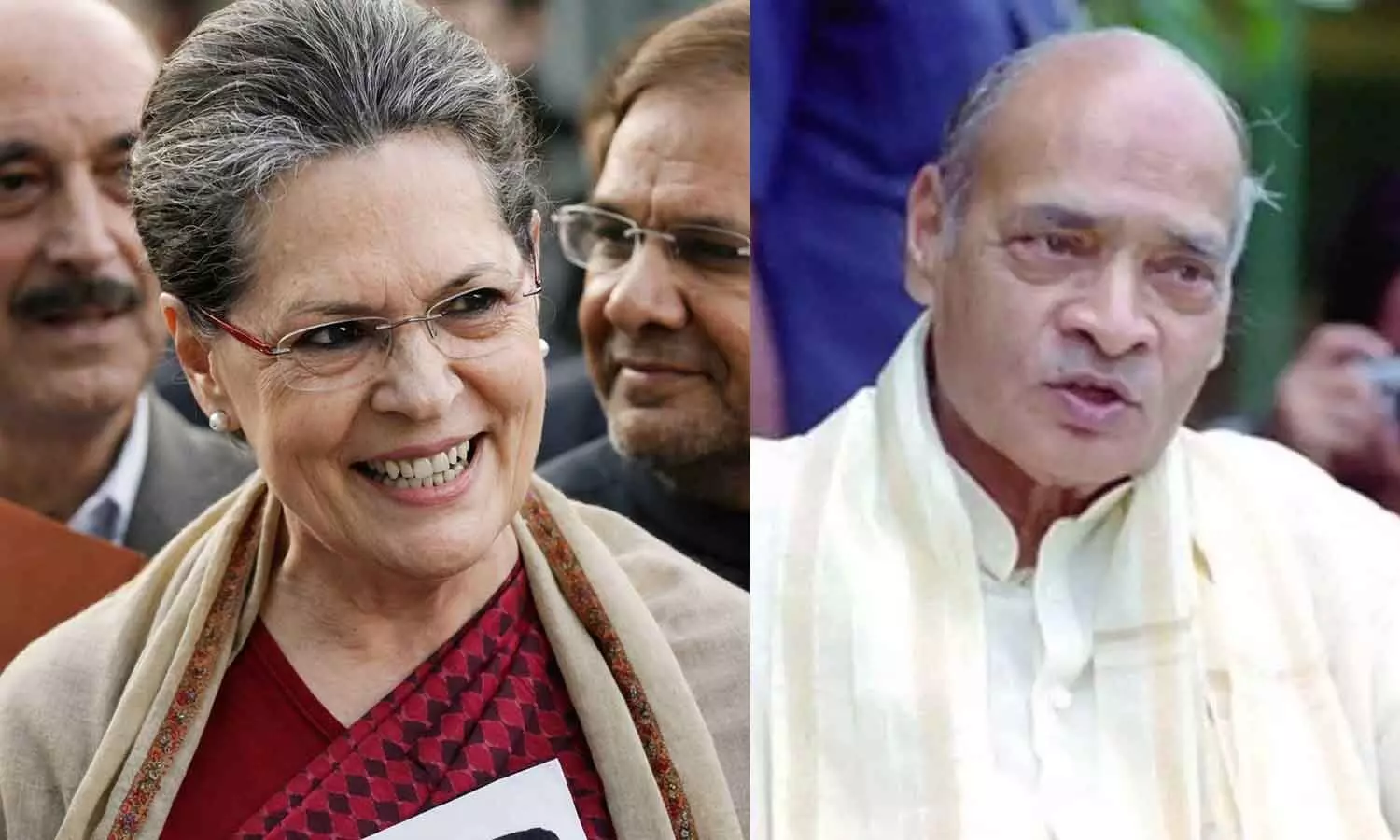
Sonia’s Memoir forgets PV Narasimha Rao from the History of Economic Reforms
In Short
Sonia Gandhi’s memoir Belonging: A Journey of Love credits Manmohan Singh for India’s 1991 economic reforms but reportedly overlooks former Prime Minister P V Narasimha Rao’s pivotal political leadership.

Sonia Gandhi’s long-awaited memoir, Belonging: A Journey of Love, which hit the book stalls on Tuesday, credits Dr Manmohan Singh, who served as Finance Minister in P V Narasimha Rao’s Cabinet, with introducing the landmark economic reforms of the early 1990s. However, in doing so, it appears to overlook the pivotal role played by Narasimha Rao in initiating and steering the reforms.
A look back at recent Indian history makes it clear that the 1991 economic reforms became a reality because Rao took the crucial political decision to usher in sweeping economic changes. The reform proposals presented in Parliament by Dr Manmohan Singh were shaped by consultations with economists and translated Rao’s vision into concrete policy measures. It would, therefore, be historically inaccurate to credit Manmohan Singh alone for the reforms. The contributions of Rao and Singh were distinct but complementary.
P V Narasimha Rao was the political architect of the reforms. As Prime Minister, he took the decision to initiate sweeping economic changes, provided them with political backing and exercised the leadership necessary to overcome resistance within the government and Parliament. He also held the industries portfolio and played a key role in dismantling the Licence Raj.
Dr Manmohan Singh, on the other hand, was the economic architect and chief executor of the reform programme. As Finance Minister, he formulated and presented the landmark Union Budget on July 24, 1991, and outlined the economic liberalisation programme. He translated the reform vision into concrete economic policies.
The distinction between their respective contributions was also highlighted by former President Pranab Mukherjee, who described the combination of Rao, the practical politician, and Manmohan Singh, the economist Finance Minister, as crucial to the success of the reforms.
It is also worth recalling that Manmohan Singh himself acknowledged the importance of Rao’s leadership. As Prime Minister, he pointed out that economic reforms could not be brought about merely because economists recommended them. They required political leadership willing to take the necessary decisions and stand by them. He specifically acknowledged Rao’s leadership and support.
Yet, Sonia Gandhi’s memoir makes no mention of these crucial aspects of the story. By highlighting Manmohan Singh’s contribution without adequately acknowledging the political leadership that made the reforms possible, the memoir presents an incomplete account of one of the most consequential turning points in India's economic history.
For a memoir that revisits the Congress party's political legacy, the omission of P V Narasimha Rao's contribution to the 1991 reforms is particularly striking.
A Journey of Three Decades Time passes faster than we realise. What feels like a journey that began only yesterday has today grown into more than three decades of a meaningful and fulfilling life devoted to education, journalism, and the empowerment of young minds. My professional journey began with journalism training in New Delhi in 1979. I went on to work as an independent journalist, drawing on my fluency in both English and Telugu. Over the years, I have edited and worked on Telugu articles in both languages, an experience that strengthened my command of language and sharpened my understanding of society, people, and contemporary issues. Yet, my principal profession and enduring passion have always been teaching. My decision to become a teacher was not merely a career choice—it was a calling. Teaching offered me the rare privilege of inspiring young minds, guiding them through their formative years, and making a lasting difference in their lives. I found immense satisfaction in simplifying complex concepts, nurturing curiosity, encouraging independent thought, and building confidence among students. Every moment in the classroom—every question, every moment of discovery, and every spark of understanding—reminded me why I had chosen this path: to empower young people through knowledge, values, and essential life skills. My teaching career began at the grassroots level as a Montessori teacher and gradually progressed to the position of Vice Principal. I had the opportunity to work in reputed educational institutions, including Dilsukhnagar Public School in Hyderabad, where I shouldered both teaching and administrative responsibilities. Although I have always considered myself, at heart, a teacher, my administrative experience enabled me to understand and contribute to the education system from a much broader perspective. For my students, I have always tried to be an approachable and dependable presence—someone they could turn to not only for academic support, but also for guidance and emotional encouragement. At the same time, I developed a reputation as a firm disciplinarian who believed that integrity, fairness, responsibility, and discipline were fundamental to education. I was also consistently appreciated for maintaining clear communication with parents and staff and for ensuring that examinations and other academic processes were conducted with transparency, fairness, and efficiency. As my career progressed, however, I began to feel that academic education alone was not enough. This realization led me to work more closely with students following the SSC and CBSE curricula, while consciously bringing life-skills education into my teaching. I came to understand that education becomes truly meaningful when it prepares children not merely to pass examinations, but to face life. Teaching emotional resilience, self-reliance, social awareness, communication, decision-making, and other practical life skills often had a deeper and more lasting impact than academic achievement alone. I saw how these skills could help students navigate challenges with greater confidence, maturity, and responsibility. My academic background provided a strong foundation for this approach. My degree in Psychology from the University of Madras helped me develop a deeper understanding of young people's minds, their emotional needs, and the influence of their family and social environments. My M.A. in Telugu with First Class from Osmania University.