




- From 'gun' bullets to bullet trains; Assam's unstoppable journey of progress, says CM Sarma
- Union Minister Pemmasani Chandrasekhar casts his Vote at Burripalem
- Bengal BJP plans to retain over 50 pc of old faces in Kolkata, Howrah civic polls
- Indian-Origin Nithya Raman Wins Los Angeles Mayoral Election, Defeats Incumbent Karen Bass
- Don't Destroy Traders' Livelihoods for Political Gains: Live and Let Live
- Canva lays off 1,271 employees, offers 6 months' salary and free MacBooks
- Two killed in explosion at gunpowder manufacturing unit in Rajasthan's Nagaur
- TGSRTC Plans Special Buses to Sabarimala during pilgrim season
Supreme Court Refuses to Transfer Tirupati Laddu Case Outside AP
In Short
A Bench of Chief Justice of India (CJI) Surya Kant and Justice Joymalya Bagchi passed the order saying no case was made out for shifting the proceedings to another state at this stage.

Share :
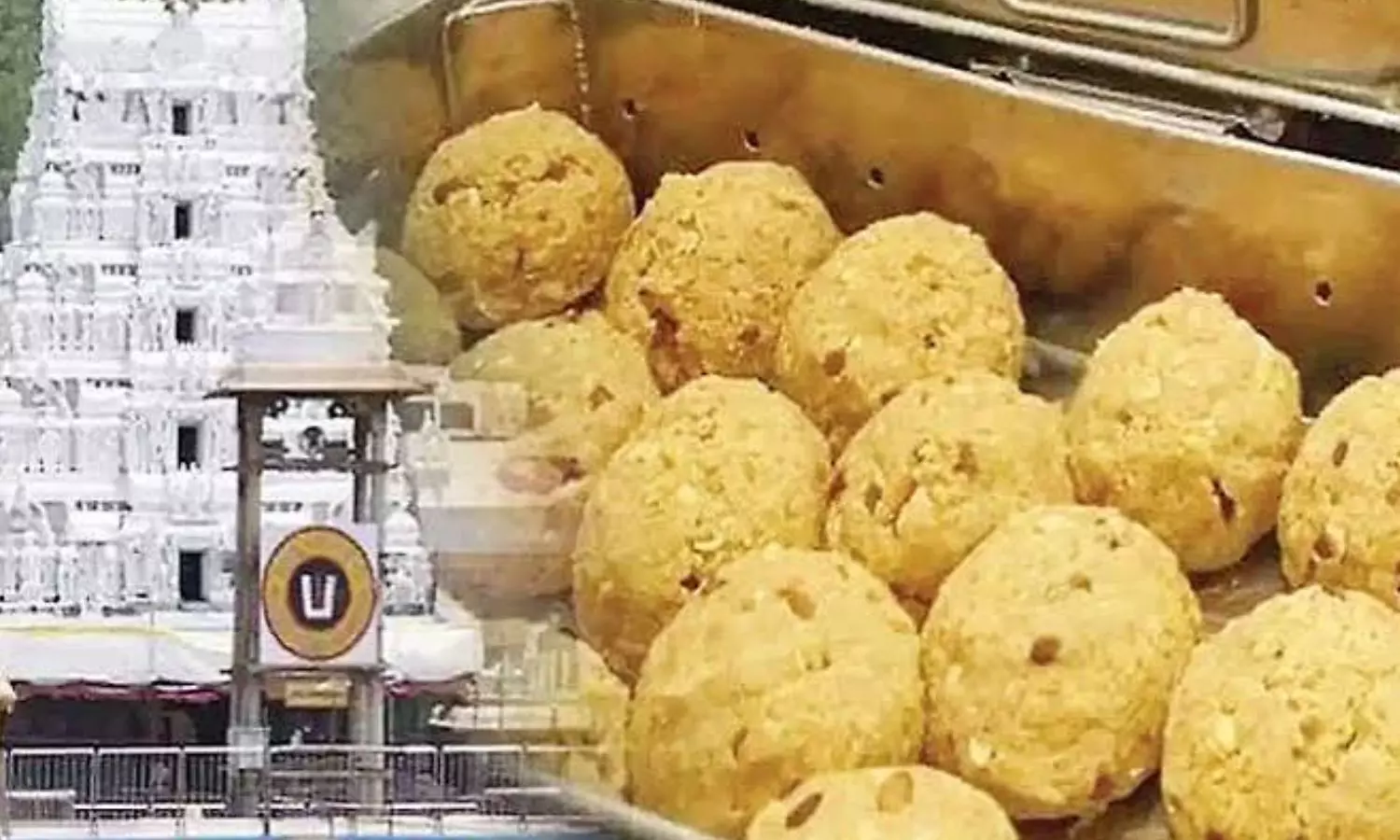
Tirupati laddu adulteration case
The Supreme Court on Thursday ruled that there was no need to transfer the alleged Tirupati laddu adulteration case outside Andhra Pradesh.
A Bench of Chief Justice of India (CJI) Surya Kant and Justice Joymalya Bagchi passed the order saying no case was made out for shifting the proceedings to another state at this stage. The bench was hearing a criminal transfer petition filed by Machindra Shantaram Lanke and M/s Malganga Milk and Agro Products.
Appearing for the petitioners, senior advocate Siddharth Dave submitted that political statements were continuously being made by Chief Minister Chandrababu Naidu and Deputy Chief Minister of Andhra Pradesh Pawan Kalyan, raising concerns over the fairness of the prosecution.
"It has become a political issue. There is a hostile environment in the state. The chief minister and the deputy chief minister are continuously making statements with regard to the case," Dave said.
Dave said even though the forensic report has ruled out the presence of animal fat in the ghee, the political leaders were indulging in making such statements.
"Prosecution has to be fair," Dave submitted, urging the top court to shift the trial to a neighbouring state where the matter would not carry the same emotive significance.
"Please transfer the case to the adjoining state, for a free and fair trial. Most of the accused are from North India. There is also a language barrier," he submitted, adding that although the trial judge might not be influenced by the comments, a fair prosecution cannot be expected in such a scenario.
The bench, however, expressed disinclination, saying there are a number of witnesses who are from the state and it will affect the trial.
It pointed out that the investigation was done by a Special Investigation Team constituted by the Supreme Court itself.
"We are not inclined to transfer the trial. Dismissed," the bench ordered. The CJI Kant-led Bench observed that the Supreme Court had already "silenced them all with our order", adding that the petitioners could approach the apex court again if any such issue arose.
The development had assumed significance as the top court-appointed panel substituted the Andhra Pradesh government's special investigation team (SIT) constituted on September 26, 2024, to probe the politically sensitive row over the alleged use of animal fat in laddus.
It had directed that the independent SIT would comprise two officers, each from the Central Bureau of Investigation (CBI) and the Andhra Pradesh Police, besides a senior official of the Food Safety and Standards Authority of India (FSSAI).
The court had said that in the independent SIT, the two officers from the CBI would be nominated by its director while the two officers from the Andhra Pradesh Police would be named by the state government. The FSSAI chairperson would nominate a senior officer of the authority to be a part of the SIT, it had said.
It had directed that the SIT shall work under the supervision of the CBI director.
Andhra Pradesh Chief Minister N Chandrababu Naidu had claimed earlier that animal fat was used in preparing Tirupati laddus during the previous Y S Jagan Mohan Reddy-led regime in the state, triggering a massive political row.
The YSR Congress Party accused Naidu of indulging in "heinous allegations" for political gains, while the ruling Telugu Desam Party in the state has circulated a laboratory report to back its claim.


