






DHARA: Turning Coastal Humidity into Drinking Water Security
In Short
- EESL's innovative initiative offers sustainable, decentralised drinking water solutions for Andhra Pradesh's coastal districts..
- Akhilesh Kumar Dixit,CEO EESL thanked Ronald Ross the Secretary Finance for inviting EESL to highlight Global Technologies in the area of Energy Efficiency & it's impact in Andhra Pradesh.
- EESL plans to showcase the Air2to water machine during the Public finance Summit on 2-3 rd December 2026.

Share :
Energy Efficiency Services Limited (EESL) Under the Ministry of Power.
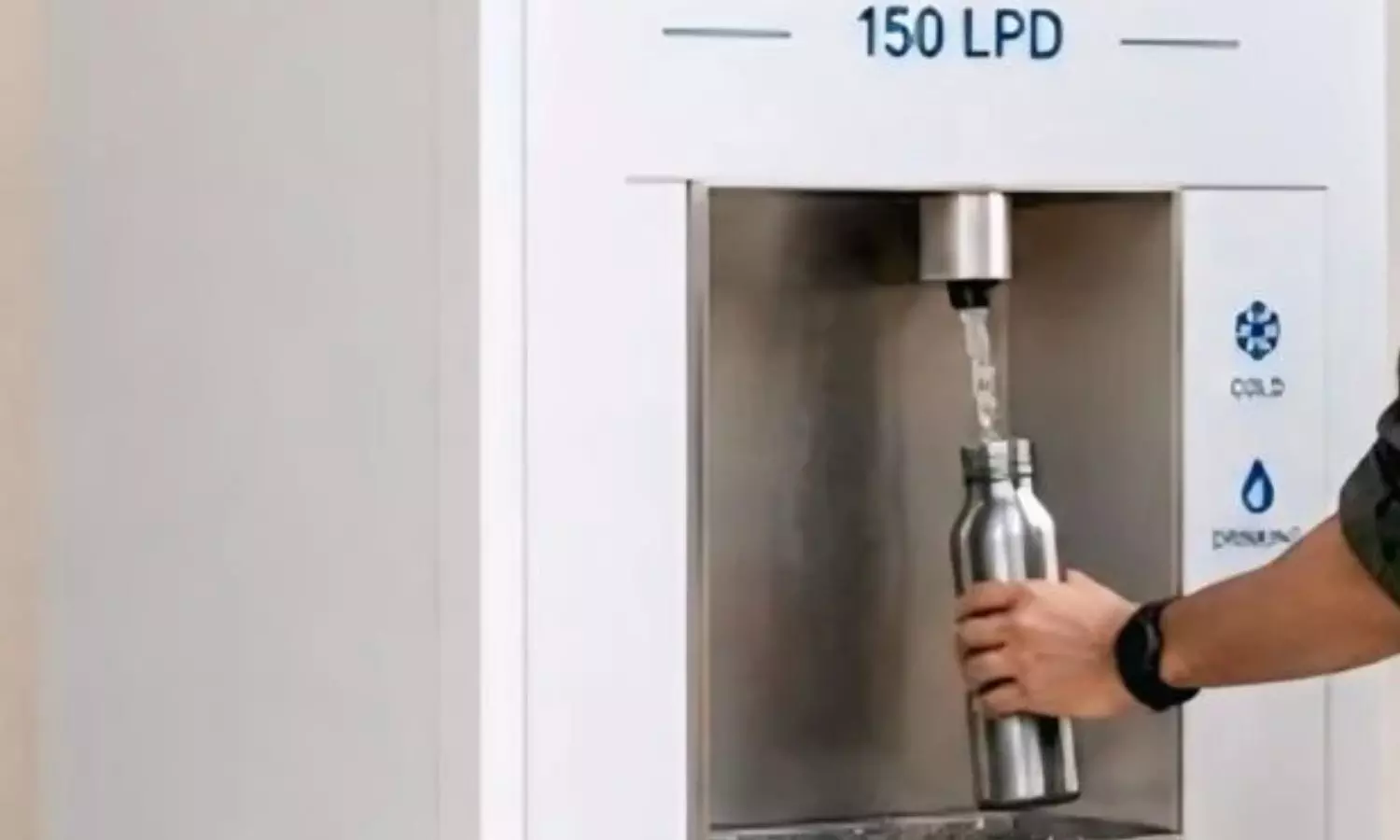
Vijayawada: Andhra Pradesh's extensive coastline could emerge as a major beneficiary of an innovative drinking water initiative that seeks to turn atmospheric moisture into safe, potable water. Energy Efficiency Services Limited (EESL), a joint venture of public-sector undertakings under the Ministry of Power, Government of India, is developing DHARA(Drinking Water from Humid Air with Reliable Availability), an innovative programme that harnesses atmospheric humidity to generate drinking water through Atmospheric Water Generation (AWG) technology. With this initiative EESL's makes its entry into decentralised drinking water security.
As per the directions of the Ministry of Power the EESL has contemplated to promote DHARA program across the country.. As part of this major initiative for the the first time the EESL plans to showcase the Air2 Water machine during the upcoming Public finance Summit at Vijayawada on 2-3 rd December 2026. CEO EESL Akhilesh Kumar Dixit thanked Ronald Ross the Secretary Finance department of AP Government to specifically show case the DHARA apart from the impact of Energy Efficiency technologies for sustainable economic and environmental sustainability in the State..
The CEO said that in a previous high level program held in Vijayawada Shri.Manohar Lal the Hon'ble Union Minister of Power Housing, Urban development has extended full support to the Hon'ble Chief Minister Shri N.Chandra Babu Naidu for accelerating energy efficiency and to implementing advanced technologies in Andhra Pradesh..
Accordingly the EESL has taken up several key Energy Efficiency programs across the country in MA& UD, PR & RD, Anganwadi centres, Housing, Industrial sector and particularly in pro- active States like Andhra Pradesh..
As far as the latest technology oriented initiative of DHARA was concerned,
with coastal Andhra Pradesh experiencing varying pressures on freshwater resources, particularly in vulnerable and remote locations, DHARA offers the potential for a decentralised and dependable supplementary source of drinking water. The initiative could prove particularly beneficial to districts such as Srikakulam, Vizianagaram, Visakhapatnam, Anakapalli, Kakinada, Dr B.R. Ambedkar Konaseema, East Godavari, West Godavari, Krishna, Guntur, Bapatla, Prakasam and SPSR Nellore, subject to site-specific climatic and technical assessments.
Unlike conventional drinking water systems that depend on groundwater extraction, surface water sources, pipelines or tanker supplies, DHARA uses atmospheric moisture to produce potable water at the point of consumption. The technology draws humid air through a filtration system, cools it to condense moisture into water, and subsequently subjects the collected water to multi-stage filtration, ultraviolet disinfection and re-mineralisation before hygienic storage.
Visakhapatnam offers particularly promising conditions for the technology. Preliminary assessments indicate that a typical 100-litre-per-day atmospheric water generation unit could achieve an indicative annual average output of approximately 88 litres daily, equivalent to around 350 glasses of drinking water. Its estimated output rises to approximately 97 litres daily during the monsoon and remains around 80–84 litres during other seasons. These figures are indicative and actual production depends on prevailing humidity, temperature and operating conditions.
The potential benefits extend well beyond urban centres. DHARA could provide drinking water support to schools, government hospitals, Primary Health Centres, Anganwadi centres, fishing communities, port facilities, defence establishments, educational campuses, tourism infrastructure and other public institutions. For remote coastal settlements and institutions facing irregular pipeline supplies or dependence on water tankers, the technology could offer an additional source of local water security.
Another important advantage is its potential contribution to disaster preparedness. Andhra Pradesh's coastline is periodically exposed to cyclones, floods and other extreme weather events that can disrupt conventional water supply networks and transportation. Since atmospheric water generation systems can operate independently of external water pipelines and tanker supply chains, appropriately deployed units could provide supplementary drinking water during emergencies and support continuity of essential public services.
DHARA also offers environmental advantages.
By reducing dependence on groundwater, minimising the transportation of drinking water and potentially replacing packaged drinking water, the initiative can contribute to water conservation, reduced plastic waste and lower logistics-related carbon emissions. Its decentralised approach could be particularly valuable for institutions seeking reliable drinking water without adding pressure on already stressed local water resources.
EESL proposes to implement DHARA through demand aggregation, technology standardisation, competitive procurement, quality assurance and innovative service-delivery models. These include Water-as-a-Service, with payments linked to verified litres supplied, as well as outright purchase options. Water quality will be tested against the IS 10500:2012 drinking water standard, while metered output and energy consumption will help ensure performance transparency.
Drawing on its experience in transforming India's energy-efficiency landscape through flagship programmes such as UJALA, the Street Lighting National Programme and the Smart Meter National Programme, EESL aims to apply a similar scalable implementation model to drinking water security.
DHARA represents an opportunity for Andhra Pradesh's coastal districts to convert their natural climatic advantage into a public benefit. By combining innovative technology with decentralised delivery, the initiative can complement existing drinking water infrastructure, strengthen climate resilience and help ensure more reliable access to safe drinking water.
EESL will undertake site-specific assessments based on location, humidity, electricity availability and daily water requirements before recommending deployment.


