




- Deepavali celebrated at Indiramma housing projects
- DCHS offices in every district to monitor hospital services
- BITS Hyderabad researchers develop low-cost insect trap
- Rice prices: Govt warns middlemen, hoarders against exploiting situation
- Keesara SI lands in ACB net; caught taking Rs 2 lakh bribe
- Digital resurvey to put an end to boundary disputes
- Congress will win 100 seats, Revanth to return as CM: TPCC chief
- Residents voice civic grievances to newly-elected 25th division corporator
Natural farming crops buck up cyclones fury
In Short
Field observations across 10 districts reveal significantly lower crop damage compared with chemical farming

Share :
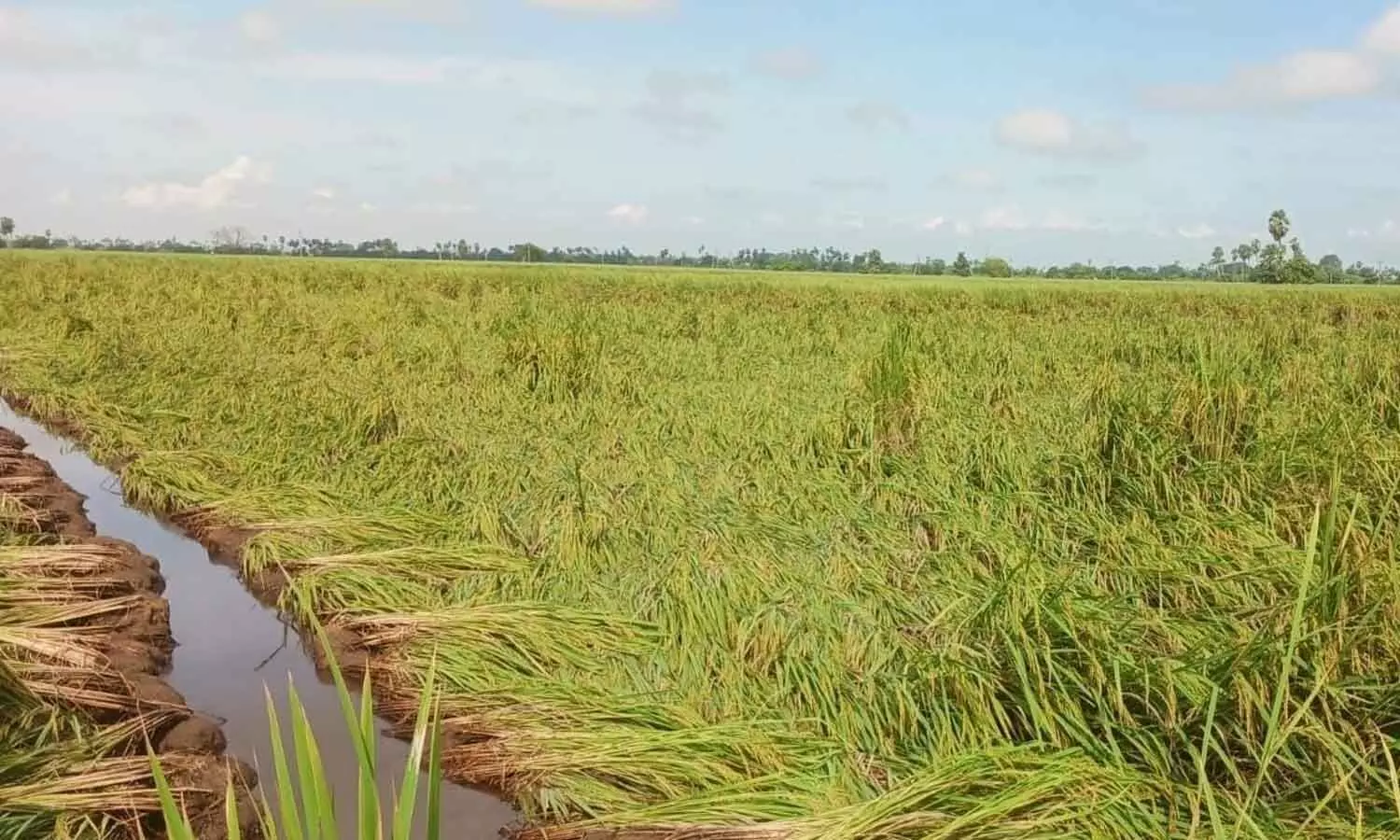
Chemcial farming paddy field of J Sanjiva Reddy in Krishna district
Vijayawada: Crops cultivated under Andhra Pradesh Community-managed Natural Farming (APCNF) have demonstrated significantly greater resilience to successive cyclones Arnab and Murasu compared to those grown under chemical farming, according to field-level observations across several districts of the state. While crop damage in chemical farming fields ranged from 40 to 100 per cent in several locations, Natural Farming fields generally reported zero to 20 per cent damage despite facing similar rainfall and wind conditions.
In Krishna district, at Katuru village in Uyuru mandal, paddy variety MTU-1318 cultivated by farmer Tummuru Sanjeeva Reddy under chemical farming was largely flattened, while the same variety grown by Gujjula Nagaraju through Natural Farming remained standing, as observed by District Collector D.K. Balaji during his visit on October 30.
In Guntur district, Natural Farming paddy fields at Erukalapudi remained upright, while neighbouring chemical farming crops were flattened. At Hanumanpalem, only 20 per cent of Natural Farming banana plants were uprooted, against nearly 80 per cent in the neighbouring chemical farming field.
In West Godavari district, around 70 per cent of Natural Farming paddy at Mogalthur remained standing, while the neighbouring chemical farming crop was completely flattened. At B Kondepadu, nearly 80 per cent of Natural Farming paddy survived.
In Prakasam district, natural farming chilli at Purumetla suffered no uprooting, compared with 40 per cent damage to chemical farming chilli. At Chinna Kothapalli, Natural Farming paddy remained standing, while nearly 70 per cent of the neighbouring crop was damaged. In Kakinada district, natural farming paddy at Yeleswaram recorded 61 tillers per plant and 18 cm root length, while the neighbouring chemical farming crop had 46 tillers and 13 cm roots, with nearly 80 per cent lodging. In Palnadu district, natural farming paddy and cotton crops remained stable despite rainfall of up to 147.45 mm and winds reaching 120 kmph. In Anakapalli district, Natural Farming paddy survived at Marepalli despite 261.5 mm rainfall and winds of up to 135 kmph.
In Bapatla district, natural farming paddy suffered zero to 15 per cent damage, against 80 to 95 per cent in neighbouring chemical farming fields. In Eluru district, Natural Farming paddy remained unaffected, while the neighbouring chemical farming crop suffered complete loss.
Similarly, in Srikakulam district, natural farming paddy fields at Boravelli and Bairi remained healthy and standing despite successive cyclones.
Practices such as pre-monsoon dry sowing, dravajeevamrutham, ghanajeevamrutham and botanical pesticides improve soil health, organic matter and water retention, contributing to stronger root and shoot systems and better crop anchorage.
These observations underline the potential of Natural Farming in building climate-resilient agriculture. The State Government aims to extend these practices to all 60 lakh farmers in Andhra Pradesh.


