Defiance to Compliance: Supreme Court Makes TVK Government See the Light

In Short

The lamp was lit at 5 pm under the supervision of a 13-member committee comprising retired High Court judges S. Vaidyanathan and S. Parthiban, Madurai District Collector Nishant Krishna, senior police officials and temple priests.

Supreme Court Makes TVK Government See the Light
X

 Supreme Court Makes TVK Government See the Light

Font size
FOLLOW ON Google News

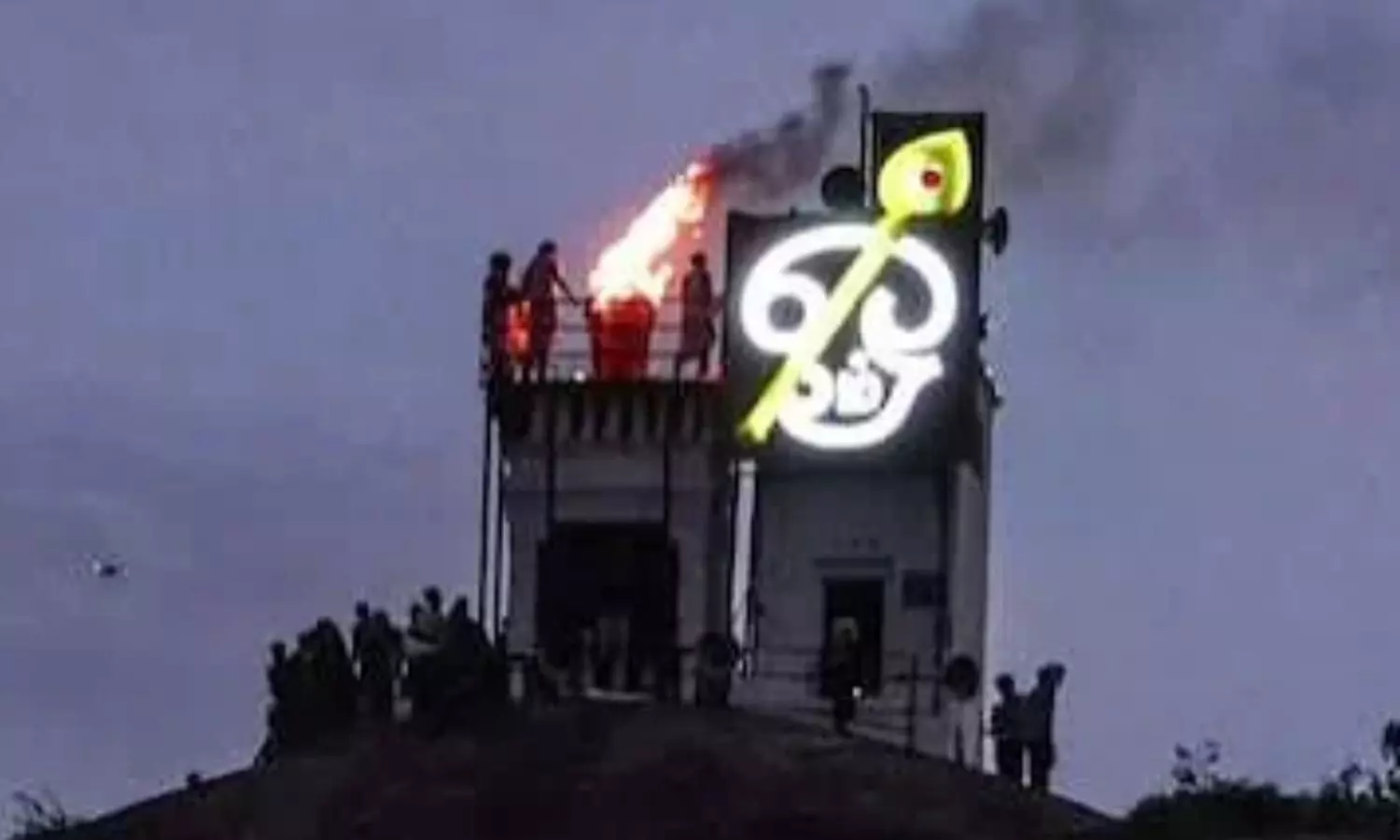
Finally, the sacred lamp at Deepathoon atop Tirupparankundram Hill in Tamil Nadu was lit amid celebrations and the bursting of firecrackers. People hailed it as a victory for Sanatana Dharma, made possible by the Supreme Court's intervention, which came down heavily on the state government.

The lamp was lit at 5 pm under the supervision of a 13-member committee comprising retired High Court judges S. Vaidyanathan and S. Parthiban, Madurai District Collector Nishant Krishna, senior police officials and temple priests.

This has clearly exposed how the TVK government and the Congress party attempted to build a false narrative around a possible law-and-order problem. What the government was compelled to do following the Supreme Court's strongly worded intervention could easily have been done on November 24, the day of Karthika Purnima. Such a decision would have earned the government appreciation from devotees as well as the apex court.

Instead, the TVK government demonstrated how inexperienced leadership could turn a relatively straightforward issue into a major controversy. The bureaucracy, too, must share the blame. It should have advised the political executive on how best to implement the court's directive. Instead, officials came up with arguments that failed to convince the court. The government argued that the temple trust board could not act independently of the Endowments Department. It also claimed that the priests had asked it to light the lamp only at the traditional spot near the Pillayar temple. The priests, however, denied this, stating that they had never been consulted.

The entire episode has not only provided ammunition for a political slugfest but has also opened the government to criticism that, like the previous DMK dispensation, the TVK government is also hostile to Sanatana Dharma. The BJP was quick to seize the opportunity and launch a sharp attack on the government.

However, on Saturday, as the appointed time for lighting the lamp approached, devotees celebrated the occasion by raising slogans of "Muruganukku Arohara" amid the beating of traditional drums.

Elaborate security arrangements were put in place, with Central Reserve Police Force (CRPF) personnel deployed across the hill and surrounding areas. An additional 400 CRPF personnel were brought in to reinforce security.

The Supreme Court had, on November 20, permitted the lighting of the lamp at the hilltop stone pillar during the Karthigai Deepam festival. The ceremony eventually passed off peacefully, without any untoward incident.

However, some Congress sympathisers and commentators have sought to muddy the waters by drawing comparisons with other religious sites, including Sabarimala, and questioning the deployment of CRPF personnel at Tirupparankundram.

The lighting of the sacred lamp at Deepathoon marks a significant development in the prolonged legal and religious dispute over Tirupparankundram, regarded as the first of the six sacred abodes of Lord Murugan.

A Journey of Three Decades Time passes faster than we realise. What feels like a journey that began only yesterday has today grown into more than three decades of a meaningful and fulfilling life devoted to education, journalism, and the empowerment of young minds. My professional journey began with journalism training in New Delhi in 1979. I went on to work as an independent journalist, drawing on my fluency in both English and Telugu. Over the years, I have edited and worked on Telugu articles in both languages, an experience that strengthened my command of language and sharpened my understanding of society, people, and contemporary issues. Yet, my principal profession and enduring passion have always been teaching. My decision to become a teacher was not merely a career choice—it was a calling. Teaching offered me the rare privilege of inspiring young minds, guiding them through their formative years, and making a lasting difference in their lives. I found immense satisfaction in simplifying complex concepts, nurturing curiosity, encouraging independent thought, and building confidence among students. Every moment in the classroom—every question, every moment of discovery, and every spark of understanding—reminded me why I had chosen this path: to empower young people through knowledge, values, and essential life skills. My teaching career began at the grassroots level as a Montessori teacher and gradually progressed to the position of Vice Principal. I had the opportunity to work in reputed educational institutions, including Dilsukhnagar Public School in Hyderabad, where I shouldered both teaching and administrative responsibilities. Although I have always considered myself, at heart, a teacher, my administrative experience enabled me to understand and contribute to the education system from a much broader perspective. For my students, I have always tried to be an approachable and dependable presence—someone they could turn to not only for academic support, but also for guidance and emotional encouragement. At the same time, I developed a reputation as a firm disciplinarian who believed that integrity, fairness, responsibility, and discipline were fundamental to education. I was also consistently appreciated for maintaining clear communication with parents and staff and for ensuring that examinations and other academic processes were conducted with transparency, fairness, and efficiency. As my career progressed, however, I began to feel that academic education alone was not enough. This realization led me to work more closely with students following the SSC and CBSE curricula, while consciously bringing life-skills education into my teaching. I came to understand that education becomes truly meaningful when it prepares children not merely to pass examinations, but to face life. Teaching emotional resilience, self-reliance, social awareness, communication, decision-making, and other practical life skills often had a deeper and more lasting impact than academic achievement alone. I saw how these skills could help students navigate challenges with greater confidence, maturity, and responsibility. My academic background provided a strong foundation for this approach. My degree in Psychology from the University of Madras helped me develop a deeper understanding of young people's minds, their emotional needs, and the influence of their family and social environments. My M.A. in Telugu with First Class from Osmania University.

Next Story
      Share it