




- UP: Rs 8 lakh compensation for lives lost in disaster, 30 pc higher compensation for crop losses
- 1984 anti-Sikh massacre trials conducted like institutional fraud, says former judge
- BJP leader Ravi Kumar demands apology from Priyank Kharge over ‘village idiot’ remark
- Karnataka CM Shivakumar to attend LoP Gandhi's meeting in Delhi, call on Union Ministers
- Anil Ravipudi And Venkatesh’s January 12 Vidudala Team Heads To Kazakhstan
- Mahesh Babu Too Heaps Praises On Nitish Tiwari’s Ramayana
- OpenAI Launches GPT-6 Cyber, Uncovers 81 Firefox Flaws and 948 Linux Exploits
- J’khand road accident: President Murmu expresses grief, extends condolences to bereaved families
‘Hope You Are Enjoying Delhi Weather’: CJI Flags Vehicular Pollution As Supreme Court Hears Delhi-NCR Air Crisis
In Short
The Supreme Court on Friday said it had serious concerns to raise in view of the rising pollution level in Delhi-NCR and Chief Justice of India (CJI) Surya Kant pointed out that stubble burning and vehicular emissions were significant factors in the issue.

Share :
Supreme Court
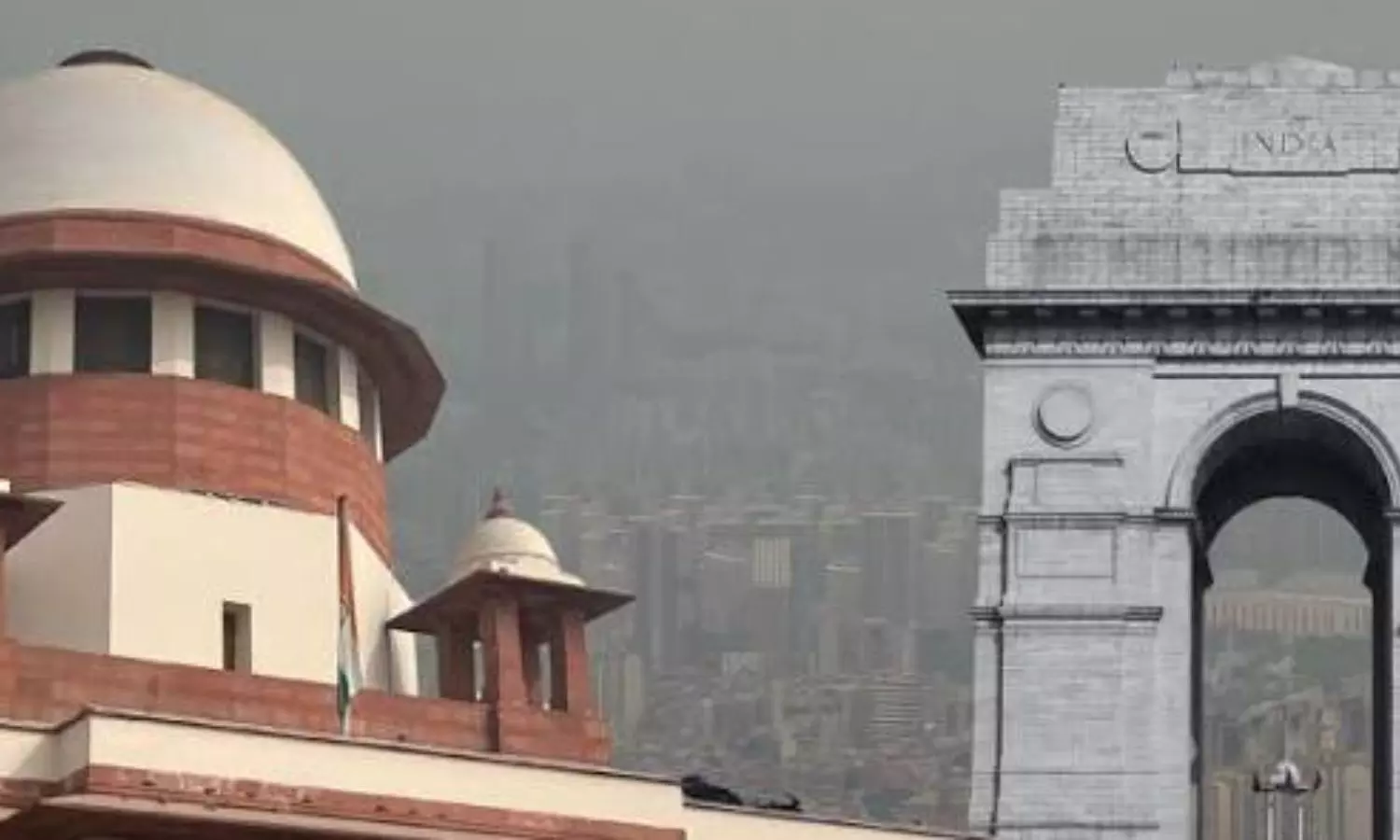
The Supreme Court on Friday said it had serious concerns to raise in view of the rising pollution level in Delhi-NCR and Chief Justice of India (CJI) Surya Kant pointed out that stubble burning and vehicular emissions were significant factors in the issue. During the hearing, the CJI made a pointed remark, saying, “We hope all of you are enjoying Delhi weather.
The three-judge bench presided over by CJI Surya Kant and Justices Joymalya Bagchi and V Mohana was considering a suo motu case concerning air pollution in NCR.
Pollution levels remain severe
In the course of the proceedings, senior advocate Aparajita Singh appeared as amicus curiae in the court in which he informed that pollution levels were on the verge of reach the severe category. She also pointed out the effects of poor air quality on health, noting it is like smoking 30 cigarettes per day.
The CJI remarked that Delhi was witnessing a decrease in pollution after the rains. Singh told the court that stubble burning added 14 per cent to the pollution on November 5 and the national capital was already suffering from poor air quality before the addition of stubble burning to the mix.
She pointed out that one of the most significant sources of pollution is transportation, and that it is essential to take action on local emissions, energy related pollution and burning of waste in the NCR region.
CJI calls for better stubble management
The bench also discussed measures to prevent stubble burning, with the CJI observing that the ongoing sowing season should mean a reduction in farm fires.
However, Singh pointed out that providing machinery to farmers alone would not resolve the problem. She said many farmers could not afford the fuel required to operate the equipment and that such machines were not always suitable for smaller agricultural fields.
Justice Joymalya Bagchi referred to a proposal under which authorities could procure stubble from farmers at a fixed price.
The CJI suggested that procurement rates should be announced well in advance and that stubble-management machinery should be provided to gram panchayats instead of individual farmers, who may not be able to afford expensive equipment.
The bench also discussed creating storage facilities for collected stubble, which could provide an additional source of income for those involved in its management.
The Centre's counsel informed the court that several measures had been introduced to tackle stubble burning and that farm fires had declined significantly this year, particularly in Haryana.
Vehicular emissions under Supreme Court's scrutiny
The discussion then shifted to vehicular pollution, with the CJI identifying traffic congestion on roads connecting Delhi to neighbouring NCR cities as a major concern.
He pointed to the large number of vehicles moving bumper-to-bumper on these routes and stressed the need to improve public transportation.
The Additional Solicitor General informed the bench about measures such as phasing out diesel-operated rickshaws and regulating buses entering Delhi from other cities.
Singh also flagged incomplete implementation of an earlier court order concerning toll plazas. She said vehicles were being stopped at NCR borders and left idling, further contributing to pollution. The Centre's counsel acknowledged that the order had not been fully implemented.
CJI questions pollution during Diwali
The court also talked about the effects of the seasons on air quality. Singh had said smoke is able to dissipate more freely in summer and is likely to hang around in winter.
The CJI called for greater awareness about traditional practices and questioned why people could not return to their original customs during festivals.
Singh suggested that using traditional diyas during Diwali would be preferable. She also highlighted how poorer sections of society were among the worst affected by pollution.
The CJI observed that while poorer people often suffer the consequences of deteriorating air quality, those who can afford expensive celebrations and treat firecrackers as a status symbol also contribute to the problem.
Delhi's AQI approaches 400
During the hearing, he expressed his concern on the city's air quality as the Air Quality Index (AQI) had hit near 400, the CJI said.
Delhi's air quality index (AQI) was 389 at 8 am on Friday, which is a very poor category, according to the Central Pollution Control Board (CPCB). Several readings were high across the city.
The AQI for IIT Delhi was 474, Rohini AQI was 474 and Punjabi Bagh AQI was 465. Severe pollution level was also reported in other areas such as RK Puram, ITO, Firoz Shah Road & India Gate.
Meanwhile, authorities deployed truck-mounted water sprinklers around India Gate as part of pollution-control measures under Stage II of the Graded Response Action Plan (GRAP).
Despite the measures, residents continued to report discomfort amid worsening air quality.


