






- Anthropic Launches Claude Ship to Review and Approve Code Changes
- Drone strikes in Sudan threaten humanitarian operations: UN
- Schools across Denmark receive bomb threats, police say threats not 'credible'
- ‘Takes a toll on bowlers’ bodies; we were happy’: Daryl Mitchell on India’s decision to settle for draw in 1st Test
- Delhi Police reunites two minor sisters from Madhya Pradesh with father after nearly two months
- Varanasi imposes traffic restrictions ahead of Dev Deepawali celebrations today
- Petrol and diesel prices today in Hyderabad, Delhi, Chennai and Mumbai on 24 November 2026
- Gold and Silver rates today, 24 Nov, 2026 in Hyderabad, Visakhapatnam, check gold prices of 18K, 22K, 24K
Karthigai Deepam Row: Religious Dispute Turns Political Flashpoint
In Short
The Thiruparankundram Deepathoon dispute over Karthigai Deepam lighting has escalated into a legal and political controversy involving the Tamil Nadu government, temple authorities and Supreme Court.

Share :
Karthigai Deepam Row: Religious Dispute Turns Political Flashpoint
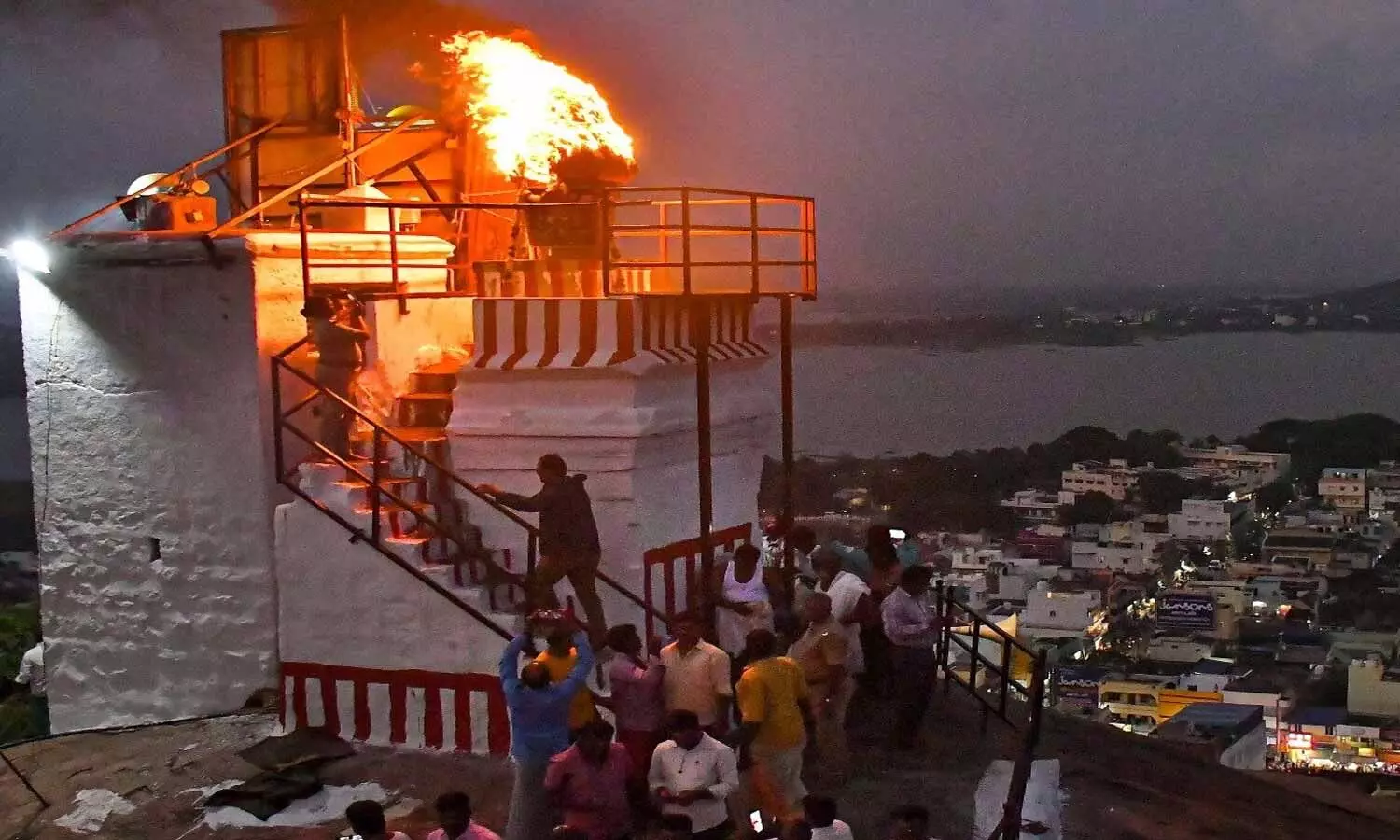
Devotees have carried a ceremonial cauldron, 4,500 litres of ghee and cotton cloth to the summit of Annamalai Hill, behind the Arunachaleswarar Temple, where the Maha Deepam will be lit at 6 pm on Tuesday. An estimated 50 lakh devotees are expected to participate in the celebrations at Tiruvannamalai.
The annual ritual has traditionally been conducted without objections from the local Muslim community, even though a controversy over the ownership of the hill dates back to 1920. However, the dispute over lighting the Karthigai Deepam at a stone pillar on Thiruparankundram Hill near Madurai has now emerged as a major political and legal controversy in Tamil Nadu.
The DMK government had opposed the lighting of the lamp at the Deepathoon during its tenure. The present TVK government has also challenged the move, arguing that there is no established historical or customary practice of lighting the Karthigai Deepam at that particular location.
The traditional procedure at Tiruvannamalai is that, after special prayers, devotees carry the ceremonial vessel up the hill. The ghee and cotton cloth used for the wick are taken separately. On the night before Maha Deepam, the Panchamurthis, the five principal processional deities, are taken through the streets on ceremonial mounts.
On the morning of Maha Deepam day, a procession accompanied by the beat of drums is taken out. As the deities pass, devotees lining the streets break coconuts and light camphor as an offering.
The evening procession begins at 10 pm. The deities carried through the streets include Murugan with his consorts Valli and Deivanai, Arunachaleswarar with Unnamulai Amman, Parasakthi Amman, Vinayakar and Chandikeswarar.
The controversy discussed here, however, concerns the lighting of the traditional Karthigai Deepam at a stone pillar known as the Deepathoon on Thiruparankundram Hill near Madurai.
What began as a dispute over the location of a religious ritual has evolved into a major legal and political controversy involving the Madurai Subramaniya Swamy Temple, the adjoining Sulthan Sikkandar Avulia Dargah, the Tamil Nadu government, the Madras High Court and, subsequently, the Supreme Court.
The dispute, dates back to 1920, has primarily concerned the boundaries of the hill and the respective religious and access rights of the temple and the dargah. It was not originally a dispute over Hindu devotees lighting the Karthigai Deepam.
The issue has now become more complicated, with the state government opposing the lighting of the lamp at the Deepathoon. Devotees, meanwhile, insist that the ritual should be permitted at the location. The matter has moved from the Madras High Court to the Supreme Court, with the state government challenging the directions issued by the High Court.
The Dargah's principal objection is that the hilltop area is connected with its established religious and access rights. The Tamil Nadu government has questioned the historical basis for the proposed ritual and raised concerns about public order, existing practices and the implications of the court's directions.
The BJP, however, alleges that the issue became complicated only after the previous DMK government encouraged sections of the Muslim community to oppose the ritual at the stone pillar.
The BJP and Hindu organisations maintain that the Deepathoon is reportedly around 50 metres from the Sulthan Sikkandar Avulia Dargah. They argue that since the lighting of the lamp is an annual ritual, no obstruction should be created.
A look at the timeline shows that the dispute dates back to 1920, when the Subramaniya Swamy Temple Devasthanam filed a civil suit claiming ownership of the hill. In 1923, the trial court recognised the temple's rights over much of the unoccupied hill and the pilgrim pathway, while protecting the rights of the dargah. The court also divided the rights over different portions of the hill.
However, the litigation between the temple authorities and the other parties continued into the 1930s, eventually reaching the Privy Council.
There have been claims that the Karthigai Deepam was regularly lit at the hilltop until a fresh dispute arose in 1994. However, the DMK government informed the court that there was no recorded evidence to establish such a practice.
In 1994, devotees sought permission to light the Karthigai Deepam at the hilltop. In 1996, the Madras High Court directed that the lamp be lit at the Uchi Pillaiyar Temple mandapam. The High Court also permitted the consideration of an alternative location, subject to maintaining a minimum distance of 15 metres from the dargah.
In 2017, a Division Bench of the Madras High Court asked the temple authorities not to introduce new religious practices without establishing that they were accepted customs.
In 2021, a proposal to replace the wooden flagstaff with an iron one atop the hill led to another dispute. Disagreements over various activities on the hill continued, while an attempted animal sacrifice further escalated tensions.
In 2025, a devotee, Rama Ravikumar, sought permission from the temple authorities to light the Deepam at the Deepathoon. The temple administration refused, maintaining that the designated location for the ritual was near the Uchi Pillaiyar Temple.
In December 2025, the Madras High Court directed the temple administration to light the Karthigai Deepam at the Deepathoon in addition to the existing location. However, the temple administration did not light the lamp there on December 3, 2025.
This led to contempt proceedings, following which the court directed that a small group of devotees be allowed to light the lamp with CISF protection. The administration, however, imposed prohibitory restrictions, citing the possibility of law-and-order problems.
On January 6, 2026, the Madras High Court upheld its direction to light the lamp at the Deepathoon with a small group of devotees, while restricting public access. The Tamil Nadu government challenged the order in the Supreme Court.
The Supreme Court permitted the Deepam to be lit at the disputed pillar as a one-time interim arrangement. However, on November 21, 2026, the TVK government filed a review petition seeking reconsideration of the Supreme Court's interim order. It argued that there was no established historical or customary practice of lighting the Karthigai Deepam at the Deepathoon.
Thus, what began as a dispute over the ownership and use of parts of a hill has turned into a larger contest over religious custom, judicial authority and the role of the state in religious affairs.
Karnataka BJP accuses Cong govt of sacrificing farmers' interests by releasing Cauvery water to Tamil Nadu
Big News: Megastar Chiranjeevi Teams Up With Netflix For The ‘Megaverse’ Talk Show
Jhansi Rajender Reddy visits Jwalamukhi and Baglamukhi Shakti Peethas
Lewis-Potter brace inspires Brentford to emphatic win over 10-man Everton
Maha Deepam Ritual Enters Final Stage Amid Heavy Police Bandobust
Kartika Purnima brings throngs of people to Shiva temples across Telangana
How PM Modi led restoration of historic Lakhpat Gurdwara in Kutch while serving as Gujarat CM
Nvidia Reinstates Jensen Huang as CEO After White House Intervention; Board Cites National Security Clearance
Heavy rain likely in nine Tamil Nadu districts today
Nara Lokesh extends Kartika Purnima greetings


