




- Repolling at Tirupati booth records 21.62 percent turnout by 11 am
- Kerala PSC faces fresh scrutiny over DySP recruitment amid ongoing probe
- Six killed in van-truck collision in UP's Kushinagar
- 'We walk away in a stronger position': McDonald backs Australia batting unit despite SA thrashing
- India’s manufacturing sector logs another strong expansion in Oct: PMI data
- HBD Shah Rukh Khan: 33 Iconic Dialogues Of Bollywood’s Badshah
- India, Australia conclude 5th edition of joint military exercise AUSTRAHIND 2026
- UP CM expresses grief over Kushinagar road accident, assures assistance
Murasu Threatens Andhra Coast: IMD Warns Issues Storm Surge Warning
In Short
Murasu is a Tamil word meaning a drum, particularly a traditional war drum. India proposed this name to the World Meteorological Organization's regional cyclone-naming panel.

Share :
Murasu Threatens Andhra Coast: IMD Warns Issues Storm Surge Warning
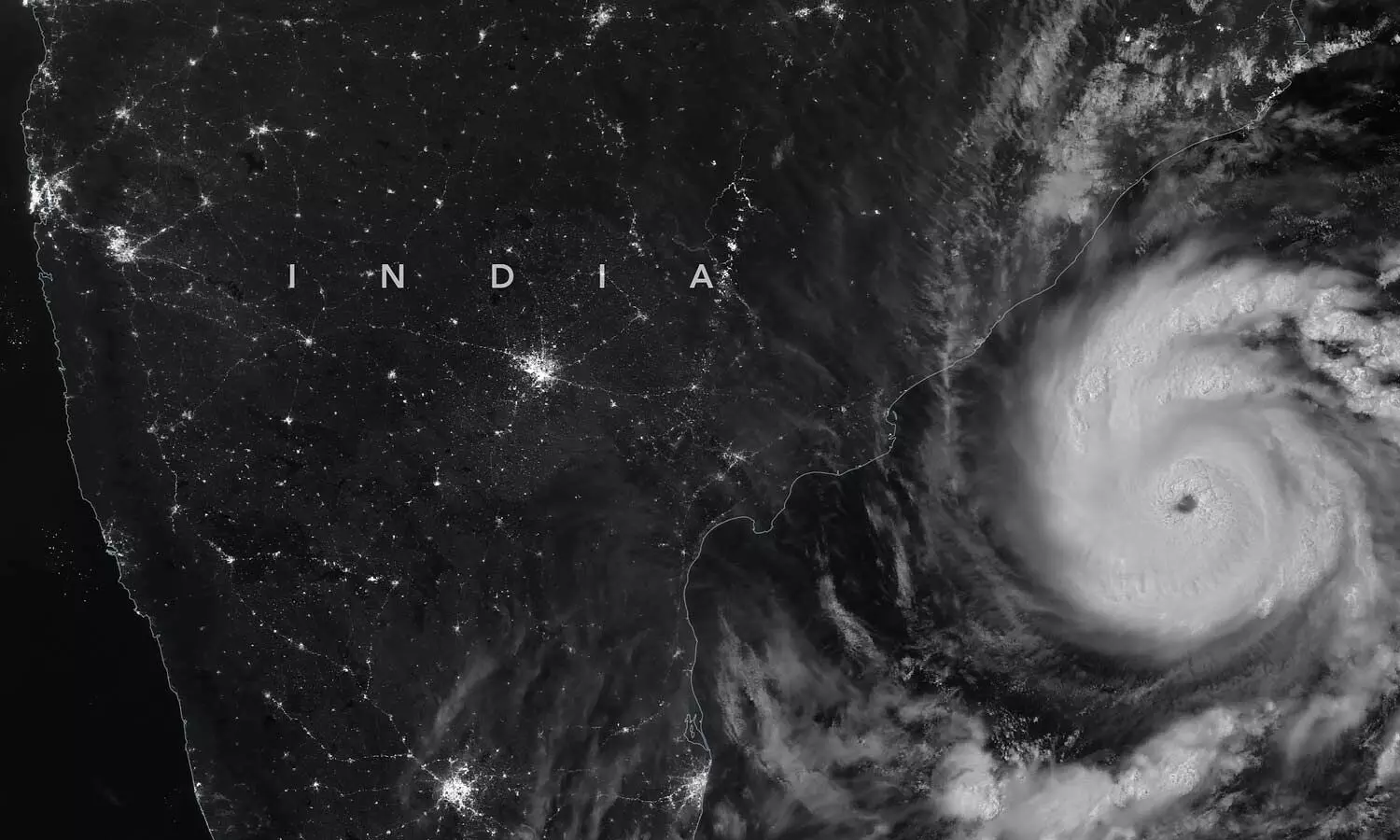
Even as Andhra Pradesh is yet to fully recover from the impact of Cyclone Arnab, which left a trail of devastation in North Coastal Andhra Pradesh, the state is now gearing up to meet the challenge from the ‘Murasu’ cyclone, which will have its impact on South Coastal Andhra Pradesh, consisting of Nellore, Kavali, Ongole, Bapatla, Machilipatnam, and Narsapur, where the landfall is expected around 11.30 pm on Monday night or in the early hours of Tuesday.
According to IMD, the severe cyclonic storm is centred around 170 kms east-northeast of Chennai and about 160 km east-southeast of Nellore and 180 km from Kavali. It is moving northwestwards at around 25 kmph. The sustained wind speed according to the IMD is likely to be around 100-120 kmph. The impact of this would be felt in neighbouring Tamil Nadu and Karnataka states as well. Even Telangana is witnessing cloudy weather on Monday.
Krishna district is expected to receive very heavy rains.
Andhra Pradesh Chief Minister N Chandrababu Naidu, who has been constantly reviewing the situation, spoke to his counterparts, Tamil Nadu CM Joseph Vijay and Karnataka CM D K Shivakumar, over the phone and requested them to send the necessary machinery and personnel to undertake restoration of snapped power supply and take up infrastructure restoration works. About 500 personnel have already arrived from Telangana.
According to officials, there is a possibility of damage to six to eight thousand electric poles, which could cause power disruption on a large scale.
The weather department has warned people planning to travel to Srisailam, Nagarkurnool, Markapuram, Cumbum, and Atmakur to avoid the ghat road on November 3-5 as this is the period when peak rains are expected causing landslides.
Nalgonda, Nagarkurnool, Mahabubabad, Khammam, Bhadradri, Kothagudem, Mulugu, Suryapet, Rangareddy, Yadadri and Bhongir districts have been witnessing scattered rains. Hyderabad is likely to see scattered rain during the noon and night.
The Bay of Bengal is one of the world's most cyclone-prone regions, particularly during the post-monsoon season from October to December. However, six cyclones do not necessarily form every year; the number varies from season to season.
Murasu is a Tamil word meaning a drum, particularly a traditional war drum. India proposed this name to the World Meteorological Organization's regional cyclone-naming panel.
The names of the cyclones are decided based on the list of names submitted by thirteen countries, including India, Bangladesh, Sri Lanka, Pakistan and Thailand, contribute names. Arnab, the name of the recent cyclone, was suggested by Bangladesh. The names are used sequentially according to an agreed list. A name is assigned when a weather system reaches cyclonic storm intensity. Once used, a name is not repeated.
The important point is that Murasu is approaching the coast as a severe cyclonic storm. It is not merely a rain-bearing depression.
This is a particularly important danger. IMD has warned of a possible 1–1.5 metre storm surge above astronomical tide, which could inundate low-lying coastal areas. Bapatla, Krishna and Prakasam districts are identified as particularly exposed.
Damage to electricity poles, trees, communication networks, houses with weak roofs, standing crops and coastal infrastructure is possible. Localised flooding and waterlogging are also major concerns.


