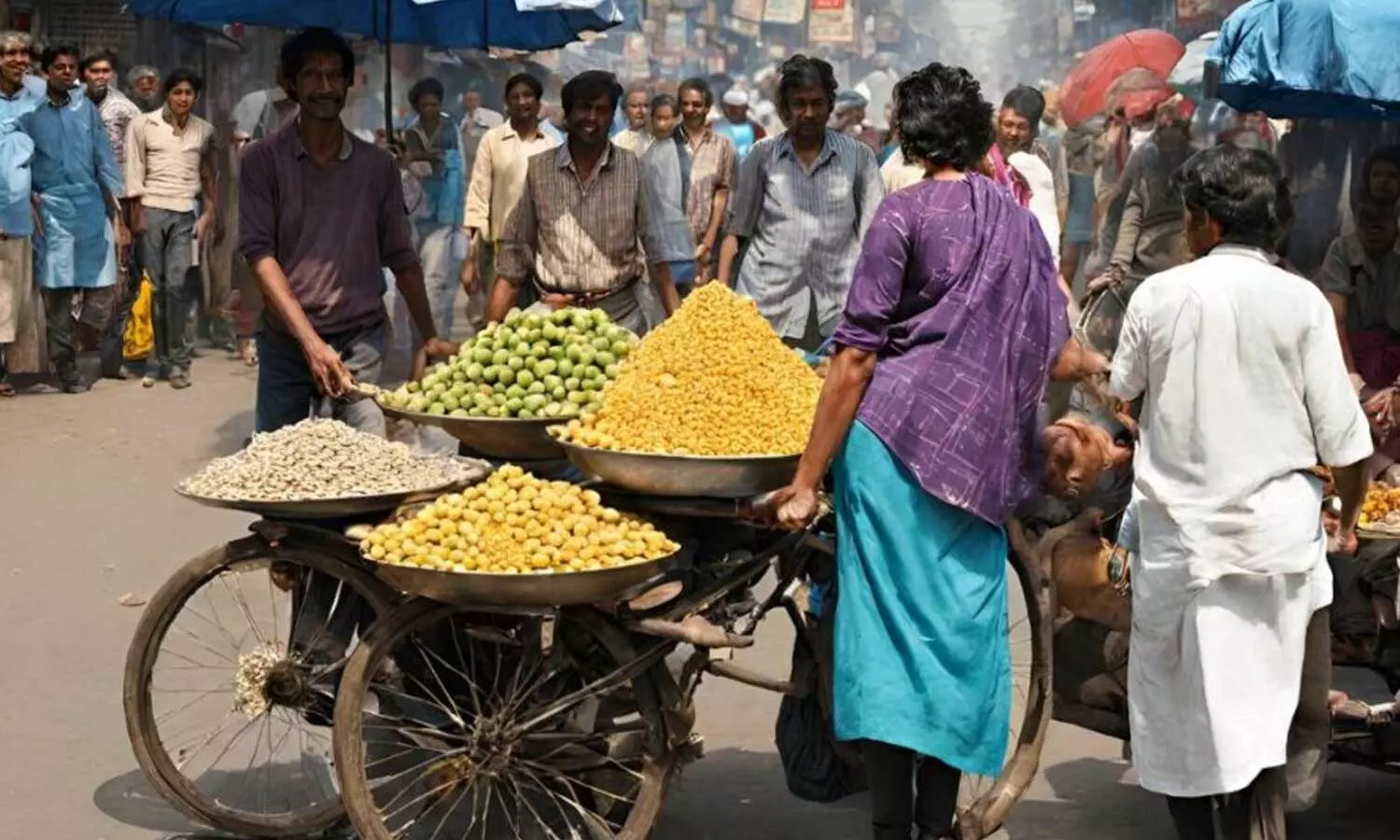
The common people and street vendors in Janpath Market and adjoining commercial areas of the national capital heaved a sigh of relief on Wednesday, welcoming the decision to shift the protest site. They said the move would spare them road closures, traffic diversions, congestion and loss of business.
Frequent protests by various political parties and groups, including the Cockroach Janata Party (CJP), demanding the resignation of Chief Election Commissioner Gyanesh Kumar had severely affected customer footfall during the crucial festive shopping season.
The vendors said they often get goods on short-term credit. When protests hit their business, they suffer losses and struggle to repay their dues, creating further financial problems. They felt this was not the right season for demonstrations. According to them, they had lost 90% of the business this season.
“This is the festive season, but protests by political parties are affecting our daily earnings,” they said. Some vendors had stocked products for the Garba season, but their businesses suffered because of the protests.
The vendors argued that demonstrations should be held during the hot summer months of May and June, rather than during the festive season, when business normally picks up. Saturdays and Sundays, in particular, are crucial for sales, but they said they had been forced to shut their shops due to protests.
Political parties should not disrupt the livelihoods of small vendors during the festive season, they pleaded.
The vendors said political parties must understand that small traders live from hand to mouth and do not have large bank balances to fall back on.
“We are less privileged. Political parties may have plenty of money, and that is why they can take to the streets,” they said.
Another vendor said the protests had disrupted business across Connaught Place, affecting ordinary people and causing heavy losses to small traders who had to keep their shops closed.
“I have a glasses shop and a garments shop. Both were closed because of the protests,” he said.
Another vendor argued that political parties could stage demonstrations elsewhere without harming the interests of the general public. Markets such as Connaught Place, Palika Bazaar and Janpath had all been affected, they said.
One vendor said he was unsure whether vote theft had taken place, adding that his own vote had not been stolen. He also pointed to another consequence of such protests: while politicians and party activists could often secure bail if arrested, ordinary people caught up in the demonstrations could find it difficult to do so because they lacked the resources.
Shopkeeper Abbas described the impact on his business in stark terms.
“The shops opened after three days; only two pieces were sold. What should we sell, and how do we feed the children?” he asked.
For him, the opposition's political agenda was secondary to the immediate challenge of earning a livelihood and feeding his children.
A Journey of Three Decades Time passes faster than we realise. What feels like a journey that began only yesterday has today grown into more than three decades of a meaningful and fulfilling life devoted to education, journalism, and the empowerment of young minds. My professional journey began with journalism training in New Delhi in 1979. I went on to work as an independent journalist, drawing on my fluency in both English and Telugu. Over the years, I have edited and worked on Telugu articles in both languages, an experience that strengthened my command of language and sharpened my understanding of society, people, and contemporary issues. Yet, my principal profession and enduring passion have always been teaching. My decision to become a teacher was not merely a career choice—it was a calling. Teaching offered me the rare privilege of inspiring young minds, guiding them through their formative years, and making a lasting difference in their lives. I found immense satisfaction in simplifying complex concepts, nurturing curiosity, encouraging independent thought, and building confidence among students. Every moment in the classroom—every question, every moment of discovery, and every spark of understanding—reminded me why I had chosen this path: to empower young people through knowledge, values, and essential life skills. My teaching career began at the grassroots level as a Montessori teacher and gradually progressed to the position of Vice Principal. I had the opportunity to work in reputed educational institutions, including Dilsukhnagar Public School in Hyderabad, where I shouldered both teaching and administrative responsibilities. Although I have always considered myself, at heart, a teacher, my administrative experience enabled me to understand and contribute to the education system from a much broader perspective. For my students, I have always tried to be an approachable and dependable presence—someone they could turn to not only for academic support, but also for guidance and emotional encouragement. At the same time, I developed a reputation as a firm disciplinarian who believed that integrity, fairness, responsibility, and discipline were fundamental to education. I was also consistently appreciated for maintaining clear communication with parents and staff and for ensuring that examinations and other academic processes were conducted with transparency, fairness, and efficiency. As my career progressed, however, I began to feel that academic education alone was not enough. This realization led me to work more closely with students following the SSC and CBSE curricula, while consciously bringing life-skills education into my teaching. I came to understand that education becomes truly meaningful when it prepares children not merely to pass examinations, but to face life. Teaching emotional resilience, self-reliance, social awareness, communication, decision-making, and other practical life skills often had a deeper and more lasting impact than academic achievement alone. I saw how these skills could help students navigate challenges with greater confidence, maturity, and responsibility. My academic background provided a strong foundation for this approach. My degree in Psychology from the University of Madras helped me develop a deeper understanding of young people's minds, their emotional needs, and the influence of their family and social environments. My M.A. in Telugu with First Class from Osmania University.