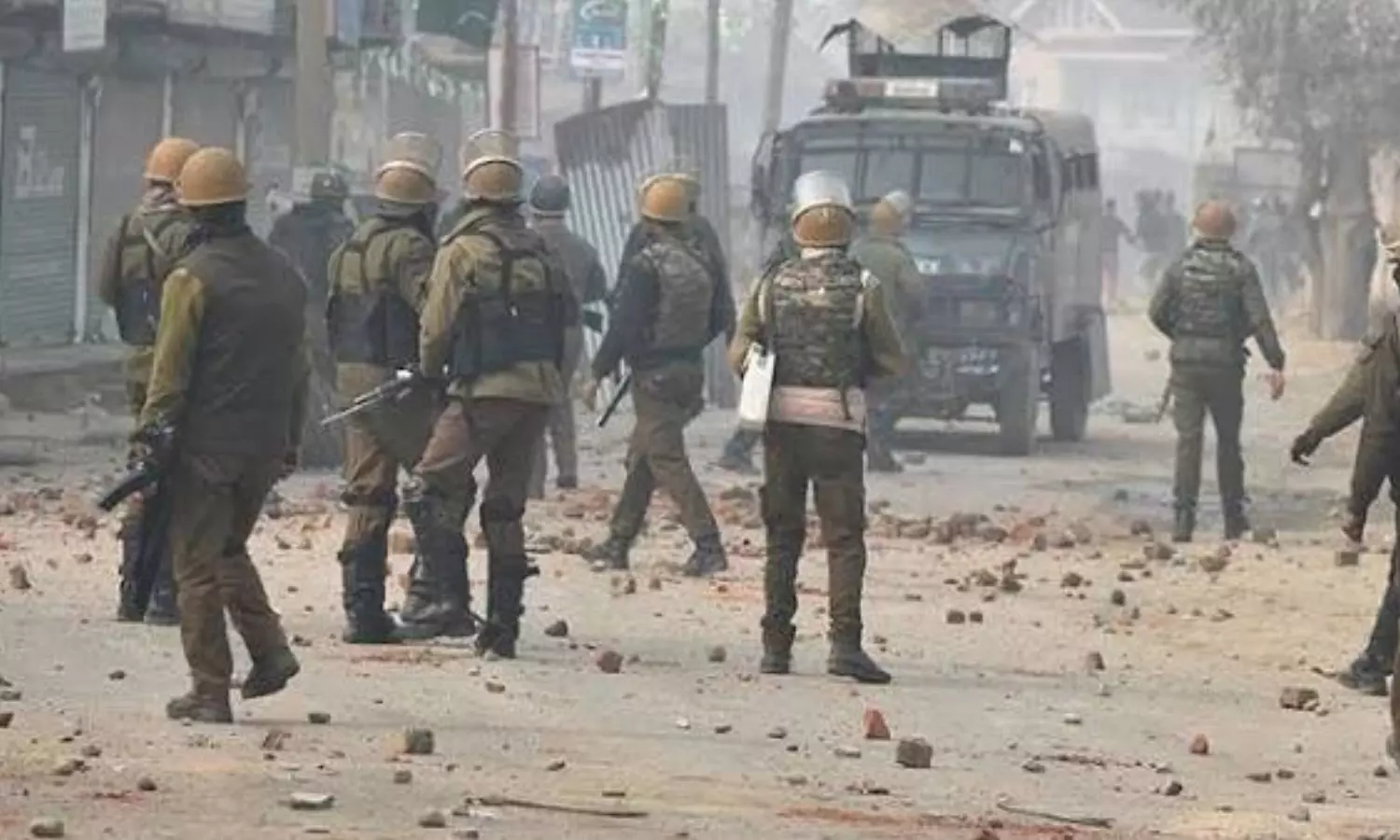
Twin Terror Attacks in J&K Reignite Debate Over Article 370
In Short
Instead of standing by the government, they have been criticising the Centre for abrogating Article 370. Jammu and Kashmir Deputy Chief Minister Surinder Choudhary asked what had changed at the ground level since the state’s special status was removed.
The opposition parties had opposed the abrogation of Article 370, which had effectively done away with the special status enjoyed by Jammu and Kashmir are now up in arms against the Union Government following the two terror attacks in Kulgam and Kishtwar in Jammu and Kashmir in a span of 24 hours.
Instead of standing by the government, they have been criticising the Centre for abrogating Article 370. Jammu and Kashmir Deputy Chief Minister Surinder Choudhary asked what had changed at the ground level since the state’s special status was removed.
"Militancy was there before 2019, and it is still happening today. There was an attack yesterday (in Kulgam), and there was another militant attack today (in Kishtwar). If people were getting martyred then and are still losing their lives today, what has actually changed?" The National Conference leader said.
The National Conference chief Farooque Abdullah, while stating that the terrorists will not succeed in their attempts, said that those in Delhi who keep “shouting” that terror has been wiped out should think over these attacks and see the ground realities.
Meanwhile, the Security agencies are pursuing Mohammad Lateef Bhat in connection with the Kulgam attack in which three Central Reserve Police Force (CRPF) personnel were injured.
It is said that Bhat has been on the radar of security agencies for some time; the emergence of a relatively new outfit, the Kashmir Revolutionary Army (KRA), has added a new dimension to the investigation. Bhat is believed to be associated with the outfit, which security agencies suspect is a proxy organisation of the Lashkar-e-Tayiba (LeT).
Analysts would describe the KRA as an offshoot of the Resistance Front (TRF). The front organisation is the Lashkar, and the TRF was created following the abrogation of Article 370 in August 2019.
The TRF was meant to give the LeT an indigenous appearance. The TRF was first banned by India. Following the Pahalgam attack, the United States also designated the TRF Front as a Foreign Terrorist Organisation in July 2025.
According to reports in news agencies, an Intelligence Bureau official said that the KRA and TRF are one and the same, and they share the same handlers, ground operatives and their recruitment pipelines are identical. These new outfits, it is said, are created to shield the parent body LeT.
A Journey of Three Decades Time passes faster than we realise. What feels like a journey that began only yesterday has today grown into more than three decades of a meaningful and fulfilling life devoted to education, journalism, and the empowerment of young minds. My professional journey began with journalism training in New Delhi in 1979. I went on to work as an independent journalist, drawing on my fluency in both English and Telugu. Over the years, I have edited and worked on Telugu articles in both languages, an experience that strengthened my command of language and sharpened my understanding of society, people, and contemporary issues. Yet, my principal profession and enduring passion have always been teaching. My decision to become a teacher was not merely a career choice—it was a calling. Teaching offered me the rare privilege of inspiring young minds, guiding them through their formative years, and making a lasting difference in their lives. I found immense satisfaction in simplifying complex concepts, nurturing curiosity, encouraging independent thought, and building confidence among students. Every moment in the classroom—every question, every moment of discovery, and every spark of understanding—reminded me why I had chosen this path: to empower young people through knowledge, values, and essential life skills. My teaching career began at the grassroots level as a Montessori teacher and gradually progressed to the position of Vice Principal. I had the opportunity to work in reputed educational institutions, including Dilsukhnagar Public School in Hyderabad, where I shouldered both teaching and administrative responsibilities. Although I have always considered myself, at heart, a teacher, my administrative experience enabled me to understand and contribute to the education system from a much broader perspective. For my students, I have always tried to be an approachable and dependable presence—someone they could turn to not only for academic support, but also for guidance and emotional encouragement. At the same time, I developed a reputation as a firm disciplinarian who believed that integrity, fairness, responsibility, and discipline were fundamental to education. I was also consistently appreciated for maintaining clear communication with parents and staff and for ensuring that examinations and other academic processes were conducted with transparency, fairness, and efficiency. As my career progressed, however, I began to feel that academic education alone was not enough. This realization led me to work more closely with students following the SSC and CBSE curricula, while consciously bringing life-skills education into my teaching. I came to understand that education becomes truly meaningful when it prepares children not merely to pass examinations, but to face life. Teaching emotional resilience, self-reliance, social awareness, communication, decision-making, and other practical life skills often had a deeper and more lasting impact than academic achievement alone. I saw how these skills could help students navigate challenges with greater confidence, maturity, and responsibility. My academic background provided a strong foundation for this approach. My degree in Psychology from the University of Madras helped me develop a deeper understanding of young people's minds, their emotional needs, and the influence of their family and social environments. My M.A. in Telugu with First Class from Osmania University.