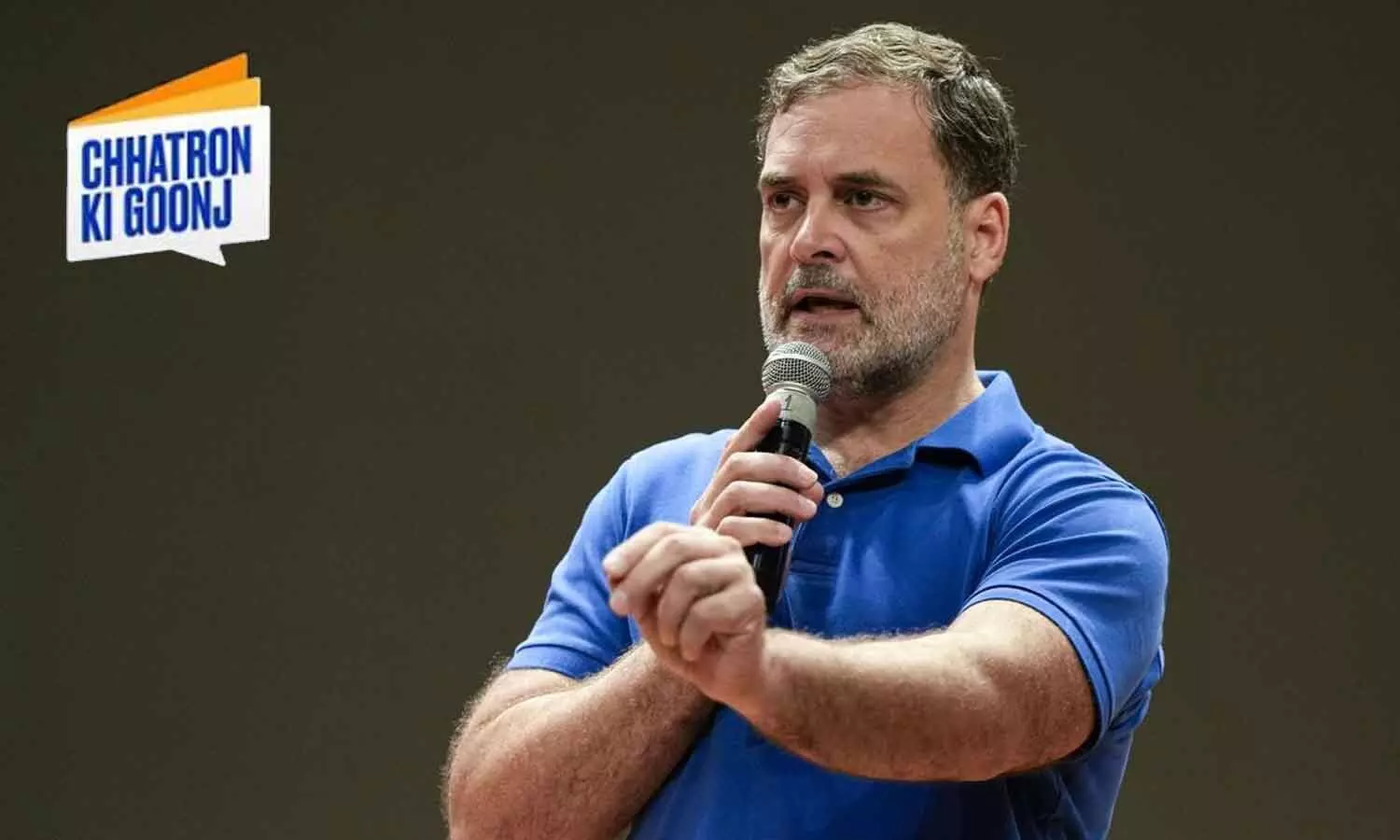


Will it be Poha-Jalebi or a concrete Goonj on youth and jobs?

In Short

Explore the debate surrounding Rahul Gandhi’s 'Chhatron Ki Goonj' youth conclave in Indore, focusing on whether the event addresses student employment issues or turns into a broader political attack.

Rahul Gandhi
X

Rahul Gandhi

Font size
FOLLOW ON Google News

Will Chhatron Ki Goonj, to be held in Indore today, be broader than the Pune event and focus on youth and jobs, or will it be about Poha-Jalebi and turn into a larger attack on the BJP, RSS and Narendra Modi?

The Congress has publicly stated that the fifth edition of the youth conclave, which is a student outreach exercise led by LoP Rahul Gandhi, will primarily focus on education, recruitment and employment, rather than simply repeating the “smash patriarchy” theme.

The Congress party has said that the programme in Indore, a city famous for its Poha and Jalebi, will focus on question-paper leaks, the high cost of education, the shortage of government jobs and growing unemployment. Rahul Gandhi is also likely to speak about the obstacles students face in pursuing their goals and ambitions. He is expected to highlight the problems confronting tribal youth as well, particularly students from the Jhabua belt.

Whatever the party’s claims may be, it has been observed that the earlier four such events turned out to be more political gatherings, full of rhetoric, under the guise of the Goonj agenda. While one will have to wait and watch the impact of these events, which are meant to achieve greater student outreach, Rahul Gandhi’s speeches have been becoming increasingly political.

In Pune, he spoke about women, Manusmriti and patriarchy, and explicitly called for “smashing patriarchy”.

It remains to be seen how different the Indore meeting will be.

Meanwhile, Congress leader Rahul Gandhi left Delhi for Indore on Saturday morning. Before leaving, he showed interest in Poha-Jalebi through a social media post that has now gone viral on Instagram. According to official information, approximately two lakh participants have registered for the programme.

The big question is whether Rahul’s reference to the local culinary favourites will help him connect with Gen Z. It is also being speculated that he may choose to visit 56 Dukan and Sarafa Chaupati, two popular destinations for lovers of street food.

Indore’s Poha has long enjoyed special recognition. Even former Prime Minister Jawaharlal Nehru, during a visit to the city, is said to have praised the local preparation extensively.

The uniqueness of Indore’s Poha lies in its distinctive preparation method, which produces a light and fluffy texture while keeping the grains separate.

A Journey of Three Decades Time passes faster than we realise. What feels like a journey that began only yesterday has today grown into more than three decades of a meaningful and fulfilling life devoted to education, journalism, and the empowerment of young minds. My professional journey began with journalism training in New Delhi in 1979. I went on to work as an independent journalist, drawing on my fluency in both English and Telugu. Over the years, I have edited and worked on Telugu articles in both languages, an experience that strengthened my command of language and sharpened my understanding of society, people, and contemporary issues. Yet, my principal profession and enduring passion have always been teaching. My decision to become a teacher was not merely a career choice—it was a calling. Teaching offered me the rare privilege of inspiring young minds, guiding them through their formative years, and making a lasting difference in their lives. I found immense satisfaction in simplifying complex concepts, nurturing curiosity, encouraging independent thought, and building confidence among students. Every moment in the classroom—every question, every moment of discovery, and every spark of understanding—reminded me why I had chosen this path: to empower young people through knowledge, values, and essential life skills. My teaching career began at the grassroots level as a Montessori teacher and gradually progressed to the position of Vice Principal. I had the opportunity to work in reputed educational institutions, including Dilsukhnagar Public School in Hyderabad, where I shouldered both teaching and administrative responsibilities. Although I have always considered myself, at heart, a teacher, my administrative experience enabled me to understand and contribute to the education system from a much broader perspective. For my students, I have always tried to be an approachable and dependable presence—someone they could turn to not only for academic support, but also for guidance and emotional encouragement. At the same time, I developed a reputation as a firm disciplinarian who believed that integrity, fairness, responsibility, and discipline were fundamental to education. I was also consistently appreciated for maintaining clear communication with parents and staff and for ensuring that examinations and other academic processes were conducted with transparency, fairness, and efficiency. As my career progressed, however, I began to feel that academic education alone was not enough. This realization led me to work more closely with students following the SSC and CBSE curricula, while consciously bringing life-skills education into my teaching. I came to understand that education becomes truly meaningful when it prepares children not merely to pass examinations, but to face life. Teaching emotional resilience, self-reliance, social awareness, communication, decision-making, and other practical life skills often had a deeper and more lasting impact than academic achievement alone. I saw how these skills could help students navigate challenges with greater confidence, maturity, and responsibility. My academic background provided a strong foundation for this approach. My degree in Psychology from the University of Madras helped me develop a deeper understanding of young people's minds, their emotional needs, and the influence of their family and social environments. My M.A. in Telugu with First Class from Osmania University.

Next Story
      Share it