




- JMI's Persian department organises Hafez Shirazi commemoration ceremony
- Dharavi rehabilitation construction starts officially with 'Bhoomi Poojan'
- Gujarat govt clears incentives for 25 industrial units with Rs 3,903 crore investment
- Ache Din for Delhiites? Central Delhi May Finally Be Free of Protests
- Denmark Open: Sindhu faces daunting An Se-young test; Satwik-Chirag set to return (Preview)
- Rahul Gandhi, 10 other INDIA bloc leaders file petition before SC against SIR of electoral rolls
- UP CM Yogi releases Rs 493 Crore subsidy to over 9 Lakh farmers hit by crop damage
- Newly elected Assam BJP MP rushes accident victim to hospital in his car
Bandaru Dattatreya Recognised for Promoting Life Skills Through Sports
In Short
Bandaru Dattatreya is recognised for championing life skills through sports and promoting sports as a means to empower, educate and inspire youth.

Share :
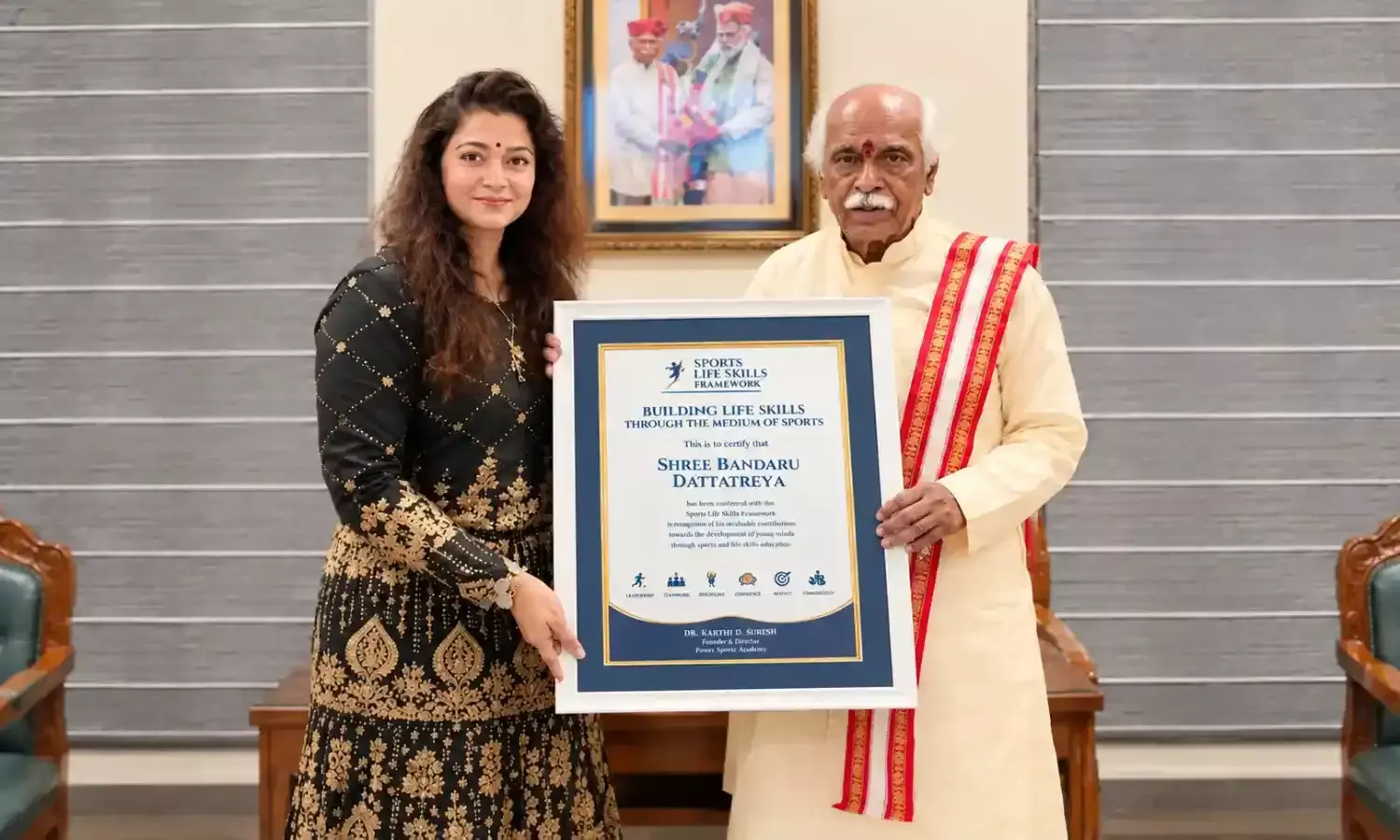
Bandaru Dattatreya Recognised for Championing Life Skills Through Sports
Hyderabad: Former Haryana Governor and Union Minister Bandaru Dattatreya was presented with a special citation in Hyderabad recently by Dr Kanthi D. Suresh, President of the Holistic International Pravasi Sports Association (HIPSA) and Founder of Power Sportz Academy.
The citation recognised Dattatreya’s contribution to youth development and his support for sport as part of a young person’s overall development.
Their meeting also led to a conversation about something schools everywhere are now dealing with — AI.
For Dr Kanthi, the question is fairly simple. If information is available to almost every child at the click of a button, what will make one student stand out from another?
“Children have access to knowledge in a way our generation never did. But having information and knowing what to do with it are not the same thing,” she said.
She believes schools will have to pay much more attention to qualities such as judgement, resilience, teamwork, adaptability and decision-making.
This is where sport, she says, has an advantage.
Put a group of children on a playing field and these skills begin to show up almost immediately. A child has to make a quick decision. Someone has to lead. Teammates have to work together. A mistake has to be dealt with. There is pressure, disagreement, success and disappointment.
And there is no answer sheet.
“Children are actually practising life skills while they play,” Dr Kanthi said. “The opportunity for schools is to recognise that learning and build on it.”
Schools already measure academic progress closely. There are marks, examinations and report cards every year.
What is much harder to see is how a child has changed as a person.
Has the child become better at working with others? Can he recover after a setback? Is she more confident about taking a decision? Can the student take responsibility when something goes wrong?
These questions have shaped Dr Kanthi’s work on AUERTA™, the Sports Life Skills Framework, developed through Power Sportz Academy.
The framework starts from Class 6 and extends into higher education. Sport remains the setting, but the learning is about situations children encounter while playing and what those situations can teach them away from the field.
Dr Kanthi is clear that she does not want life skills to become one more academic subject.
“The minute we make it another chapter to memorise, we lose the point,” she said.
Instead, the framework attempts to give some structure to experiences children are already having and to follow their development over a period of time.
That thinking also led to the Human Skills Passport.
Students generally leave school with years of marksheets and certificates. There is seldom anything similar showing how their non-academic capabilities have developed.
The Human Skills Passport is intended to create that record.
“Marks matter and they will continue to matter,” Dr Kanthi said. “But a marksheet cannot tell you everything about a young person. It cannot tell you how that person responds to failure, works in a team or behaves when a difficult decision has to be made.”
The Sports Life Skills Framework brings together teacher engagement, student application, assessment and certification. Different elements of the student and teacher pathways have received accreditation through UK continuing professional development accreditation organisations. The approach also sits within the wider move towards holistic and competency-based education envisaged in the National Education Policy 2020.
Dattatreya’s own record made the conversation particularly relevant.
As Governor of Haryana, he regularly spoke about young people, skills, education and sport. He encouraged participation in sport and also spoke about education developing values and character.
The subject came up again when he addressed a graduation programme in Hyderabad in September this year, where he stressed the importance of values alongside education.
Dr Kanthi says there is little disagreement today about whether children need qualities such as resilience, teamwork or leadership.
The harder question is what schools are doing about it.
How does a school know that a child has become more resilient between Class 6 and Class 10? How does it know whether the student has become a better team member or decision-maker?
AI has made those questions more relevant.
“A lot of things for which a student once had to search, write or work out an answer can now be done with the help of technology,” Dr Kanthi said. “But a child still has to deal with people, make choices, take responsibility and handle situations when things don’t go according to plan. Those abilities have to be developed.”
She does not see this as a contest between technology and education.
Nor does she believe academics will become less important.
What may change is what parents expect alongside academics.
A parent may still ask about marks. But increasingly, Dr Kanthi believes, parents may also want to know whether their child can communicate confidently, work with other people, recover from failure and make sensible decisions independently.
Those qualities are difficult to capture in a conventional report card.
That does not make them less important.
In fact, Dr Kanthi believes AI may end up making them more important.
“There was a time when access to knowledge itself gave you an advantage,” she said. “Today that knowledge is available to almost everyone. What you do with it, and the person you become while using it, will matter much more.”
For schools, that could mean looking at sport differently too.
Not only as exercise. Not only as competition. And not only as a route to medals.
But as a place where children get something increasingly valuable — the chance to practise being human.
PHOTO CAPTION
Dr Kanthi D. Suresh, President of HIPSA and Founder of Power Sportz Academy, presenting a special citation to former Haryana Governor Bandaru Dattatreya during their interaction in Hyderabad. The citation recognised his contribution to youth development and the role of sports in building life skills.
Karnataka Congress Chief Alleges CJI Is Behaving Like a BJP Member
Rahul’s Big Claims: 200 Officers Feeding Him Information, Police and CRPF Backing Opposition; Protests to Intensify
Why Is CJI Not Meeting Us?” Congress Asks
Don’t Turn SC into a Political Battleground, CJI
‘Maan Na Maan,’ We Will March to SC. SIR Campaign Enters a New Political Phase
Fight the Government, Not the Common Man


