




- Canadian poet and essayist Anne Carson wins Nobel Prize in literature
- Congress should introspect instead of blaming EC for poll defeats: MP CM
- PM Modi Highlights India’s Digital Growth, Seeks Global Cybercrime Framework
- Everyone must participate in the mission to make Wanaparthy a TB-free district: District Collector Adarsh Surabhi
- Battle between two ideologies in country, Oppn wants to spread anarchy: Gaurav Bhatia
- HDFC Bank CEO Anup Bagchi’s Rs 35.89 Crore Pay Package Explained
- ‘Do-or-die fight to protect democracy’: Congress as Kharge hosting lunch for INDIA bloc
- Uttarakhand Man Missing In UAE: Family Seeks Help To Trace 28-Year-Old Yuvraj
PM Modi Highlights India’s Digital Growth, Seeks Global Cybercrime Framework
In Short
At IMC 2026, PM Modi highlighted India’s digital expansion and called for global cooperation to tackle cybercrime and online fraud.

Share :
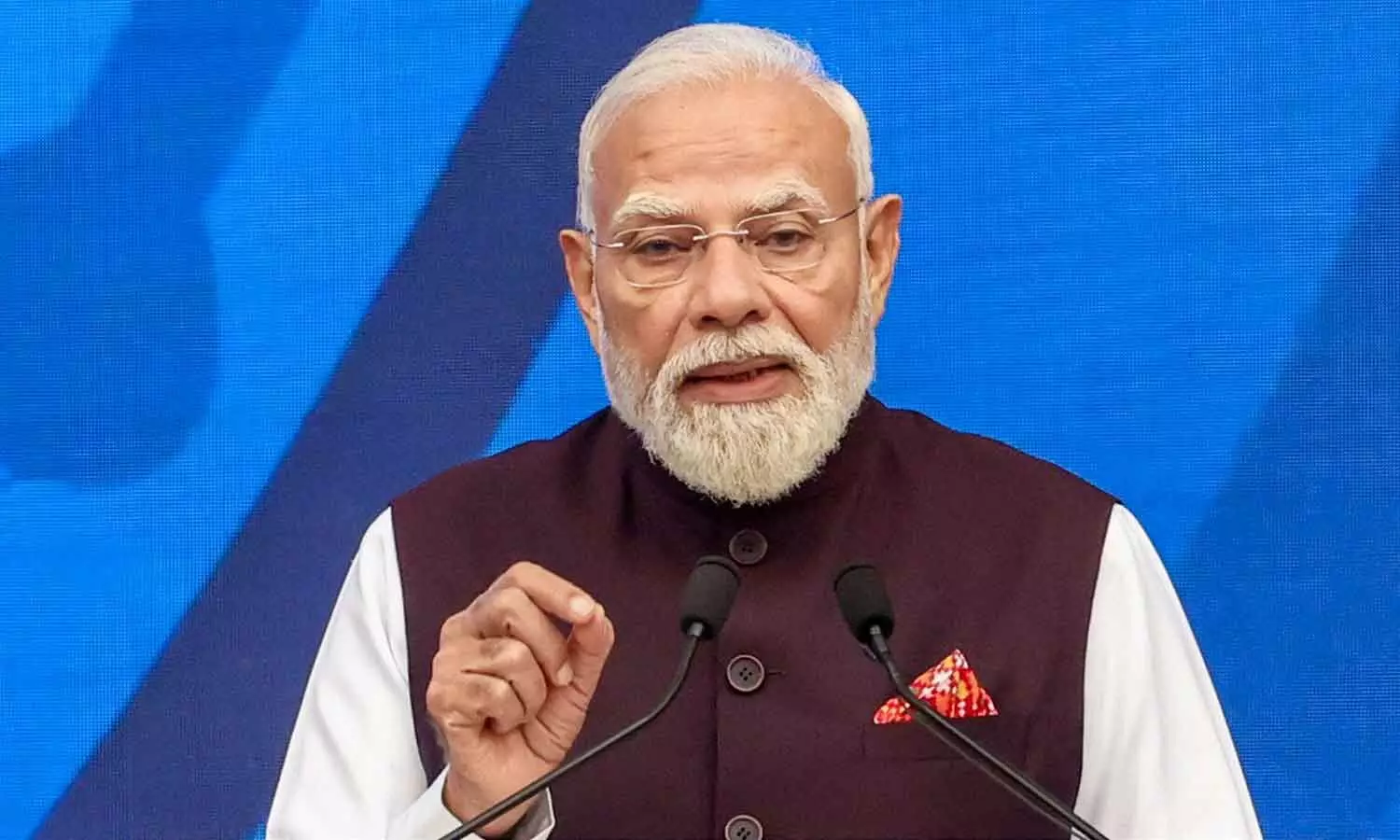
Prime Minister Narendra Modi
Prime Minister Narendra Modi on Thursday inaugurated the 10th edition of the Indian Mobile Congress (IMC), using the platform to highlight India’s rapid digital transformation and call for stronger international cooperation against cybercrime.
Speaking at the event, Modi said India’s digital ecosystem had demonstrated how to “Scale Without Boundaries.” He pointed to the growth of telecom access, digital governance and online education, describing IMC as a platform that has come to represent “India’s progress and India’s dreams.”
According to the Prime Minister, telecom in India is no longer limited to networks, spectrum, towers and faster connections. “Over the past 10–12 years, mobile phones have not only served as a medium of modern communication but have also emerged as an essential tool for good governance,” he said, adding that this lay at the core of the government’s Digital India vision.
Digital India and the changing landscape
Modi said India faced a significant digital divide around a decade ago, when access to modern technology was largely limited to people with greater resources. He said the Digital India mission sought to change that by putting mobile phones at the centre of the country’s digital push.
He described telecom reforms, infrastructure expansion and the growth of domestic smartphone manufacturing as important steps in making technology more accessible. “Through every such endeavour, access to mobile phones and data became significantly easier for the average Indian citizen.”
The importance of this digital infrastructure became particularly visible during the COVID-19 pandemic, Modi said. “Yet, in India, offices continued to run. Work went on. Education never stopped. This was made possible by India’s digital ecosystem.”
He also highlighted the DIKSHA education platform, saying that up to July 2022 it had recorded “over 5 billion learning sessions and nearly 60 billion learning minutes.” The government’s digital education efforts aimed to connect nearly 250 million students, he said.
Gaming, creators and cybercrime
Modi also pointed to the growth of gaming and the creator economy. “Take the gaming sector, for example. It is estimated that today, more than 500 million people in India are connected to the gaming ecosystem in some way,” he added.
“In other words, in India, the mobile phone today is not just a gaming console—it has also become a creation studio.” He said smartphones had helped democratise content creation and played a major role in the rise of India’s creator economy.
However, the growing digital footprint has also brought new challenges. Highlighting the threat of cyber fraud, Modi said, “An ordinary citizen does not think in terms of protocols or architecture. For them, trust is extremely important.”
Calling for international cooperation, he said, “Cyber fraud and cybercrime do not respect borders. They have already crossed those boundaries.”
“Therefore, it is important that we work towards a global framework to address this. Governments, technology companies, telecom operators and financial institutions—all of them will have to be part of this framework.”
He also urged the GSMA and telecom operators globally to develop mechanisms to stop fraudulent messages and scams before they reach users. “I also urge the GSMA and telecom operators around the world: let us create a global mechanism that can prevent such fraud from reaching people in the first place,” he said.
“India has learned a great deal from its own experience in this direction, and India is always ready to share its experiences with the world.”

Canadian poet and essayist Anne Carson wins Nobel Prize in literature
'Punched, kicked and assaulted': Delhi Police Constables recount ordeal during Cong protest
Rabada out, Nortje returns after three years as SA name Playing XI for Australia Test
Most Americans think artificial intelligence is developing too fast, new AP-NORC poll finds
Delhi Anti-CEC Protest: BJP Alleges Rahul Gandhi Pushed Woman Cop, Priyanka Elbowed Officer
Will MDR Be Postponed To January 2027?
CEC Gets Z Plus Security as Congress Intensifies Protests
Govt coming out with paper on AI regulations next month: Ashwini Vaishnaw
CR Paatil hails PM Modi's vision on integrating water into school, college education
K'taka BJP chief to CM Shivakumar: Who conducted, protected ex-Min Ramesh Jarkiholi sting Op


