






- Bengal govt ends system of appointing private agencies as ‘knowledge partners’
- Telangana Minister Sridhar Babu invites Mumbai industry to " Global Summit" 2026 at Future City in Hyderabad
- Prince William, Princess Kate to meet PM Modi in Delhi today
- Congress Party’s New Poll Slogan: "Bahut hui mehengaai ki maar, ab Jawaab de Modi Sarkaar,"
- Naga Chaitanya’s Vrushakarma Second Single ‘Chalo Padhave’ Will Be Out Tomorrow
- Zepto Co-founder Recalls Near Shutdown Scare After Major Technical Failure
- Most-Wanted LeT Terrorist Lateef Bhat Killed After Standoff Inside Kulgam Mosque
- AI Could Be Behind Global Tech Outages, US Official and CEOs Suggest
Diviseema Cyclone: The 1977 Natural Disaster – A Testament to Service, Humanity and Rehabilitation
In Short
Former Governor Bandaru Dattatraya recalls the devastating 1977 Diviseema cyclone, the RSS volunteers’ relief efforts, the ‘Shava Sena’ service and the rehabilitation of Moolapalem as Deen Dayal Puram.

Share :
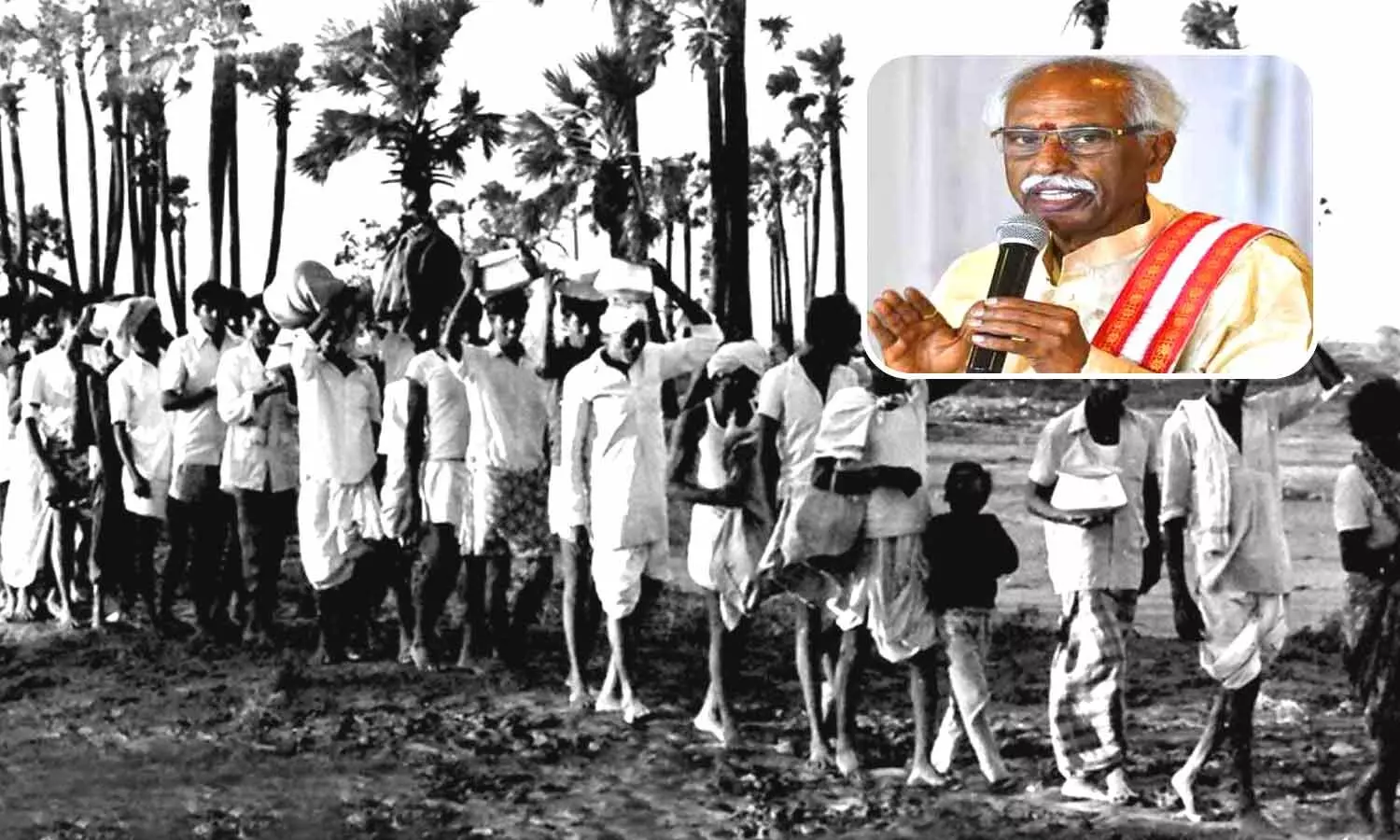
Diviseema Cyclone: The 1977 Natural Disaster – A Testament to Service, Humanity and Rehabilitation
The devastating cyclone that ravaged the Diviseema region on 19 November 1977 remains one of the most unforgettable experiences of my life. Thousands of people lost their lives, several villages were completely devastated, and roads, electricity and communication systems were destroyed. With drinking water and food in short supply, people faced unimaginable hardships.
Every year, as November 19 approaches, the people of Diviseema are reminded of that terrible tragedy, which continues to evoke deep sorrow and painful memories. The devastating cyclone of 19 November 1977 shattered thousands of families and claimed countless lives. The scars and memories of that catastrophe remain etched in the hearts of the people even today.
At that time, following the instructions of Shri Sompalli Somaiah, the then Regional Pracharak of the Rashtriya Swayamsevak Sangh (RSS), a group of Swayamsevaks, including myself, reached the Avanigadda region on 21 November to participate in relief operations. As young volunteers, we were firmly determined to stand by the affected people and extend a helping hand to those in distress.
The scenes we witnessed upon reaching the affected areas remain vivid in my memory even today. Everywhere, normal life had been completely shattered, and the entire region resembled a vast graveyard. Bodies, many beyond recognition, lay scattered in heaps across the area. Thousands had perished, and the situation was so heartbreaking that even relatives were unable or unwilling to come forward to perform the last rites of the deceased.
In those circumstances, we took upon ourselves the responsibility of ensuring that the departed souls received a dignified farewell. Working as a team, we would secure each body with bamboo poles and carry it on our shoulders, four volunteers at a time, chanting the name of Lord Rama as we proceeded to perform the last rites through cremation. We considered it our solemn duty to bid a final farewell even to those unfortunate victims who had no one to claim them.
I participated in these service activities wearing khaki shorts and a white shirt, with a mask covering my face and a cloth tied around my head. For nearly ten days, we continued our work tirelessly, without worrying about regular meals or personal comforts. We survived on whatever was available, mainly milk and a few biscuits, while remaining committed to the relief work.
The newspapers took special note of our humanitarian service and referred to our team as the *'Shava Sena'* (the Army of the Dead). The name was not confined to newspaper reports; the local people too affectionately began calling us *'Shava Sena'*.
## An Unforgettable Encounter with the Then Chief Minister, Shri Jalagam Vengala Rao
The then Chief Minister of Andhra Pradesh, Shri Jalagam Vengala Rao, visited Koduru to review the relief operations being carried out in Diviseema. At that time, we were engaged in performing the last rites of the deceased, wearing our khaki shorts and white shirts.
On seeing us, the Chief Minister asked, "Are you policemen?" We clarified that we were Swayamsevaks who had come to help the cyclone-affected people.
After learning about our service activities, he appreciated our efforts wholeheartedly. He observed that even police personnel and rescue teams from Singareni were finding it extremely difficult to face the sight of so many dead bodies. He then asked us how we were able to carry out such work and whether we were accustomed to any intoxicating substances that helped us overcome the situation.
In response, I told him, "We have no such habits or dependence on intoxicants. Our organisation has instilled in us the spirit of selfless service to society. It is this inspiration that motivates us to undertake these humanitarian activities."
The Chief Minister was greatly pleased with our response. He also made arrangements to provide kerosene and other essential materials required for our relief operations. His encouragement gave us renewed confidence and inspiration to continue our work.
Shri Mandali Venkata Krishna Rao, the MLA from Avanigadda and a Minister in the then state government, personally visited village after village, extending various forms of assistance to the affected people. He closely assessed the extent of the devastation, stood by the victims and coordinated relief efforts.
When people came to know about our activities, we were invited to Gandhi Kshetram, where our efforts were appreciated. On that occasion, Shri Prabhakarji, a prominent Gandhian from Maharashtra who was present there, remarked, **"RSS means Ready for Selfless Service."** His words filled us with immense enthusiasm and renewed inspiration.
## Rebuilding Moolapalem as Deen Dayal Puram – A Special Chapter in My Life
Along with immediate relief operations in Diviseema, we realised that providing permanent rehabilitation to the affected families was equally essential. With this objective, we adopted a village called Moolapalem and took responsibility for its reconstruction.
With the active cooperation of the villagers, we worked towards rebuilding houses and providing essential infrastructure such as a school, roads, drinking water facilities and electricity. We also provided fishing boats and nets to fishermen, helping them resume their traditional livelihoods and rebuild their lives.
The completion of the reconstruction of Moolapalem, which was renamed **Deen Dayal Puram**, was a moment of immense pride for all of us. The inauguration ceremony was graced by the personal presence of Shri Atal Bihari Vajpayee, the then Union Minister for External Affairs and former Prime Minister of India.
The rehabilitation efforts received support from the Andhra Pradesh Cyclone Relief Committee and several organisations and individuals from different parts of the country. Relief materials collected at the Indian Express warehouse in Vijayawada were systematically sorted and distributed to approximately 56 villages. Nearly 400 to 500 volunteers participated in these activities.
Several organisations, including the Ramakrishna Mission, Sathya Sai Seva Organisations, Arya Samaj, Vishwa Hindu Parishad and the Salvation Army, also extended their valuable support and cooperation.
The greatest lesson the Diviseema cyclone taught me is that **true humanity lies in standing by those in distress and extending a helping hand to those in need.** Serving disaster-affected people without discrimination based on caste, religion, region or political affiliations is the responsibility of every individual.
I express my heartfelt gratitude to all the volunteers who worked alongside us during those difficult days, as well as to the organisations, officials and donors who extended their support and cooperation.
I pay my humble and heartfelt tributes to all those who lost their precious lives in the Diviseema cyclone. May the memories of that tragedy, the spirit of selfless service and the values of humanity it inspired continue to guide us for generations to come.
The Author –-- Bandaru Dattatraya
Former Governor of Haryana and Himachal Pradesh.
Shaina NC Tears Photo Featuring Bal Thackeray During Sonia Gandhi Book Protest, Sparks Row
OpenAI’s GPT-6 Cyber reportedly bypasses Apple’s Lockdown Mode
Diviseema Cyclone: The 1977 Natural Disaster – A Testament to Service, Humanity and Rehabilitation
Balance Needed Between Development and Environment for Western Ghats Conservation: Vivek Alva
Shaina NC Tears Photo Featuring Bal Thackeray During Sonia Gandhi Book Protest, Sparks Row
Diviseema Cyclone: The 1977 Natural Disaster – A Testament to Service, Humanity and Rehabilitation
Cyclone Akvan threat eases as it is likely to weaken, heavy rain forecast
PM Modi to inaugurate FICCI Annual General Meeting and Annual Convention on Nov 19
Cyclone Akvan: Odisha orders suspension of beach tourism, tightens transport safety measures
Telangana Minister Seethakka Announces Pensions for 4.63 Lakh People


