




- Medicover Hospitals hosts major public awareness event on World Heart Day
- Bolisetty launches nationwide movement ‘Dharma’ to save nature, temple lands
- City’s beautification works to be expedited
- Roundtable demands removal of CEC
- Visitors can explore bean to cup journey at Araku Coffee Centre
- DRUCC member pitches for Telugu-speaking railway employees
- ‘World Heart Day’ meet focuses on prevention mechanism
- SKVT student selected for SGF boxing meet
Centre must pay heed to mineral-rich states
In Short
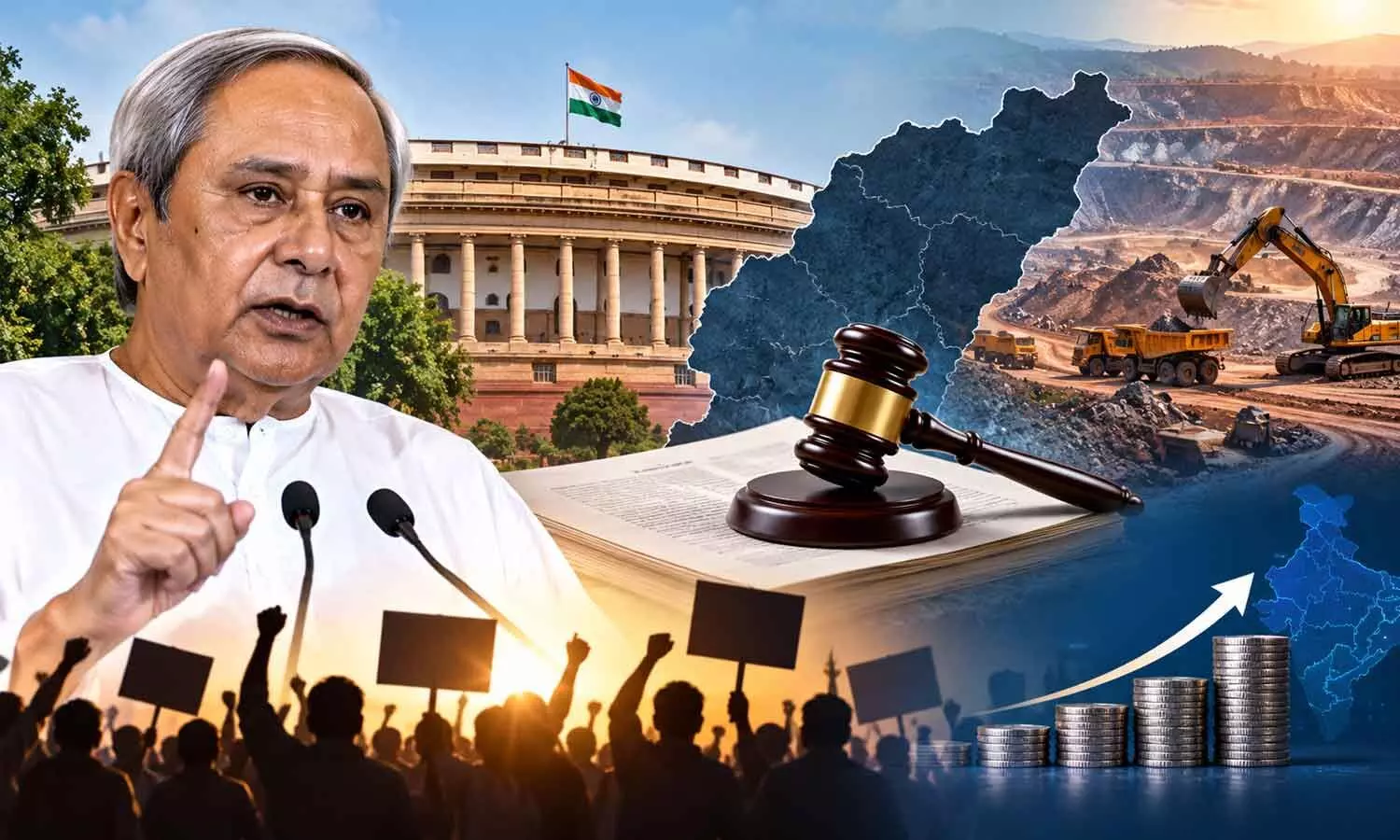
Former Odisha CM Naveen Patnaik’s street protest against the MMDR Amendment Act 2026 highlights rising friction over state fiscal autonomy, uniform mining taxes, and retrospective taxation.

Share :
Centre must pay heed to mineral-rich states
With Biju Janata Dal (BJD) president and former Odisha chief minister Naveen Patnaik himself leading the agitation against the Mines and Minerals (Development and Regulation) Amendment Act, 2026, politics is expected to heat up not just in the eastern state but also in other mineral-rich states. Patnaik has been a popular leader for quite some time, yet he has never been known for leading or participating in street-level public agitations; after all, he is no Mamata Banerjee or Arvind Kejriwal.
In fact, the suave and mild-mannered Odisha leader is known for his reticence and composure, so his very visual opposition to the Act cannot be taken lightly. While the Act is not without its merits, the Narendra Modi government’s decision to clear it in Parliament by brute force of numbers doesn’t sound judicious. The Centre’s position is that the new law enables states to impose new levies, the caveat being that these must be compliant with the conditions set by the Central government. Making a political point, BJD and Congress MLAs claim that the Act “snatches the rights” of mineral-rich states.
Earlier, mining was taxed differently in every state, whereas now there will be a single, Centre-directed tax framework. The Centre claims that earlier the maximum burden fell on small and medium miners, whereas now every miner benefits from a fair and equal framework. These measures don’t sound unreasonable, which begs the question: were adequate efforts made to persuade mineral-rich states to support the legislation that hugely impacts the economy as well as employment-generation potential? Further, the new mines law invalidates all pending retrospective dues, but this raises another question: has the Union government bid adieu to the abomination called retrospective taxation?
The answer, sadly, is ‘no,’ it did take recourse to retrospective taxation late last year in the case of Safari Retreats, despite having pledged not to do so in the past. Now following the 2026 Act, the ball is in the Centre’s court. The Modi government may have the numbers in Parliament to push through legislation, but legislative majorities cannot by themselves create political legitimacy, particularly when a law directly affects wide economic interests, the federal structure, and fiscal autonomy of states.
The Centre would therefore do well to engage with Odisha and other mineral-rich states and address their apprehensions rather than dismissing them as politically motivated opposition. A transparent dialogue over the proposed levy framework, the distribution of revenues and the safeguards against arbitrary intervention by the Centre could go a long way towards allaying fears of centralisation. It would also demonstrate that cooperative federalism is not merely a slogan invoked when convenient, but a principle that informs the making and implementation of important economic legislation.
The controversy over retrospective taxation makes such engagement even more necessary. If the government wishes to persuade industry and the states that the new framework provides certainty, predictability and fairness, then it must itself adhere consistently to those principles.
The Centre cannot reasonably ask investors and states to repose faith in a ‘stable’ tax regime, while retaining the option of intervention whenever circumstances demand such a measure. The government has an opportunity to reassure states that the new regime will be administered fairly, predictably, and in consultation with them and not unilaterally.
Centre must pay heed to mineral-rich states
Only the voters are saving our democracy
Creativity is destroying the environment
Revanth meets Rahul, Venugopal
CM Revanth urges Centre to clear hurdles for Tummidihetti
Siang multi-purpose project is a national project with strategic, security implications: Arunachal CM


